

Table of Contents
- Peak-Wave Drift When Color Meanings Are Spoken, Not Written
- Designing a Written Taxonomy: Axes, Primary Signals, and Freeze Rules
- Dye-Lot and Replenishment Locks So Later Lots Keep the Same Dialect
- Pilot Protocol Under Real Light, Distance, and Cage Occlusion
- Printed Taxonomy Codes and Contrast Marks That Cut Oral Guesswork
- Locked Color-and-ID Builds Procurement Should Require on Reorders
- Stable Color and Pocket Layouts That Make Field Drift Visible
- Bag ID Layers: Where Color Assists Scan and Route Verify
- Empty-Fold Return With Taxonomy Marks Still Readable
- What to Send a Manufacturer So Color Builds Match the Hub Taxonomy
Peak-Wave Drift When Color Meanings Are Spoken, Not Written
Peak outbound waves expose informal color systems quickly. A chute or table sort feeds bags into staging lanes that still look orderly at the start of the shift; by the third inbound truck, floaters and overtime crews are parking units by memory. Blue “meant express this morning” becomes “means returns on dock two” because a supervisor pointed once and never wrote it down. The next loader rolls two look-alike Logistic Sorting Bags into the same cage, and the mis-stage only surfaces when the vehicle is already sealed or the downstream depot opens the wrong stream.
The operational throughline is fixed: inbound chute or table sort → color-lane staging → cage or vehicle load → empty fold return with ID still readable. Drift can break any station. Tape labels peel. Marker codes smear under glove grease. A borrowed tote from another site arrives in a near-shade that night crews treat as approved. None of that is a catalog problem; it is an equipment-identification problem riding on physical bags. Networks that already standardized sizes and pocket positions still fail here when color meanings live only in oral habit.
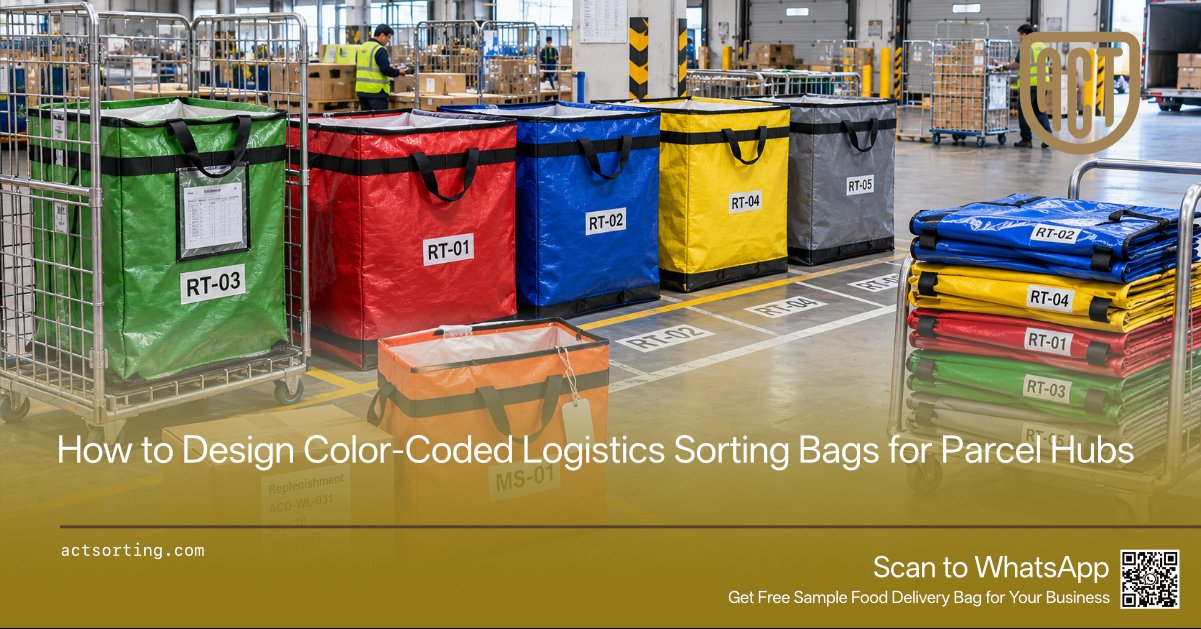
Custom color-coded bags earn their keep when the product itself carries a locked dialect: written taxonomy mapped to body and webbing colors, dye-lot continuity on replenishment, readable marks after fold, and ID layers that do not block each other. Buyers comparing Parcel Sorting Bags for hub staging and dispatch should treat those deliverables as part of the manufacturer brief—not as decoration added after a generic tote is already on order.
Designing a Written Taxonomy: Axes, Primary Signals, and Freeze Rules
A usable taxonomy is short, owned, and frozen. Pick one primary axis first—outbound region, service class, or return stream—then add at most one secondary axis that webbing or binding can carry without crowding the body palette. Four or five high-contrast body colors with plain-language lane names outperform ten near-greens that only veterans can tell apart. Write the legend as a product reference: color name, pantone or physical chip reference, lane or stream meaning, which bag roles may use it, and what the color does not mean.
Decide which signal is primary before sampling. Body color usually owns the lane family; contrasting webbing or edge binding can mark owner site, priority, or exception without adding a sixth body dye. Permanent branding and asset IDs stay outside the wave-level meaning; transparent pockets carry cards that change by dispatch. Freeze rules matter as much as the palette: who may add a color, who must retire one, and what happens when a new service class appears mid-season. Without a freeze, every peak invents a temporary shade that never leaves the floor.
When ACTSORTING quotes custom body and webbing colors for warehouse fleets, the productive input is that written legend—not a request for “brighter options.” A one-page taxonomy with owner name, revision letter, and effective date turns color from decoration into a manufacturable specification that can travel from chute sort to vehicle load without reinterpretation. Pair the legend with how bags will sit in lanes and cages so pocket height and contrast choices match real sightlines, not a meeting-room swatch alone.
Dye-Lot and Replenishment Locks So Later Lots Keep the Same Dialect
The first approved lot is only the start. Replenishment that arrives “close enough” quietly invents a second dialect: night crews stage the new shade as the old lane; day crews treat it as returns; scanners later spend minutes untangling both. Dye-lot lock means the purchase file names the approved body color, webbing contrast, binding, and any printed marks as a combination that later orders must match—not as three independent aesthetic choices.
Practical lock language stays measurable. Reference a retained master bag, a fabric chip kept under controlled light, and photos of the approved combination on floor and in cage. State that shade drift visible at staging distance is a reject, even if the fabric hand-feel matches. Ask how the manufacturer controls lot-to-lot color on PP woven and webbing so a second container does not land in a neighboring hue. Pack and carton marks should call out the taxonomy code, not only a commercial SKU, so receiving can pull the correct master before knives hit the wrap.
Limits are honest: perfect spectral identity across years of outdoor dock light is unrealistic, and coatings can shift appearance as they scuff. The lock’s job is to keep replenishment inside the readability band the pilot already proved—not to promise museum-grade colorimetry. When ACTSORTING runs repeat production for color-coded Logistic Sorting Bags, the useful commercial ask is a replenishment description tied to the frozen taxonomy and master sample, so later lots keep the same staging dialect the hub trained on.
Pilot Protocol Under Real Light, Distance, and Cage Occlusion
Conference-table color approval fails warehouses. A pilot should place filled and empty bags in the real path: under the chute or table, in the painted staging lane, nested in a roll cage, and on the vehicle shelf used at dispatch. Run the same set under day shift and night shift lighting. Have observers identify lane meaning from working distance—roughly the span a loader covers when choosing a cage—before they walk up to read the pocket card.
Score what matters for staging, not brochure beauty. Can two approved body colors still be told apart when both are dusty? Does contrasting webbing still read when the bag sits behind cage mesh? Does the pocket card remain visible at walking height, or does it drop behind a bar once the bag is nested? Include empty folded stacks in the pilot: return crews must still recognize owner color and taxonomy code when mouths are collapsed and cards are removed. Record fail modes with photos and distances, then adjust palette, webbing contrast, or pocket height before bulk release.
Keep structure checks in their own lane. Fit, handles, and fold behavior deserve a handling pilot; color readability deserves light and distance trials. Programs that already use sample readiness guidance for daily courier handling can keep that track separate and still run a color-specific protocol for taxonomy lock—see ACTSORTING’s notes on PP woven sample readiness for daily courier operations for structure and handling context, while this pilot answers whether the chosen dialect survives the hub’s actual lamps and sightlines. Let the readability score sheet decide whether the palette is ready for wave traffic—field recognition results matter more than brochure adjectives.
Printed Taxonomy Codes and Contrast Marks That Cut Oral Guesswork
Oral color meanings collapse when floaters and traveling crews join a peak wave. The manufacturer lever that reduces that risk is not a classroom curriculum; it is what is printed and sewn onto the bag. Permanent taxonomy codes, owner or depot marks, and high-contrast webbing give crews a readable object even when the briefing was short. A body color that matches the lane family, plus webbing or binding that carries a secondary cue, lets someone new stage by eye without inventing a private mnemonic.
Placement matters as much as the code text. Marks that sit under a folded zipper flap, behind a cage bar, or under a large logo panel fail the same way blank fabric fails. Transparent route pockets should leave a clear window for wave cards while permanent codes stay outside that window so ownership and lane family remain visible after the card is pulled. ACTSORTING lists logo application, unique barcodes, NFC options, and transparent route label pockets among customization levers for logistics bags; procurement can specify those as a coordinated ID set rather than as separate print afterthoughts.
Custom Parcel Sorting Bags pay off when the bag itself carries the dialect. Buyers should ask for sample photos of taxonomy codes and contrast webbing at staging distance, in a cage, and on a folded empty pack—not only for a color chip on a white table. That product evidence shortens how much oral teaching the hub must repeat every peak, because the equipment keeps saying the same thing after the supervisor leaves the dock.
Locked Color-and-ID Builds Procurement Should Require on Reorders
Near-shade replenishment is how dialects re-enter after a clean first lot. The commercial control sits with what the buyer requires from the bag supplier: a locked combination of body shade, webbing contrast, binding, pocket placement, and permanent marks, reproduced against a retained master. “Close enough” fabric that stages wrong at loader distance is a defective identification build, even when seams and handles are fine.
Ask the manufacturer to mark cartons with the taxonomy code as well as the commercial SKU, and to confirm how PP woven and webbing lots are held to the approved combination. Permanent barcodes or NFC that overlap the pocket window are ID defects on the product, not only warehouse paperwork problems. When empty bags return from other sites without network marks, they are foreign equipment relative to the locked build—retired or recoded before they rejoin live lanes—because the physical marks no longer match the master.
ACTSORTING can manufacture to a locked color and ID combination for Logistic Sorting Bags; the purchase file should name that combination so second and third containers do not quietly rewrite the palette. Procurement that treats color as three independent aesthetic lines—body, webbing, print—invites the mismatch that staging crews will then “work around.” Require one frozen build, one master sample, and reject language tied to staging-distance readability.
Stable Color and Pocket Layouts That Make Field Drift Visible
Drift along the throughline—chute sort, color staging, cage or vehicle load, empty return—is easier to spot when every bag presents color and pockets in the same place. Unstable layouts force inspectors to hunt for cards and codes; stable layouts make a wrong shade or missing mark obvious in a quick lane walk. That is a product consistency issue before it is a calendar of warehouse audits.
Specify pocket height and face so cards remain visible at walking height and through typical cage mesh. Keep taxonomy codes and owner marks in fixed zones across sizes in the same family. Contrasting webbing should stay in the same relative position so secondary cues do not migrate between lots. When ACTSORTING reproduces a color-coded family, consistent pocket and mark geometry is part of what makes later field checks feasible—inspectors know where to look because the manufacturer put the same ID architecture on every unit.
If a color pair cannot be told apart under night dock light, the fix is often a webbing or body contrast change on the next build—not louder coaching against physics. If folded empties hide all marks, the fold and print layout need a product revision so taxonomy codes still show on the banded pack. Custom Logistic Sorting Bags with stable color and pocket layouts turn “something looks wrong in that lane” into a concrete supplier conversation: shade drift, pocket shift, or missing code—each tied to the master sample.
Bag ID Layers: Where Color Assists Scan and Route Verify
Color on a sorting bag is a fast filter. It assists staging and load selection; it does not replace scan and route verification where custody, exceptions, or conflicting signals appear. The manufacturer’s job is to build ID layers that support that boundary: body color for lane family, webbing contrast for secondary class, transparent pockets for wave-level cards, permanent asset marks for ownership, and optional unique barcodes or NFC for bag-level tracking—each with a clear job and without covering the others.
Conflict between layers is a design failure on the product. A logo that eats the pocket face, a barcode printed across the card window, or a pocket that disappears behind cage mesh once nested recreates unlabeled-fleet risk with prettier graphics. Parcel Sorting Bags specified for hubs should list exclusion zones, pocket insert direction, and scan-path placement in the same ID block as body and webbing colors. When card and body disagree, or when two approved colors cannot be told apart under that door’s light, crews fall back to scan and route verify—the bag’s color layer has reached its limit.
ACTSORTING can place branding, pockets, barcodes, and NFC so they do not block each other; buyers should describe which layer authorizes a load versus which layer only speeds recognition. That keeps custom color useful in peak waves without asking hue to do a scanner’s job. Clear layer roles on the manufactured bag protect both the palette and the verification process the hub already runs.
Empty-Fold Return With Taxonomy Marks Still Readable
The throughline ends when empties come home. Fold density matters for transport cube, but taxonomy continuity depends on whether permanent marks and contrast cues survive the fold. If banded empties hide webbing contrast and bury asset IDs, return stacks become mixed inventory that later reopen as mystery stock at the wrong depot—even when outbound staging still looked clean.
Specify fold behavior as part of the color build. Permanent owner marks and taxonomy codes should remain visible on the folded pack or on an agreed bundle tag after wave cards are removed. Retired colors should stay visually distinct so they cannot drip back into live lanes. When bags circulate across hubs, the same locked color-and-ID combination governs reverse moves: a near-shade return lot is still a dialect risk against the master.
Foldable, warehouse-ready constructions in logistics sorting programs only keep the dialect alive if the print and contrast plan anticipates the collapsed shape. ACTSORTING’s sorting-bag range includes foldable and reinforced-base options with custom colors and ID features listed on the parcel sorting bag category; buyers should require sample photos of folded packs that still show taxonomy marks—not only a claim about compact return. Empty return is where many color systems silently die; design the bag so the locked map is still readable when the mouth is closed.
What to Send a Manufacturer So Color Builds Match the Hub Taxonomy
A manufacturer brief for color-coded hub bags should carry identification requirements, not only dimensions. Send the written taxonomy with revision letter: primary axis, secondary webbing rules, freeze owner, and photos of approved masters in lane and cage. Attach dye-lot lock language—what must match on replenishment—and the pilot score sheet from light and distance trials. Note where scan and route verify must lead so pocket and barcode placement do not fight those limits.
Add the physical path in one paragraph: chute or table sort, color staging, cage or vehicle load, empty fold return. Name opening preference by station if both open-mouth and zipper roles exist, handle needs for the lifts crews actually use, and cage or shelf clearances that bound finished size. Route-card dimensions and insert direction belong in the same ID block as permanent branding zones and optional unique barcodes or NFC. Environmental notes—night lighting, dust, open-dock moisture—belong as pilot conditions with field photos.
That package lets a manufacturer such as ACTSORTING sample Logistic Sorting Bags and Parcel Sorting Bags against a locked dialect: PP woven builds with reinforced handles, optional zipper lids, foldable or reinforced bases, custom colors, and coordinated ID features, reproduced so later lots stay inside the readability band. A practical sequence is an on-site readability pilot, then a replenishment description that cites the master and taxonomy code. When the brief carries taxonomy, lock, pilot criteria, and ID layer roles, custom color stops being a paint choice and becomes equipment the wave can trust from first sort to empty return.
FAQ
Q: What belongs in a written color taxonomy for hub sorting bags?
A: A short primary axis (region, service class, or return stream), optional secondary webbing or binding cues, plain-language meanings, freeze ownership, revision letter, and photos of the approved combination in lane and cage. State what each color does not mean so peak crews cannot invent local dialects.
Q: How should dye-lot locks work on replenishment orders?
A: Tie reorders to a retained master sample and taxonomy code covering body shade, webbing contrast, binding, and permanent marks as one combination. Reject lots that fall outside the pilot-proven readability band at staging distance, even when fabric hand-feel seems acceptable.
Q: What should a color readability pilot include beyond a meeting-room sample?
A: Place bags under real day and night lighting at chute or table, in staging lanes, inside roll cages, and on vehicle shelves. Score recognition from loader distance, pocket visibility behind mesh, and empty-fold recognition after cards are removed. Record fail distances with photos before bulk release.
Q: How should bag ID layers relate to scan and route verification?
A: Body color and webbing contrast speed recognition; transparent pockets carry wave cards; permanent marks and optional barcodes or NFC cover ownership and asset tracking. Color assists staging but does not replace scan and route verify when cards conflict, colors are unreadable under that light, or shipments need custody-level checks. Layers must not cover each other on the manufactured bag.
Q: What should procurement send a manufacturer before a custom color-coded sorting-bag build?
A: The written taxonomy and freeze owner, dye-lot lock language, pilot score sheet, ID layer roles (what is fixed vs wave-level), hub path (sort → staging → load → empty return), card size, and clearances for cages or shelves. Photos of current near-shade or unreadable-mark problems help more than fabric adjectives alone.