

Table of Contents
- Why Buyers Should Test a Parcel Sorting Bag Before Bulk Purchasing
- Where Large PP Woven Sorting Bags Are Used in Daily Logistics
- What Makes a Good PP Woven Parcel Sorting Bag?
- Why Do Handles and Webbing Reinforcement Matter?
- Can One Sorting Bag Fit Different Delivery Vehicles and Warehouse Systems?
- What Should Buyers Check When Selecting Bag Colors?
- What Does “Pieces Per Pack” Mean for Foldable Logistics Bags?
- Which Details Should Be Tested on a Product Sample?
- When Should Buyers Choose Standard Products or OEM Customization?
- ACTSORTING Supports Sample Evaluation and Large-Volume Manufacturing
Introduction
A buyer looking for a large PP woven parcel sorting bag usually starts with a few practical questions. Is this the correct type of bag? Does it come in the color shown in the reference photo? Can a sample be purchased before placing a larger order? And perhaps most importantly, how many bags are included in one pack?
These questions may sound simple, but they reveal a common challenge in commercial logistics procurement. Buying a reusable sorting bag is not the same as purchasing ordinary packaging. The product must withstand repeated loading, dragging, lifting, stacking, and folding while keeping parcels organized throughout warehouse and delivery operations. A bag that looks suitable in a photograph may behave very differently once filled with cartons and moved between sorting lanes and delivery vans.
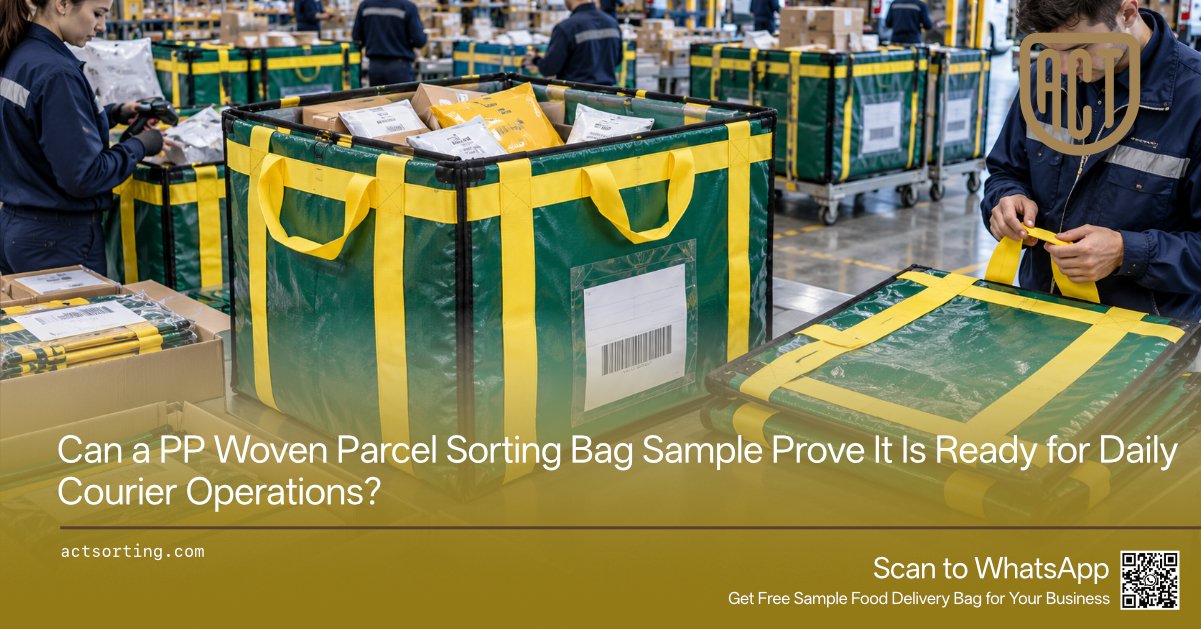
Consider a large rectangular PP woven bag with a green body, contrasting yellow webbing handles, and black edge reinforcement. The appearance is easy to recognize, but a purchasing decision requires more information. Buyers need to understand the fabric construction, finished dimensions, lifting points, base support, folding method, available colors, and packing configuration. Before purchasing hundreds or thousands of units, many prefer to test one or several samples under real working conditions.
ACTSORTING manufactures reusable logistics equipment for parcel delivery companies, e-commerce distribution centers, warehouse operators, and commercial courier networks. Established in 2013, the company operates a manufacturing facility covering more than 12,000 square meters in Yangchun, Guangdong, China, with over 400 experienced workers. Supported by BSCI and ISO9001 certification, ACTSORTING provides OEM and ODM services for PP Woven Logistic Sorting Bags, Parcel Delivery Bags, Parcel Sorting Bags, Courier Sorting Totes, Last-Mile Delivery Totes, and Van Loading Totes.
The ACD-WL-017 PP Woven Logistic Sorting Bag is one example of a reusable large-capacity sorting tote developed for warehouse and delivery operations. Its product family supports material, dimension, color, and printing customization, allowing commercial buyers to select a structure suited to their actual workflow.
For buyers considering their first purchase, a sample is not just a smaller transaction. It is an opportunity to check whether the product can actually solve the handling problems that caused them to search for a supplier in the first place.
Why Buyers Should Test a Parcel Sorting Bag Before Bulk Purchasing
Buying a product sample is one of the most practical steps a logistics purchasing team can take before committing to a larger order. Photographs and technical descriptions can explain the general construction of a PP Woven Logistic Sorting Bag, but they cannot fully demonstrate how the bag behaves when workers load parcels, carry it by the handles, drag it across warehouse floors, or fit it inside a delivery van.
A typical product sample allows buyers to inspect fabric thickness, stitching, handle reinforcement, zipper operation, opening dimensions, and bottom construction. More importantly, it provides an opportunity to test the bag using the same parcels and equipment found in the customer’s facility. A warehouse handling lightweight poly mailers may evaluate a bag differently from a courier fleet carrying mixed cardboard boxes. The products may look identical, but their working conditions are not.
For example, a purchasing manager may receive a sample of a large rectangular sorting tote and discover that the bag fits the warehouse roll cage perfectly but is slightly too tall for the delivery vehicle’s upper shelves. Another buyer may find that the handles are strong enough but positioned awkwardly for pulling the bag out of a narrow van compartment. These issues are relatively easy to correct during sample evaluation and considerably more expensive to discover after several hundred units arrive.
ACTSORTING supports sample evaluation for buyers considering PP Woven Logistic Sorting Bags and related commercial delivery equipment. Sample arrangements depend on the selected model, material, color, available stock, and whether the buyer requires a standard version or a specially developed structure.
A standard sample can be useful for confirming basic construction, while a customized sample is more appropriate when dimensions, handles, closures, branding, or reinforcement differ from existing products. Buyers should also distinguish between the minimum quantity for sample purchasing and the minimum order quantity for mass production. These are separate commercial conditions and should be confirmed before ordering.
The purpose of sampling is straightforward: identify problems before they become expensive. For logistics companies planning repeated purchases, a properly evaluated sample also becomes a physical reference for future production, helping ensure that subsequent orders follow the same approved specification.
Where Large PP Woven Sorting Bags Are Used in Daily Logistics
Large PP Woven Logistic Sorting Bags are used wherever workers need to consolidate individual parcels into manageable handling units. One of the most common environments is an e-commerce sorting center, where thousands of shipments arrive from packing lines and must be separated by destination, carrier, route, or dispatch time before leaving the facility.
Imagine a morning dispatch operation at a regional courier warehouse. Several delivery vans are waiting outside while employees scan parcels and place them into route-assigned sorting bags. Each bag may contain small cartons, poly mailers, retail packages, and other shipments belonging to a specific delivery area. Once the sorting process is complete, workers move the filled Parcel Sorting Bags into staging lanes before loading them into the correct vehicle.
Without reusable sorting totes, those parcels would often require more individual handling. Workers might move packages between carts, shelves, floor areas, and vehicles several times before dispatch. Grouping parcels inside a large bag reduces repeated movement and creates a more predictable loading process.
Parcel Sorting Bags are also useful inside delivery vehicles. Drivers can organize route groups according to stop sequence, neighborhood, apartment complex, or postal area. Instead of searching through a vehicle filled with loose parcels, they can focus on the current bag or delivery section. Clear route labels and standardized bag dimensions help the driver maintain this structure throughout the working day.
Regional distribution hubs use similar bags for temporary parcel consolidation. A facility may separate shipments by destination warehouse or departure wave, then transfer the completed bags between conveyor areas, sorting carts, and loading docks. Once unloaded, the empty bags can be folded and returned to the originating location for reuse.
ACTSORTING manufactures Parcel Delivery Bags, Courier Sorting Totes, Van Loading Totes, and reusable Parcel Sorting Bags for these demanding commercial applications. The material, dimensions, reinforcement, handles, and identification areas can be selected according to how frequently the bag moves and what it carries.
The main operational advantage is not simply larger capacity. It is the ability to keep packages grouped during several stages of the logistics process, reducing unnecessary handling and helping warehouse teams maintain clearer control over their parcels.
What Makes a Good PP Woven Parcel Sorting Bag?
A reliable PP Woven Logistic Sorting Bag needs to balance strength, weight, flexibility, and practical handling. Increasing fabric thickness alone does not guarantee a better product. A bag with thick material but weak seams, poorly positioned handles, or an unsuitable bottom structure may still fail early in commercial use.
Woven polypropylene provides a useful combination of tear resistance, relatively low weight, and foldability. Depending on the product specification, laminated woven materials can also provide a surface that is easier to wipe clean and more resistant to moisture and warehouse dirt. These properties make PP woven construction suitable for reusable sorting equipment that circulates between distribution centers and delivery vehicles.
The bag’s geometry is equally important. A rectangular design generally makes better use of vehicle shelves and staging areas than a soft, irregular sack. Workers can place several bags beside one another while keeping route labels accessible. A wide opening helps employees load mixed parcels quickly, while reinforced upper edges may improve handling when the bag is only partially filled.
Bottom construction should be selected according to the working environment. A flexible woven bottom allows compact folding and reduces weight, while a removable rigid board or reinforced base panel may improve stability when the bag contains mixed cartons. Buyers should consider whether workers mainly lift the bag, slide it across shelves, or drag it along warehouse floors before choosing the appropriate reinforcement.
Closure design also affects daily use. An open-top bag provides rapid access during sorting, while a zipper or hook-and-loop closure can help contain parcels during transportation. A closure that works well for hub-to-hub transfer may be unnecessarily slow for a delivery driver who needs to open the bag repeatedly throughout the route.
ACTSORTING’s ACD-WL-017 product family provides a starting point for evaluating these requirements. Commercial buyers can review material choices, finished dimensions, structural reinforcement, and available configurations before deciding whether an existing design meets their needs.
The most suitable Parcel Sorting Bag is therefore not necessarily the one with the highest advertised capacity. It is the product that carries the expected load reliably, fits the available equipment, remains easy for workers to handle, and can be reused through many logistics cycles.
Why Do Handles and Webbing Reinforcement Matter?
Handles are among the most frequently stressed components of a large sorting bag. During a normal warehouse shift, workers may lift a loaded tote from the floor, pull it toward a vehicle, move it between staging zones, or carry it over short distances. These movements concentrate force around the webbing attachment points, making handle construction just as important as the main fabric.
A large PP Woven Logistic Sorting Bag may use handles on two opposite sides, allowing workers to lift or reposition it from different directions. Some designs also include additional top or lower webbing to accommodate different loading methods. The most appropriate arrangement depends on the bag’s dimensions, expected load, and whether it is handled by one or two workers.
Contrasting webbing colors can make handles easier to identify. A green bag with yellow handles, for example, creates a strong visual distinction between the body and lifting points. This may be useful in crowded warehouses where employees need to locate the handles quickly. However, the color itself does not determine durability. Webbing width, material, stitching pattern, and reinforcement are the factors that affect load performance.
For bags carrying substantial parcel weight, reinforcement should extend beyond the visible handle attachment. Sewing webbing onto a small area of unsupported fabric can create concentrated stress. Longer attachment zones, reinforced stitching patterns, and additional fabric panels can help distribute force across a larger section of the bag.
Handle position should also match the way the bag moves. Side handles may be useful for pulling a tote from vehicle shelving, while longer upper handles can support lifting or short-distance carrying. An oversized bag with excessively short handles may force workers into awkward movements, particularly when the contents are heavy.
ACTSORTING supports customized webbing dimensions, colors, positions, and reinforcement structures for commercial logistics projects. These options allow customers to develop handles around the actual lifting and loading process rather than relying only on the appearance of a reference photograph.
During sample evaluation, buyers should fill the bag with representative parcels and test the handles repeatedly. They should check whether the bag remains balanced, whether stitching shows stress, and whether workers can grip the handles comfortably. A strong handle is valuable because it reduces equipment failures and makes repeated daily handling more predictable.
Can One Sorting Bag Fit Different Delivery Vehicles and Warehouse Systems?
A large sorting bag can work well in one warehouse and still be unsuitable for another. Delivery vans, metal racks, roll cages, carts, and staging areas vary considerably in their usable dimensions. For this reason, finished bag size should be evaluated against the equipment in which it will actually operate.
Consider a regional parcel company using metal shelving inside its delivery fleet. The purchasing team may prefer a large Parcel Delivery Bag because it can hold more packages. However, if the finished bag is too wide, fewer totes will fit side by side. If it is too tall, the upper section may interfere with the next shelf. If the handles protrude into the aisle, workers may struggle to remove the bag quickly.
Warehouse operations have different dimensional requirements. A large PP Woven Logistic Sorting Bag may need to stand inside a roll cage, beneath a conveyor discharge point, or beside a parcel scanning station. The opening should remain accessible, while the body should not block adjacent equipment or walkways.
Published reference dimensions for ACTSORTING’s ACD-WL-017 are approximately 57 × 45 × 77.5 cm. This provides a useful starting point for evaluating the product, but buyers should confirm the applicable version and finished measurements before purchasing because custom dimensions and alternative constructions may be available.
For customers planning a larger order, measuring the intended workspace is usually worthwhile. Useful information includes vehicle shelf width and height, internal rack depth, roll cage dimensions, typical parcel size, maximum load, and the amount of space available for folded bags after use.
ACTSORTING can develop custom dimensions through its OEM and ODM manufacturing services when a standard product does not meet these requirements. However, buyers should first determine whether an existing model is suitable. Custom sizing may add unnecessary development cost if the standard dimensions already fit the warehouse and fleet.
A correctly sized sorting bag helps workers load packages more efficiently, reduces wasted vehicle space, and makes it easier to standardize equipment across different delivery stations. The benefit becomes particularly noticeable when the same model is purchased repeatedly and used across multiple vehicles or facilities.
What Should Buyers Check When Selecting Bag Colors?
Color is often the first feature buyers notice when searching for a PP Woven Logistic Sorting Bag. A green body, yellow handles, and black edge binding create a recognizable appearance that can be useful when comparing products or developing a standardized equipment system.
However, a reference photograph should not automatically be treated as a confirmed production specification. The same product structure may be available in several colors, while a particular combination of body fabric and webbing may require separate material preparation. Buyers should therefore confirm whether their preferred color is an existing standard option or a customized configuration.
This matters especially when purchasing samples. A supplier may have a structurally identical sample in blue or black even if the buyer ultimately wants green. If the first priority is testing dimensions, material, handles, and loading performance, a sample in another available color may be sufficient. If exact visual appearance is important for brand approval or route classification, a color-matched sample may be necessary.
Color coding can also improve warehouse organization. A parcel company may use green Parcel Sorting Bags for one delivery region, blue bags for another, and yellow bags for priority shipments. In larger distribution networks, consistent colors help employees recognize route categories without reading every label individually.
Webbing and edge binding can provide an additional identification layer. Contrasting handles make lifting points visible, while black binding can help create a consistent appearance around the opening and seams. Logo printing and permanent route markings can also be added for commercial fleet orders.
ACTSORTING supports color and logo customization according to project requirements. For larger production programs, customers can provide reference photographs, color samples, or artwork so the desired appearance can be evaluated during development.
The important purchasing decision is whether the requested color is necessary for the operational purpose. Buyers who mainly need to test a product may benefit from an available standard sample. Businesses preparing branded equipment for multiple warehouses may prefer to confirm the exact colors before approving mass production.
What Does “Pieces Per Pack” Mean for Foldable Logistics Bags?
Packaging quantity is one of the most common sources of confusion when purchasing reusable logistics bags. A buyer may ask how many pieces come in one pack, but the word “pack” can describe several different levels of packaging: an individual polybag, a bundle of folded products, or a master shipping carton.
These quantities should not be assumed to be identical. One logistics tote may be packed individually in a protective polybag, while several individually packed totes may then be placed inside a larger export carton. Some bulk orders may use bundled or compressed packing arrangements to reduce transportation volume.
For example, a supplier might prepare each Parcel Sorting Bag as one folded unit inside an individual protective sleeve, then pack multiple units into a master carton. The final carton quantity depends on the finished bag dimensions, folding thickness, rigid bottom components, handles, and any additional accessories. A bag with a removable rigid board may require a different packing arrangement from a fully flexible woven sack.
This distinction matters for both sample purchases and larger orders. A buyer requesting one sample usually needs to know how many physical sorting bags will arrive, what accessories are included, and whether the sample is packed as one complete unit. For bulk orders, the buyer also needs pieces per carton, carton dimensions, gross weight, and total packing volume.
ACTSORTING’s published product information includes individually packed configurations for the ACD-WL-017 product family, but the number of finished bags per master carton should be confirmed for the exact model and shipment arrangement. Product dimensions, reinforcement, and packing methods may affect the final configuration.
For logistics companies importing hundreds of bags, carton quantity directly influences freight calculations and warehouse receiving. A shipment containing 200 bags packed in 10 cartons will be handled differently from the same quantity packed in 25 cartons. Transport cost may also change because carriers calculate charges using shipment weight, dimensions, and volume.
Buyers should therefore request a packing specification rather than relying on the phrase “one pack.” The supplier should clarify the number of bags in an individual package, the number of pieces in each master carton, and the accessories included with every unit.
A clear packing specification prevents unexpected quantities and allows purchasing teams to calculate storage, transportation, and distribution requirements before the goods arrive.
Which Details Should Be Tested on a Product Sample?
A useful sample evaluation should reproduce the conditions the sorting bag will encounter during commercial operation. Simply opening the package and checking the color is not enough to determine whether the product is suitable for a warehouse or courier fleet.
The first test should confirm the basic structure. Buyers can measure the finished length, width, and height, inspect the fabric and coating, check the stitching, and verify whether the zipper, handles, label pockets, and base support match the expected configuration. The bag should also be opened and folded several times to confirm that it can be handled without excessive effort.
The second test should focus on loading. The sample can be filled with representative parcels, including cartons and poly mailers of different sizes. Workers should observe whether the opening remains accessible, whether the sidewalls collapse, and whether the bottom supports the load evenly. This is particularly important for large sorting bags that may hold many small parcels rather than a few uniform boxes.
The third test should examine movement. The filled bag should be lifted using its designated handles, moved between staging areas, and placed into the intended delivery vehicle or warehouse rack. If the normal operation involves sliding or dragging, the test should also examine contact with representative floor surfaces, while avoiding unsafe loads and sharp obstacles.
The fourth test should focus on daily identification and storage. Workers should insert route cards into the transparent label pocket, check visibility from normal working positions, open and close the bag, and fold it after unloading. The folded dimensions should be compared with the warehouse’s available storage space.
Finally, the purchasing team should record the results. If the sample is suitable, it can become the reference for a standard production order. If adjustments are needed, those changes should be documented before another sample or mass production is approved.
ACTSORTING can support this evaluation process by confirming the selected product structure and discussing material, dimension, handle, closure, or reinforcement changes where necessary. Testing a sample is not about finding something wrong for the sake of it. It is about identifying the correct configuration before the product becomes part of a daily commercial workflow.
When Should Buyers Choose Standard Products or OEM Customization?
Not every logistics company needs a completely customized sorting bag. In many cases, a standard product already provides the required dimensions, construction, and functionality. For buyers testing a new delivery operation or replacing a small quantity of worn equipment, choosing an existing model can be a more practical starting point.
Standard PP Woven Logistic Sorting Bags may reduce the need for new material sourcing, special printing, custom cutting templates, or additional product development. If the preferred model and color are available, the purchasing process can also be simpler. However, standard availability, minimum order quantity, and shipment timing still need to be confirmed for each order.
OEM customization becomes more valuable when the existing product does not fit the workflow. A courier fleet may require shorter bags for low-clearance vehicle shelving. A warehouse may need larger transparent route pockets. A distribution center may want stronger bottom reinforcement for repeated dragging. Another operator may require a specific green-and-yellow color combination to match an established equipment system.
ACTSORTING supports these modifications through OEM and ODM manufacturing. Customers can customize PP woven material, dimensions, body colors, handles, webbing positions, logo printing, closures, transparent label holders, reinforcement panels, rigid inserts, and packaging arrangements.
Large-volume purchasing also changes the decision. A custom product may require higher initial development effort, but standardizing the finished design across several warehouses or hundreds of vehicles can create long-term operational value. Once approved, the same specification can be reproduced for future replenishment orders.
For buyers starting with one sample, the most practical approach is to identify the primary operational requirement first. If the main concern is checking whether a large PP woven tote can carry and organize parcels, a standard sample may be enough. If the bag must fit a specific van shelf or reproduce an exact design, a customized sample becomes more important.
The objective is not to maximize customization. It is to select a product that solves the handling problem without adding unnecessary cost or complexity.
ACTSORTING Supports Sample Evaluation and Large-Volume Manufacturing
ACTSORTING manufactures reusable logistics bags for parcel sorting, warehouse consolidation, vehicle loading, hub transfers, and last-mile courier operations. Since 2013, the company has developed industrial textile products for commercial customers requiring durable construction, consistent specifications, and dependable production support.
Its manufacturing facility in Yangchun, Guangdong, China, covers more than 12,000 square meters and employs over 400 experienced workers. BSCI and ISO9001 certification support responsible manufacturing and quality management across the company’s production activities.
For PP Woven Logistic Sorting Bags such as ACD-WL-017, ACTSORTING can help customers evaluate standard product configurations and determine whether material, size, color, handle, closure, reinforcement, or printing changes are necessary.
Buyers interested in a sample can identify the selected model and reference image, then confirm the available version, sample quantity, cost, packaging configuration, and shipping destination. If the preferred sample differs from the available standard model, the required changes should be clarified before sample production.
For larger purchasing programs, ACTSORTING provides OEM and ODM services covering fabric material, color matching, logo printing, dimensions, transparent label pockets, closure systems, webbing, reinforced bottom panels, and packaging. These capabilities allow parcel operators, warehouses, courier companies, and distribution networks to develop equipment that fits their actual handling process.
The company’s manufacturing scale supports commercial-volume orders and repeat production. Once a sample and technical specification are approved, future orders can follow the same confirmed material, dimensions, colors, handles, reinforcement, and packaging requirements.
ACTSORTING serves businesses that need more than an ordinary storage sack. Its products are developed for repeated warehouse handling, route-based parcel sorting, vehicle loading, and reusable delivery equipment programs.
For purchasing teams evaluating a PP Woven Logistic Sorting Bag, the first step is to confirm the actual use case, model, sample requirements, and expected purchasing volume. Useful information includes parcel type, working load, desired dimensions, preferred color, reference image, loading method, and delivery destination.
Buyers can contact ACTSORTING with these details to request information about available samples, packaging quantities, and commercial production options.
A reference photograph helps begin the conversation. A properly tested sample helps determine whether the product belongs in the warehouse.
Frequently Asked Questions
Q: Can buyers purchase a PP Woven Logistic Sorting Bag sample before placing a bulk order?
A: ACTSORTING supports sample requests for PP Woven Logistic Sorting Bags, including the ACD-WL-017 product family. Sample availability, pricing, quantity, and preparation time depend on the selected version and whether customization is required. Buyers should confirm these details before placing a sample order.
Q: How many PP Woven Logistic Sorting Bags are included in one pack?
A: Packing arrangements depend on the product model and shipment requirements. An individual sorting bag may be folded and packed in a protective polybag, while multiple individually packed products may be placed inside one master carton. The number of pieces per carton should be confirmed for the exact model and packing specification.
Q: Can ACTSORTING manufacture green sorting bags with yellow handles?
A: ACTSORTING supports customization of fabric colors, webbing colors, handles, edge binding, and logo printing. Green bags with contrasting yellow handles can be evaluated as a requested configuration, but sample availability and production requirements should be confirmed before ordering.
Q: What should buyers check when evaluating a large PP woven sorting bag sample?
A: Important factors include fabric construction, dimensions, loading capacity, handle reinforcement, bottom structure, closure operation, label pocket visibility, folding performance, and compatibility with warehouse equipment or delivery vehicles. Testing the sample with representative parcels is recommended.
Q: Why choose ACTSORTING for bulk PP Woven Logistic Sorting Bags?
A: ACTSORTING has manufactured commercial logistics bags since 2013 and operates a production facility covering more than 12,000 square meters with over 400 workers. Supported by BSCI and ISO9001 certification, the company provides standard product evaluation, OEM and ODM customization, and large-volume production for parcel delivery companies and logistics operators.