

Table of Contents
- Fresh and Frozen Supermarket Replenishment Leaves the Cold Room Before It Reaches the Store
- Building Store Deliveries as Pallet and Roll Cage Groups
- Why Covers Are Used on the Dock and During Vehicle Loading
- Fitting an Insulated Pallet Cover to the Load and the Handling Method
- Using a Roll Cage Insulated Cover for Wheeled Store Replenishment
- What a Cover Can and Cannot Do for Chilled Versus Frozen Goods
- Closures and Openings That Staff Use at the Dock and in the Backroom
- Marks That Identify the Store, the Route, and the Temperature Class
- Empty Covers, Return Flow, and Everyday Care
- What Buyers Should Send for a Supermarket Insulated Cover Specification
Fresh and Frozen Supermarket Replenishment Leaves the Cold Room Before It Reaches the Store
Supermarket fresh and frozen goods are picked and built inside a chilled room or a freezer at a retail distribution center, but they do not remain inside that room until they are placed on the shop floor. Between the DC cold room and the store’s own refrigerator, freezer, or cabinet, a finished store delivery usually crosses a loading dock, waits for a vehicle, travels, and is received in a backroom. Those intervals may be short. They are still the moments when a pallet or a roll cage stands in air that is warmer than the product it is carrying.
The operating pattern is scheduled store replenishment, not a consumer grocery order carried to an apartment door. A DC builds deliveries for named stores or routes. Chilled dairy, meat, and produce are assembled as one set of travel units; frozen lines are assembled as another. The units may be pallets of case quantities, or roll cages that will later be wheeled into a backroom or toward a sales-floor aisle. Once the group is built, it has to move as a group. If it sits uncovered on a dock while other stores are loaded, or if it waits outside a store before the backroom team can put it away, the product is already outside the room that was holding its temperature.
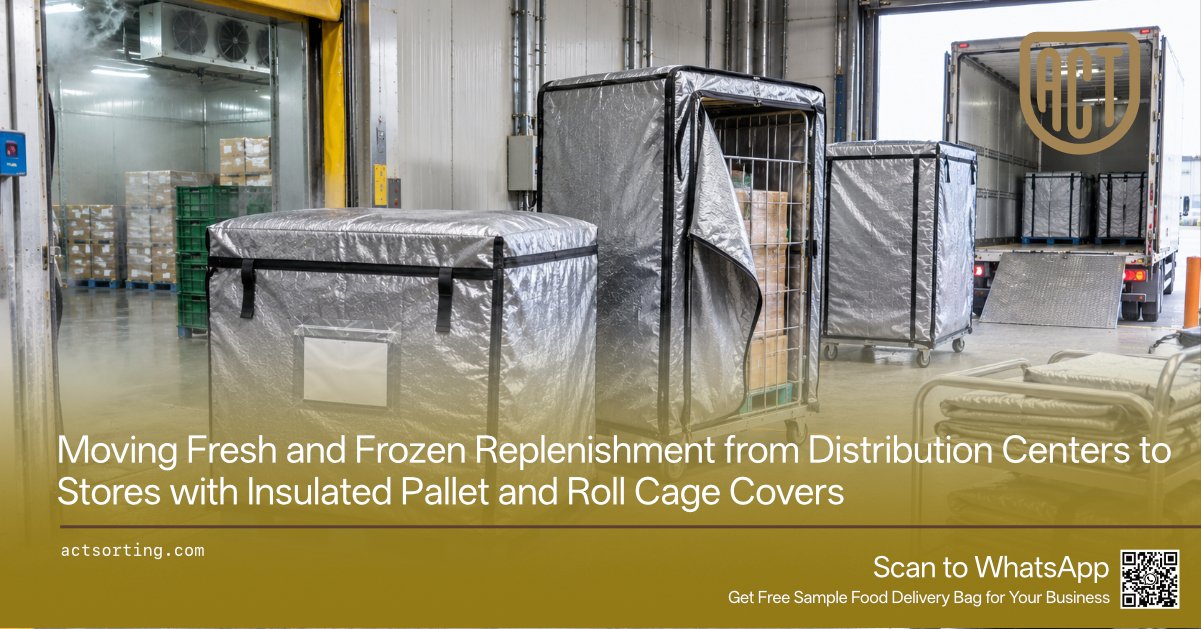
A reusable insulated cover is a fitted textile jacket for that travel unit. It does not replace the DC freezer, the store cold room, or the refrigerated vehicle the operator already runs. Its job is more limited and more practical: to help slow heat gain and limit temperature rise while the goods move between cold rooms, loading areas, vehicles, and the delivery point, and during short holding in those same intervals. In supermarket replenishment, insulated pallet and roll cage covers are used as cold chain transport covers for those crossings. The cover is specified to the pallet, the roll cage, or the trolley that already carries the store delivery, then put on before the load leaves the controlled area whenever the operation can do so.
Building Store Deliveries as Pallet and Roll Cage Groups
A store delivery starts when the pick is complete, not when the truck door closes. In the chilled room, cases of dairy, packed produce, or fresh meat are stacked on a pallet or loaded into a roll cage until the store’s order, or that store’s share of a route, is together. In the freezer, the same work happens for frozen lines, usually on a separate travel unit and often in a separate room. The group that leaves the room should already be the group that the store is meant to receive. Breaking that group on the dock in order to rebuild it in warmer air is exactly the exposure the cover is meant to shorten.
Pallets and roll cages are not interchangeable just because both can leave on the same vehicle. A pallet is a fork-moved block of cases. It suits store deliveries that will be set down in a receiving area or a backroom and broken later. A roll cage is a wheeled unit. It suits deliveries that should stay mobile from the DC floor, onto the vehicle, and into the store, sometimes as far as a holding aisle. The cover has to be chosen for the unit that actually carries the goods, because the footprint, the height of the finished load, and the way staff open the unit at the store are all different.
Chilled and frozen goods should travel as separate groups in ordinary supermarket replenishment. They come from different rooms, they are going into different store equipment, and they do not share the same product temperature. Putting both under one cover does not make them one temperature class. If a cage or a pallet is built with a mixed load, the cover cannot correct that mix; it can only jacket whatever was placed inside. The cleaner practice is to finish the chilled group and the frozen group as separate travel units, identify each one before it leaves the room, and keep that identity through loading and store receipt.
The cover goes on after the load is built and checked, and preferably while the unit is still in, or immediately beside, the cold room. A jacket that is added only after the pallet has already waited on an open dock is still useful for the remaining journey, but it has already missed the first interval the operation can control.
Why Covers Are Used on the Dock and During Vehicle Loading
The dock is where a temperature-controlled load spends time in a space that is not a cold room. Doors stand open while a trailer is positioned. Staging lanes fill with deliveries for several stores. A pallet may wait while the frozen units from another aisle catch up, or while a previous store’s drop is still being loaded. Even when the outbound vehicle itself is refrigerated or divided into temperature zones, the walk from the cold-room door to the vehicle floor is still an ambient crossing, and the vehicle door is open for as long as loading continues.
Insulated pallet covers and roll cage covers are used in that crossing, not as a substitute for the vehicle’s refrigeration and not as a claim that the dock has become a cold room. A fitted cover reduces the exposed surface of the load and slows heat transfer and the exchange of air around the cases while the unit is staged, pushed or forked to the doorway, and placed on the vehicle. The same jacket stays useful at the other end of the trip, when the store team unloads into a backroom and cannot always put every case into a cabinet or a freezer in a single motion.
The timing of the cover matters as much as the cover itself. If staff pull the jacket off on the dock in order to read a label or to restack a leaning column, the load is uncovered during the wait that usually follows. If they leave the cover in a bin inside the cold room and only remember it at the trailer, the first dwell has already happened. Operations that get consistent use from these covers treat putting the jacket on as part of finishing the store group, the same way they treat applying the store or route mark, not as an optional wrap added if someone has a spare minute at the door.
A cover also does not partition a mixed-temperature vehicle by itself. A chilled pallet and a frozen pallet may travel on the same truck, but they remain two loads. The cover on each unit protects that unit during loading, transit door-open time, and unloading. It does not create a sealed bulkhead between them, and it should not be asked to do the work of a vehicle that was specified for the product temperatures on board.
Fitting an Insulated Pallet Cover to the Load and the Handling Method
A pallet cover has to match the travel unit, not only the idea of a pallet. The buyer already knows the footprint in use, whether that is a widely used retail pallet size or a house standard, and can measure the usual finished height of a store-bound stack, including any lean, overhanging cartons, or slip-sheet build-up. A cover that is tight on the footprint but short on height leaves the top of the load exposed. A cover that is much larger than the stack is easier to drop on and harder to keep seated when a forklift turns or when the pallet is set down on an uneven dock plate. Those dimensions are a specification, not a later adjustment to be improvised with tape.
The listed reusable thermal pallet cover on the ACTSORTING site is built as a multi-layer jacket: aluminum foil facings with a woven layer, and a bubble layer is also described on that same product. Closures can be specified as a zipper or as hook-and-loop fasteners. Other insulated covers in the same product family can be sized for pallets, roll cages, or logistics trolleys, and the outer fabric and insulation can be specified differently, including an aluminized woven outer, a 1680D fabric outer, or a polyester-fiber fill whose weight is chosen against the transfer and short-holding conditions the operator actually runs. Those are construction choices. They are not a published hold time, and they should be selected against the journey the supermarket load will take, not against a generic cold-chain slogan.
Installation has to work around the way the pallet is already moved. The forks enter the pallet, not the cover. The jacket is pulled over a finished stack, or opened and closed around it, and then has to stay seated while the pallet is lifted, set on a dock, and loaded. The cover is a thermal jacket and a physical wrap for that movement. It is not a cargo-restraint device for the trailer, and it should not be asked to hold a poorly stacked column together. If a stack is unstable before the cover goes on, the stack needs to be rebuilt. The cover can follow a sound load; it cannot replace one.
Because supermarket pallets are covered and uncovered many times in a week, the fit also has to be practical for gloved staff working in a cold room and then on a dock. A design that can be dropped on only when two people are free, or only when the stack is perfectly square, will be skipped at peak. The useful cover is the one that can be put on as soon as the store group is complete, closed, and left in place until the backroom is ready to break the pallet.
Using a Roll Cage Insulated Cover for Wheeled Store Replenishment
Many supermarket replenishment moves never sit still on a pallet. Produce, chilled convenience lines, or frozen cases are often picked into a roll cage in the DC, wheeled to the dock, pushed onto the vehicle, and wheeled again into the store backroom. The thermal problem is the same as with a pallet — the goods leave a cold room and spend time in warmer air — but the handling is different. The unit has doors or an open face, it rolls, and staff at the store often need to take cases off without dismantling a whole stack.
A roll cage insulated cover is therefore cut to the cage, not borrowed from a pallet pattern. The footprint, the height to the top rail, the door swing or front opening, and the caster clearance all affect whether the jacket can be closed and whether it will catch when the cage is rolled over a dock plate. Custom sizing to the operator’s cage is the starting point, rather than hoping a loose pallet cover will drape well enough. Logistics roll cages remain the wheeled frame; the cover is the jacket around that frame. The same idea can be applied to warehouse trolleys when the store delivery is built on a trolley rather than a cage, again by fitting the cover to that unit’s dimensions and opening.
Access is the feature that makes a cage cover usable in a supermarket backroom. A zipper opening, specified for repeated loading and access, lets staff open the face, take off the cases needed for a cabinet or a freezer, and close the jacket over whatever is still inside. That matters when a delivery cannot be put away in one pass. A transparent document and route label pocket, mounted where it can be read without opening the cover, keeps the store, the route, or the temperature class visible while the jacket stays closed. Those details appear in a publicly described cold-chain distribution application for frequent transfer of chilled and frozen goods between cold rooms, loading docks, and transport vehicles; they are also the details a supermarket buyer can ask for when a cage cover is specified.
The cover still has to be put on before the cage leaves the cold room, and it has to survive being rolled, not only being lifted. If the skirt drags, if the zipper face sits where the cage door hits it, or if the jacket has to be removed every time the cage is pushed over a threshold, staff will leave it off. A cage cover that works in this setting is one that stays on from the DC room to the store holding point, and that can be opened and closed at the points where the operation actually needs access.
What a Cover Can and Cannot Do for Chilled Versus Frozen Goods
An insulated cover is a thermal buffer for a transfer, not a portable cold room. When chilled and frozen goods stand in warmer air, the main risk is heat entering the load and the product temperature rising. A fitted jacket can slow that heat transfer while the unit is moving or waiting for a short interval. It does not give the load a stated number of hours at a stated product temperature, and a construction description is not, by itself, a completed temperature-performance result. The useful starting question remains the journey: how long the units usually sit on the dock, how long the vehicle door is open, how long they wait at the store before put-away, and what air they stand in during those intervals. The cover is then chosen against that journey.
Chilled and frozen goods do not use that buffer in the same way. A chilled dairy pallet and a frozen pallet may both benefit from being covered on the same dock, but they did not start at the same temperature and they are not going into the same store equipment. A short ambient crossing that is acceptable for one class may be a poor idea for the other. The cover does not equalize those two risks. Keeping the two classes on separate travel units, each jacketed and marked, remains the practical arrangement. If an operation ever places both classes in one cage, that is a loading decision the cover cannot repair.
Confirming a cover for supermarket replenishment is two different checks, not one. A size and handling check shows whether the jacket fits the pallet or the cage, whether the closure can be operated on the dock, and whether the cover stays seated when the unit is forked or rolled. That check does not answer how the product temperature behaves. A temperature-performance check records the initial product temperature, the ambient temperature around the unit, the duration of the exposure, and the product temperature change at the end of that interval. Where a clearer reading is needed, the same conditions can be run with a cover and without one, so the difference in heat gain and temperature rise is visible. Those observations come from the operator’s own trial on the actual dock and vehicle. They are not a catalog hold time, and they should not be replaced by a generic figure taken from a product description.
Construction can still be matched to the interval. Insulation weight, often as a polyester-fiber fill, can be selected against the transfer and short-holding time the operator needs to cover. Outer materials can be chosen for the dock and vehicle environment, including aluminized woven fabric, a 1680D fabric, or other facings. A foil-and-woven or foil-and-bubble pallet jacket is one of the constructions already listed for thermal pallet covers. A heavier fill or a more reflective outer may be discussed for a longer yard wait or a warmer dock; a lighter build may be enough for a short, indoor crossing into a refrigerated trailer. Those are specification choices. Fit and temperature performance are then confirmed by the two checks above, against the operator’s own conditions.
The cover also cannot do the work of broken store equipment or a missing cold-room slot. If frozen cases have to wait in a backroom because the freezer is full, the jacket may still be the better state for that wait, but the wait itself is an operations problem. The honest use of these covers is to protect planned transfers and short, known holding — not to make an unrefrigerated delay look like a controlled storage step.
Closures and Openings That Staff Use at the Dock and in the Backroom
The closure is the part of the cover that staff actually handle, and it is the part that determines whether the jacket stays closed during the wait. Two closures are commonly specified on these covers: a zipper, and hook-and-loop fasteners. They do different jobs. A zipper is a defined opening, useful when the same face will be opened and closed many times, as on a roll cage that is accessed in a store backroom. Hook-and-loop fasteners are useful along a skirt or a flap that must be closed quickly around an irregular stack, and they can be resealed without lining up a long zipper on a cold dock. Neither closure creates a sealed chamber around the load. They are practical ways to keep the jacket in place and to limit open area around the load.
The position of the opening has to follow the work. A pallet that is only uncovered when the whole stack is broken in the backroom can use a top or an envelope opening that is closed after the cover is dropped on and left closed until put-away. A cage or a trolley that will be picked from during store receipt needs an opening on the working face, so staff are not lifting the whole jacket off in order to take a few cases. If the only way to reach the product is to remove the cover entirely, the cover will spend the most vulnerable minutes — the unloading wait — in a pile on the floor.
Repeated use is harder on closures than on the body of the jacket. Zippers pick up frost, condensation, and warehouse dust. Hook-and-loop collects fibers and can hold less firmly when it is wet. Those are ordinary wear conditions in a fresh and frozen operation, not reasons to abandon the closure. They are reasons to specify a closure that staff can operate with gloves, to keep the opening away from caster splash and dock-plate impact where possible, and to take a cover out of food-replenishment duty when the zipper no longer closes or the flap no longer stays down. A closure that looks tidy on a sample table is only useful if it still closes after a week of store deliveries.
At no point is the closed cover a substitute for keeping the unit out of a long ambient wait. A well-closed jacket on a pallet that then stands in the sun for an unplanned hour is still a pallet standing in the sun. The closure does its job when the operation already has a planned, short interval and needs the jacket to stay on during that interval.
Marks That Identify the Store, the Route, and the Temperature Class
Once several covered units stand on the same dock, they look alike. A silver or a dark jacket hides the cases inside, and a busy loading lane is a poor place to open covers in order to see whether a unit is frozen or chilled, or which store it belongs to. Identification has to remain readable while the cover is closed. A transparent document and route label pocket does that work if it is placed on a face that is visible when the pallet is forked or the cage is rolled, and if the card inside carries the store, the route or departure group, and the temperature class. Printed marks, a color used consistently for frozen versus chilled, or a logo that identifies the operator can support the same reading at a distance. The mark is a visible identifier. It is not, by itself, a warehouse-management record.
The temperature class is as important as the store name. A frozen cage and a chilled cage that are both covered can be staged in the wrong lane, or unloaded into the wrong backroom area, if nothing on the jacket says which is which. Color and a short wording on the label are usually enough. The mark has to be applied before the unit leaves the cold room, and it has to be updated if a jacket changes duty. Chilled and frozen work are different temperature-control situations, but that alone does not mean one cover cannot be used for both. Whether the same jacket can serve both duties depends on the insulation structure, the size, the cleanliness of the cover, whether temperature performance has been checked for that duty, and the operator’s equipment-management procedure. A shared pool is a managed choice, not an automatic one, and not a prohibition either.
Customization of color, printed identification, and pocket position is a normal part of specifying these covers, alongside the dimensions and the closure. The useful constraint is readability in the actual place of work: a dock with mixed daylight and vehicle shadow, a gloved hand, and no time to hunt for a tag on the far side of a cage. If the pocket sits behind a strap, under a flap, or on a face that is always turned to the trailer wall, the identification was specified, but it will not be used. The buyer can settle pocket position from a photograph of the loaded pallet or cage in the aisle where it is actually staged.
Empty Covers, Return Flow, and Everyday Care
A cover that stays at the store after the cases are put away is a cover that is missing from the next DC wave. Empty-jacket return has to be planned with the same seriousness as the outbound delivery, even though the empty cover is light and easy to overlook. In a typical replenishment loop, the store team takes the jacket off when the pallet or cage is being emptied, folds it, and sends it back on the same vehicle, often in a designated bag, crate, or shelf so that covers are not left in a shopping aisle or on a wet dock floor. The DC then has a place to receive them, check them, and send them back toward the cold rooms where the next store groups will be built.
Folding and volume depend on the construction. A flexible textile jacket can usually be folded or rolled for the return trip; a heavier insulated build takes more space and should not be stuffed in a way that breaks a zipper or crushes a standing label pocket. The exact collapsed size is a matter of the sample and the way staff actually fold it, not a figure to be assumed from the outbound dimensions. What matters operationally is that the return has a known place on the vehicle and a known place at the DC, so covers do not accumulate in stores or disappear into a general returns pile.
Fresh and frozen work is wet work. Covers pick up condensation when they move from a freezer into dock air, and they pick up dirt from floors, casters, and pallet boards. A jacket that is obviously wet or soiled can be set aside, allowed to dry, and wiped down according to the operator’s own equipment-cleaning practice before it goes back onto a food load. That is ordinary equipment care. It is not a claim that the cover is a hygienic barrier, and it is not a substitute for the operator’s existing food-handling rules. A cover with a failed zipper, a torn skirt, or a pocket that can no longer hold a label should leave the replenishment pool until it is repaired or replaced, rather than continue to travel as if it were still closing.
Turnover quantity follows the loop, not only the number of stores. Covers are needed for units currently being built, units already on vehicles, units waiting at stores, and units in drying or repair. If the pool is sized only for the pallets leaving the DC this morning, the afternoon wave will start uncovering loads because yesterday’s jackets have not yet come back. The buyer can estimate that loop from existing store delivery frequency and dwell, then adjust after a few weeks of live use.
What Buyers Should Send for a Supermarket Insulated Cover Specification
A useful specification starts with the travel unit and the journey, not with a generic request for a cold-chain cover. The buyer can say whether the goods move on pallets, on roll cages, on trolleys, or on more than one of these, and can send the footprint, the usual finished load height, and photographs of a typical built unit, including any overhang, door opening, or caster layout that will affect the jacket. If chilled and frozen deliveries both need covers, that should be stated as two duties, even when the outer look of the jackets will be similar, because identification and, in some operations, construction may differ.
The journey should be described in the operator’s own times and places: the walk from the cold-room door to the vehicle, typical dock waiting, whether the vehicle is refrigerated or divided into temperature zones, and how long a unit usually waits at the store before put-away. Those conditions are what the insulation weight and the outer material are chosen against. Closures can be named as a zipper, hook-and-loop fasteners, or a combination, according to whether staff need repeated access in the backroom or a skirt that closes around a pallet stack. A document and route label pocket, color, and printed marks can be specified so that store, route, and temperature class remain readable while the cover stays closed.
ACTSORTING can work from that package — measurements, photographs, the travel unit, and the transfer conditions — to propose a cover that fits the equipment already in the supermarket loop. A sample can then be checked in two ways on the actual dock and vehicle: first for fit, closure, and handling, and then, separately, for temperature performance, by recording the initial product temperature, the ambient temperature, the exposure time, and the product temperature change, with an uncovered comparison under the same conditions where that comparison is useful. Buyers who are ready to discuss a supermarket fresh or frozen replenishment cover can send those details through the customization inquiry path, together with any reference jacket already in use. The conversation is more precise when the load, the unit, and the interval are visible.
FAQ
Q: Can an insulated pallet or roll cage cover replace a refrigerated vehicle for supermarket frozen deliveries?
A: No. The cover is a jacket for the travel unit during transfers and short holding between cold rooms, docks, vehicles, and the store backroom. It can help slow heat gain and limit temperature rise in those intervals, but it does not replace the refrigerated or frozen rooms, or the refrigerated vehicle, that the operator already runs for the product temperature.
Q: Should fresh and frozen goods travel under the same cover?
A: In ordinary supermarket replenishment, chilled and frozen goods should travel as separate groups, each on its own pallet, cage, or trolley, because they leave different rooms and go into different store equipment. A single jacket over a mixed load does not turn two product temperatures into one, and it cannot correct a mixed build. That is a question about how the load is assembled. It is not a rule that a cover may be used for only one temperature class. Whether the same jacket, or the same cover design, is later used for both chilled and frozen duties depends on the insulation structure, the size, the cleanliness of the cover, temperature-performance checks, and the operator’s equipment-management procedure.
Q: Can one cover pattern be used on both pallets and roll cages?
A: Not as a default. A pallet and a roll cage have different footprints, heights, and openings, and they are handled differently. Covers are typically sized to the unit they will jacket. The same product family can include pallet covers, roll cage covers, and trolley covers, but each fit should be specified to that equipment, rather than assumed from a single pattern.
Q: How should insulation and outer material be chosen if no hold time has been tested yet?
A: Start with the actual journey: dock dwell, door-open time, transit, and store waiting, and the air those units stand in. Insulation weight, often a polyester-fiber fill, and the outer construction, such as an aluminized woven fabric, a 1680D fabric, or a foil-and-woven or foil-and-bubble jacket, can then be selected against that interval. A sample on the operator’s own dock and vehicle can confirm fit and handling. Temperature performance is a separate check: record the initial product temperature, the ambient temperature, the exposure time, and the product temperature change, and, where useful, compare a covered unit with an uncovered unit under the same conditions.
Q: What should be sent besides the pallet or cage dimensions?
A: Photographs of a typical built load, whether the duty is chilled, frozen, or both, how the unit is opened at the store, the preferred closure, and how store, route, and temperature class should be marked, including a label pocket if one is needed. Those details determine whether staff will leave the cover on, not only whether the jacket can be pulled over the equipment.