

Table of Contents
- Delivery Depots Break When Every Load Is Forced Into One Container Type
- Logistics Sorting Bags for Delivery and Transport Parcel Groups
- Pallet Boxes When Bags on a Pallet Are Not Enough
- Pallet-Box Footprint, Empty Collapse, and Racking Limits
- Roll Cages and Rolling Containers for Destination Movement Inside the Depot
- How Bags, Pallet Boxes, and Roll Cages Hand Work to Each Other
- Marks and Route Cards That Keep Groups Identifiable at Handover
- Empty Return: Folded Bags, Collapsed Sleeves, and Nested Cages
- Comparing Bags, Pallet Boxes, and Roll Cages for One Depot Purchase
- What Buyers Should Send When a Depot Needs More Than One Equipment Type
Delivery Depots Break When Every Load Is Forced Into One Container Type
A delivery depot that tries to move every load in a single kind of container ends up fighting the load. Mixed parcels for one route need a unit that can be opened at a sort face, closed for a short trip, carried or staged on a pallet, and read as a group at the next door. A pallet move, by itself, does not decide the container: logistics sorting bags can stand on a pallet and travel with the site’s existing jack or forklift and load-stabilization methods. Some loads still need a container with stable sidewalls and a lid, not only a pallet to ride on. Destination or route groups that have to cross the depot floor, pause at an outbound door, and roll toward a vehicle need wheels and a gate, not a unit that only moves when a fork is free. Forcing all three jobs into one container type does not simplify the operation. It just moves the breakage to the next step: bags that were never packed or stabilized for a pallet move, pallet boxes asked to sit on racking beams they have not been checked for, or roll cages left in an aisle because they will not pass a door or a dock plate.
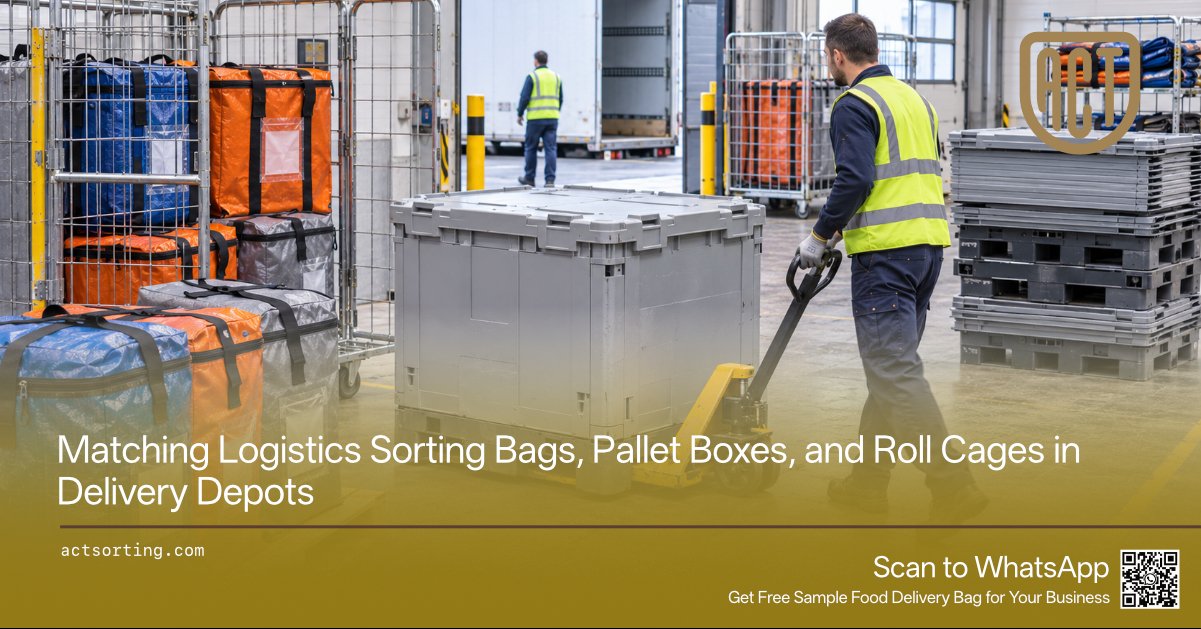
European logistics and delivery buyers often look at this problem as a set of equipment types rather than as one catalog item. The recurring set is logistics sorting bags for the delivery and transport of parcel groups, pallet boxes (often called palboxes) for pallet-unit loads, and roll cages or rolling containers for destination movement inside the depot and at the dock. Around them sit storage and warehousing equipment—mesh storage cages, bag racks, warehouse trolleys—that keep overflow off the floor, hold empty units, or move a load a short distance. Those supporting units matter, but they do not replace the three loading units.
The useful design question is which work each unit should take, and where a load should be handed from one unit to another rather than repacked without a reason. A bag, a pallet box, and a roll cage bought from separate thoughts will still meet on the same dock. If their footprints, identification faces, and empty-return methods were never considered together, the depot will spend the first weeks working out a handover the purchase did not plan.
Logistics Sorting Bags for Delivery and Transport Parcel Groups
The bag’s job in a delivery depot is to keep one parcel group together while that group is assembled, moved, and opened again. Buyers in European delivery and logistics operations often describe this unit as a delivery and transport bag: a reusable body that carries a route, a door, a service type, or a return wave from the sort face to a vehicle, a second sort, or a pickup point. That work is the work of a reusable logistics sorting bag or parcel sorting bag. It is a grouping and transfer unit for mixed parcels, not a food-delivery rider bag, and not, by itself, a pallet box or a rolling container.
A zipper or fold-over lid lets the mouth be closed between the sort and the next opening; an open top is faster at a continuous sort face but has to be managed until the bag is opened on purpose. Handles should follow the lift that is really used. A small, partly filled bag may still be moved by one person. A large filled bag should not be assumed to travel as a two-person carry; if it will be heavy when full, it should be sized and staged for a pallet, a trolley, or a roll cage the site already uses.
The bag itself has no fork entry. That fact does not rule out palletized transport. Filled bags can stand on a pallet the site already uses and move with the pallet jack or forklift already on the floor, with the wrap, straps, or other load stabilization the operator already applies to pallet loads. The bag remains the grouping unit; the pallet is the handling platform. A pallet box is not required merely because the next move uses a fork or a jack. A clear wall or lid face for a route card, a color field, or a unique mark is still part of the same job, so the next team can identify the group without opening it. What the bag still cannot do is also clear: it is not a rolling container unless it is placed on a trolley or in a cage, it does not restrain neighboring cargo, and a flexible woven body is not a sidewall or a lid. Used in the right place, the bag is the fastest way to keep mixed parcels together through a delivery and transport sequence, including a palletized move; used where the load needs walls, a lid, or wheels of its own, it has to be paired with a pallet box or a roll cage rather than asked to provide those structures.
Pallet Boxes When Bags on a Pallet Are Not Enough
A need to move goods with a pallet jack or a forklift does not, by itself, decide the container. Logistics sorting bags can stand on a pallet and travel as a palletized load when the bags already hold the groups and the site’s existing wrap, straps, or other stabilization keeps that layer in place. A collapsible plastic sleeve pack, often sold as a palbox or pallet box, earns its place when the load needs more than a platform: a stable container boundary, sidewall support, a lid that defines the top, a collapsible three-piece structure for empty return, and a loading or stacking capability that has been verified on the actual unit.
The usual construction is a pallet base, a sleeve that forms the four walls, and a lid. Those three parts are one unit. The sleeve stands on the box’s own pallet base for use and collapses for empty return. The complete box should not be treated as if it were then placed on a separate wooden pallet. Grey plastic bodies are a common sight in European warehouses because a large, plain color field is easy to see in an aisle or on a dock; the color is a visibility choice, not a performance claim. The lid keeps the top face defined so a neighboring unit, a wrap layer, or a stack that has been checked is dealing with a known upper surface rather than with a loose carton pile.
Bags plus a pallet are already enough when mixed parcels are grouped in bags, the pallet is only the handling platform, and the stabilization method the site already uses can hold that bag layer through the jack or fork move. A pallet box is the better unit when loose cartons or packed goods would slump, shift, or fall from an open pallet of bags, when the move or a verified stack needs sleeve walls and a lid, or when the empty set should collapse as a three-piece container rather than as a loose pile of bags and a separate pallet. What the structure does not solve is rapid, repeated opening at a last-mile door. A sleeve and lid take a setup and a breakdown step that a sorting bag does not. If a route group would be emptied from the box immediately to rebuild a bag for a van, the parcels still belong in bags, which may then ride on a pallet or in a cage to the door. Whether a given box can later sit in pallet racking is a separate question, not a reason to buy a pallet box by default.
Pallet-Box Footprint, Empty Collapse, and Racking Limits
A pallet box only earns its place if its own pallet base fits the handling equipment the depot already runs. The base should match the jack entry, fork length, and floor or vehicle positions the site already uses, and the packed height should clear the doors, dock plates, and trailer or van openings where that unit will actually go. The starting point is the lift path already in service, not an assumed catalog cube, and not an extra wooden pallet placed under a complete three-piece box. A base that does not match the jack or the door will be left on the floor, or it will catch an upright, a dock plate, or a vehicle threshold.
Empty return is the other half of the same design. A collapsible sleeve is useful because an empty box should not travel or sit in the return bay at its full packed volume. The sleeve folds down onto or with its own pallet base and lid, and the empty set can then be stacked or staged for backhaul or storage. How flat that stack sits, how the lid locates on the collapsed sleeve, and how many empty sets fit a return position have to be checked on a physical sample of that box. Those results vary with sleeve thickness, hinge or lock geometry, and lid design. They should not be treated as a fixed saving that applies to every pallet box.
Not every pallet box is a racking unit, and a box should not be assumed to sit directly on pallet-racking beams. Whether it can be stored in racking depends on the specific base structure, the dynamic and static load figures for that unit, the racking’s own load requirements, and a check on an actual sample in the intended position. Floor travel, trailer loading, and stacking of one box on another are also separate conditions: a stack that holds on the floor is not automatically a racking load, and a racking position that accepts a pallet is not automatically a position that accepts every pallet box. Loading and stacking capability belong in the purchase only when they have been verified for that box.
The joints between pallet base, sleeve, and lid are the geometry that has to stay true in use. A sleeve that walks off the pallet lip, a lid that sits only by its own weight in a drafty dock door, or a lock the team cannot close with gloves will show up as soon as the box is moved, not in a still photograph. If the site already wraps or straps pallet loads, those methods remain the operator’s existing way to stabilize a load. The box is a container; it should not be treated as a cargo-restraint device. Handles, if present, are for positioning an empty or lightly prepared box. They are not a reason to treat a filled pallet box as a manual carry.
Roll Cages and Rolling Containers for Destination Movement Inside the Depot
A roll cage, or rolling container, does the job that neither the bag nor the pallet box does well: it lets a loaded destination or route group roll across a depot floor, wait at a door, and move toward a vehicle without waiting for a fork. The usual structure is a wheeled base, mesh or panel sides, and a gate or an open face for loading. Some cages fold or nest when empty so that a return bay or a vehicle position is not filled with full-size empty frames. Logistics roll cages belong in a delivery depot when the next move is a push or a tug along a floor the wheels can actually use, and when the group should stay visible and accessible through a gate rather than behind a lid.
That is a different purchase decision from using a cage the site already owns as a staging envelope for bags. A buyer who needs rolling containers as equipment is specifying a mobile unit: wheel type and lock for the floor and dock plate in use, gate opening for the way the cage is loaded, packed width and height for aisles and vehicle doors, and an empty fold or nest that has been checked on the actual frame. A cage that will live in an outbound lane also needs a front face that can take a route card. Ordinary mesh is a wall, not a reliable concentrated anchor for a strap pulled tight from a single point; if bags or loose cartons are placed inside, they should be packed so they stay in the footprint of the base, not tied to the mesh as if the wire were a lashing point.
A roll cage is not a substitute for a pallet box when the load needs a closed, pallet-based container, and it is not a substitute for a sorting bag when the next step is a hand carry of a small group into a van or a pickup point. Wheels need floor quality and turning space; a cage that cannot make a dock-plate break or a tight aisle will be dragged or abandoned. The gate has to stay closed in motion and still open quickly at the destination. Those are structural limits of daily use. The cage is the right unit when the depot’s real move is to roll a destination group as one container, and the wrong unit when the next genuine step is a pallet-unit move with a jack or fork, or a closed bag into a vehicle.
How Bags, Pallet Boxes, and Roll Cages Hand Work to Each Other
The three units are most useful when each one hands work to the next instead of repeating it. A practical depot sequence, without assuming a particular warehouse system, looks like this. Mixed parcels are sorted into logistics sorting bags by route, door, or service type and closed if they will travel or wait. Bags for the same outbound wave can then be placed in a roll cage and rolled to a door or a vehicle, so the cage moves several groups at once without a fork. The same bags can also stand on a pallet and move with the site’s existing jack or forklift and load stabilization, without being emptied into a pallet box. A pallet box is used when that pallet move also needs sleeve walls, a lid, and a verified container boundary—not merely because a fork is involved. The useful test at each step is whether the receiving unit is the one that will actually make the next move. Repacking a closed bag into a pallet box only to empty the box again at the van is a wasted handling step.
Supporting warehouse equipment sits around that sequence rather than inside it. Overflow cartons that are not yet a route group can wait in a wire mesh storage cage so they stay off the sort face. Empty bags can sit on a bag rack instead of in a pile that blocks an aisle. A warehouse trolley can move a few bags a short distance when a roll cage would be too large and a pallet jack is the wrong tool. Those units should be chosen from the equipment the depot already understands, so the handover stays tied to movement the floor already makes.
Handover points are where mixed fleets usually fail. A cage arriving at a door should present bag faces or a cage card that the loader can read without unloading first. A pallet of bags, or a pallet box, arriving at a dock or a storage position should still show its marks after the jack or fork move. If that position is a racking bay, it should be used only when the pallet box—if a box is used at all—has already been checked for that rack. A bag leaving a cage for a vehicle should still be the same closed group that entered the cage, not a loose spill over the gate. If the depot already uses a short manual check at these points—destination, closed or open state, obvious short or extra items—the container set should make that check possible. The aim is fewer unnecessary transfers, not a requirement that every parcel pass through all three units.
Marks and Route Cards That Keep Groups Identifiable at Handover
A group that cannot be identified without being opened is already at risk of a misload or a mis-unload. The three container types present three different faces, and the mark has to be designed for the face that the next team will actually see. On a sorting bag, a large color field and a pocket or patch on a wall that faces the aisle or the door remain readable when bags stand in a lane, sit in a cage, or wait on a pallet. A card tucked only under a lid flap, or a small label placed on a face that turns against a cage wall, will disappear at the moment it is needed.
A pallet box offers lid and wall faces, but those faces are handled by forks and may sit in a stack or, only when that box has been checked for it, in a rack. A loose card laid on the lid can fall at the first lift or be hidden by the next layer. A mark belongs on a wall that stays visible after the box is set down, and it has to survive the scrape of a neighboring sleeve, a strap, or a nearby upright. If boxes are stacked, the lid mark is for the top unit only; lower units still need a wall mark. A roll cage often takes a route card on the front frame, a hanging sleeve, or a plate at the gate. Mesh can hide a small label placed inside the volume. The card should be readable with the gate closed, because a loader who has to open the cage to see the destination has already broken the group visually.
Manual marks, handwritten route cards, and optional barcodes are all usable, provided they are treated as marks a person can read. A barcode is a scannable identifier only when the receiving team already has a scanner and already works that way. In that case it remains a readable mark, not a complete tracking system. At handover, the check is simple and visual: does the destination on the bag, the box, or the cage match the door or the wave; is the mouth, lid, or gate in the state the next step requires; and is there an obvious short, extra, or foreign unit. A closure or a lid is a visible opening state, not a complete handover record. Using the same destination language on all three container types—the same route name, door number, or color rule—gives the receiving team one thing to look for instead of three local codes.
Empty Return: Folded Bags, Collapsed Sleeves, and Nested Cages
Empty units that travel or sit at full packed volume waste return space and block the same dock they were meant to clear. Each of the three structures returns empty in a different way, and those ways should not be assumed to share one packing method. A logistics sorting bag folds. The fold motion, the folded size, and how densely folded bags pack on a return pallet or in a cage have to be checked on a physical sample of that bag body. A bag with a stiff base, a lid, or a thick webbing layout does not fold like a simple open sack. There is no single fold sequence that applies to every sorting bag, and a drawing alone does not settle how the empty bag will actually sit.
A pallet box returns by collapsing the sleeve onto or beside the pallet and lid. That collapse is the commercial reason many depots accept a sleeve-pack instead of a rigid crate, because empty sets can be stacked for backhaul or for a storage bay. The collapsed height, the stability of a stack of empty sets, and the way the lid locates on the folded sleeve still have to be checked on the sample. A sleeve that springs back, a lid that will not nest, or a pallet that no longer aligns with the folded pack will show up on the return dock, not in a product photograph.
A roll cage returns by folding or by nesting, depending on the frame. Some cages fold their sides in; others nest by rolling one empty unit into another. Both methods need a check on the actual cage: the clearance of the folded or nested set through the same doors and aisles the full cage uses, the number of empty units that fit a return bay or a vehicle position, and whether a wheel lock still holds the nested stack. Empty bags, collapsed pallet boxes, and nested cages should not be assumed to share one return pallet. If they go back on the same vehicle, the brief should say how they are separated, because a collapsed sleeve stack and a nested cage frame do not occupy space in the same way. The procurement value of empty return is real; the numbers for that value come from the sample, not from a generic saving.
Comparing Bags, Pallet Boxes, and Roll Cages for One Depot Purchase
A mixed purchase is easier to judge when the three units are compared on the same points, rather than described again as three separate products. The table below is a starting comparison for a delivery depot that may need more than one type. It is not a finished specification. The limits in the last row have to be checked on the actual unit and on the floor where it will run.
| Point | Logistics sorting bags | Pallet boxes (sleeve packs) | Roll cages |
|---|---|---|---|
| Applicable goods | Mixed parcel groups for a route, door, or service type | Loose cartons or packed goods that need a stable boundary and sidewall support | Destination or route groups that should remain together while rolling |
| Handling equipment | Manual lift only where the filled bag is actually light enough; otherwise a pallet, trolley, or cage already in use. The bag has no fork entry, but bags can stand on a pallet and move with the site’s jack or forklift and existing load stabilization | Pallet jack or forklift under the box’s own pallet base | Pushed or tugged on wheels along a floor and dock plate the cage can use |
| Main structure | Flexible woven body, a closable mouth, handles, and an identification face | Three-piece unit: pallet base, collapsible sleeve, and lid | Wheeled base, mesh or panel sides, and a gate or open face |
| Empty return | Fold checked on that bag body | Sleeve collapses with its own pallet base and lid; collapsed pack checked on the sample | Fold or nest checked on that frame |
| Limits | Not a sidewall, lid, or cargo-restraint device; not a rolling container unless placed on a trolley or in a cage | Loading, stacking, and racking are not defaults. Racking depends on base structure, dynamic and static load figures, the rack’s requirements, and a sample | Not a pallet-unit or racking container; mesh does not enclose like a lid; small loose items need bags or cartons that will not fall through |
The useful buying question is which combination covers the depot’s real moves with the fewest wasted transfers: bags plus a pallet when grouping and existing pallet handling are enough; a pallet box when a verified container boundary is required; a roll cage when the group must roll. One depot may need two or all three. Each additional type should earn its place against this comparison, not against a separate product brochure.
What Buyers Should Send When a Depot Needs More Than One Equipment Type
A complete specification is useful, but contact does not have to wait for one. Reference photographs of the depot floor, an existing bag, pallet box, or cage already in use, approximate dimensions, or a rough account of how loads move today give ACTSORTING enough to review the application and talk through a build. European logistics and delivery buyers who are looking at bags, pallet boxes, and roll cages together can start from the work each unit has to do, rather than from a finished catalog list.
It helps to organize that starting point around three needs. For logistics and parcel sorting bags used as delivery and transport groups: whether a filled bag is still lifted by hand, or is staged on a pallet, a trolley, or in a cage; whether the mouth has to ride closed; and which wall or lid face must remain readable at the next door. For pallet boxes: the jack or forklift already in use, the packed height that has to clear doors and the positions the box will actually occupy, whether the sleeve must collapse for empty return, how the lid and wall will be marked, and whether racking or stacking is a required use that will be checked on a sample. For roll cages and rolling containers: the floor path and dock plate the wheels will use, the gate opening and packed size at aisles and vehicle doors, whether bags will be staged inside the cage, and how empty cages fold or nest in the return bay. Storage cages, bag racks, and trolleys can be described as the surrounding equipment already on the floor, so the handover around the three main units is visible.
To evaluate the combination, and to discuss how many of each unit that combination would require, it also helps if the buyer can share operating figures already known on site. Useful figures include daily parcel volume, the number of route or line groups, how long goods typically dwell in a container, how often each unit turns around in daily work, and the empty-container return cycle. When those figures are available, ACTSORTING can review the mix against real throughput and dwell, rather than against equipment descriptions alone. Contact can start before every figure is in hand; photographs, drawings, approximate dimensions, or a sample already on site are still enough to open an evaluation.
Color, logo artwork, unique marks or barcodes, and a preferred closure or lid type can be added when the buyer already has them. How a typical filled unit is moved in daily work can be described as an operating condition. Commercial terms follow from that evaluation; they are not a substitute for saying how the units will work together on the floor. A mixed inquiry of this kind is a natural OEM starting point for ACTSORTING: the bags, the pallet boxes, and the roll cages can be reviewed as a working set for the same delivery depot, rather than as three unrelated catalog items.
FAQ
Q: What is the difference between a delivery and transport bag and a logistics sorting bag?
A: In a delivery depot they are usually the same kind of unit described two ways. Buyers often say “delivery and transport bag” when they want a reusable bag that carries a grouped set of parcels from a sort to a vehicle, a second sort, or a drop. That grouping and transfer work is what a logistics sorting bag or parcel sorting bag is built to do: a woven body, a mouth that can be closed for travel when needed, handles placed for the lift that is actually used, and a face that can carry a route mark. It is not a food-delivery rider bag, and it is not, by itself, a pallet box or a roll cage. Bags have no fork entry, but they can stand on a pallet and move with the site’s existing jack or forklift and load stabilization. If the load needs sidewalls and a lid, or must roll across the depot as one container, the bag should be paired with a pallet box or a roll cage rather than asked to provide those structures.
Q: When is a pallet box needed if bags can already travel on a pallet?
A: Bags plus a pallet are already enough when mixed parcels are grouped in bags, the pallet is only the handling platform, and the wrap, straps, or other stabilization the site already uses can hold that bag layer through a jack or fork move. A pallet box is the better unit when the load needs a stable container boundary, sidewall support, and a lid, or when empty return should be a collapsible three-piece set, and when loading or stacking capability has been verified on that box. A need to use a forklift or a pallet jack does not, by itself, require a pallet box. If a team would have to empty the box immediately to rebuild a route group for a van, the load probably still belongs in bags, which may then ride on a pallet or in a cage to the door. Racking is a separate decision: not every pallet box can sit on racking beams, and that use has to be checked against the base structure, dynamic and static load figures, the rack’s requirements, and a sample.
Q: Can a roll cage replace a pallet box?
A: Not for the work a pallet box is built to do. A roll cage is a rolling container for destination or route groups that should be pushed or tugged across a floor and through a gate. A pallet box is a three-piece pallet-unit container—pallet base, sleeve, and lid—for a jack or a fork, with loading or stacking used only when those conditions have been verified. A cage is not a pallet-racking unit, and a pallet box should not be assumed to sit on racking beams either; racking, if required, has to be checked on the actual box. A pallet box will not roll down an aisle as a cage does. Some depots use both: bags may be staged in a cage for an outbound wave, or stood on a pallet, while loads that need sidewalls and a lid travel in pallet boxes. Choose from the next genuine move, not from a wish to buy only one of the two.
Q: Is there one standard way to fold empty bags or collapse empty pallet boxes?
A: No. An empty sorting bag folds in a way that depends on that bag’s body, base, lid, and webbing, and the folded size and pack density should be checked on a physical sample. A pallet box returns by collapsing the sleeve onto or beside the pallet and lid; collapsed height and stack stability also have to be checked on that box. A roll cage folds or nests according to its frame, and the empty set still has to clear the same doors and bays the full cage uses. Empty bags, collapsed boxes, and nested cages should not be assumed to share one return pallet. The value of empty-return space is real; the method comes from the sample, not from a single default sequence.
Q: What should a buyer send if the depot needs bags, pallet boxes, and roll cages together?
A: Photographs of the floor and of any bag, pallet box, or cage already in use, an existing sample, approximate dimensions, or a rough account of how loads move today are enough to contact ACTSORTING and start an evaluation. Where more is available, organize it around three needs: bags as delivery and transport groups (how a filled bag is lifted or staged, including bags standing on a pallet, whether it rides closed, and which face must be readable); pallet boxes (existing lift equipment, packed height, empty collapse, wall or lid marks, and whether stacking or racking is a required use to be checked on a sample); and roll cages (floor and dock path, gate and packed size, whether bags are staged inside, and empty fold or nest). If the depot already knows them, daily parcel volume, the number of route or line groups, dwell time in a container, equipment turnover, and the empty-container return cycle help ACTSORTING evaluate the combination and discuss quantities. Surrounding storage cages, bag racks, and trolleys can be named as they already sit on the floor. Color, logo, and preferred marks can be added when they are already known. A finished catalog brief is useful but not required to begin.