

Table of Contents
- A Shipping Bag Manufacturer Is Not the Same as a Freight Forwarder
- DDP Shipping, Customs Clearance, and Last-Mile Delivery Belong to a Different Service Layer
- E-commerce Shipping Bags Still Matter Inside Cross-Border Fulfillment Networks
- Lightweight Orders Need Better Sorting Before They Ever Reach the Airline or Truck
- Fulfillment Centers Depend on Reusable Bags, Totes, and Identification Systems
- Parcel Weight Tiers Affect Freight Rates, but They Also Affect Handling Equipment
- Tracking Numbers and APIs Move Data While Physical Bags Move the Orders
- Reusable Logistics Bags Support High-Volume Fashion and Accessories Fulfillment
- Buyers Should Choose the Right Partner for Each Part of the Supply Chain
- ACTSORTING Focuses on the Physical Logistics Equipment Behind E-commerce Delivery
Introduction
A recent website inquiry arrived through an e-commerce shipping bag product page, but the buyer was not actually looking for bags. The request was for a complete China-to-Europe dropshipping and fulfillment solution: supplier pickup in China, warehousing if required, individual order processing, customs clearance, DDP delivery with taxes included, shipment tracking, Shopify or API integration, shipping-label generation, and final delivery through major parcel carriers.
The buyer also wanted detailed shipping rates for lightweight parcels from approximately 0.5 kg to 5 kg, including minimum chargeable weight, delivery time, fuel surcharge, remote-area fees, and other possible charges. The products were mainly fashion accessories, and the intended business model was direct-to-customer e-commerce delivery from China into mainland Europe.
This is a legitimate logistics requirement, but it is not the service ACTSORTING provides.
ACTSORTING is a manufacturer of logistics equipment rather than a freight forwarder, customs broker, dropshipping platform, or fulfillment operator. The company does not sell tariff-free shipping lines, generate individual international tracking numbers, clear parcels through European customs, operate Shopify order-management systems, or contract final-mile delivery on behalf of e-commerce sellers.
The inquiry is still useful because it reveals an important source of confusion in the logistics industry. “E-commerce shipping” can refer to several completely different businesses. One company moves the parcel internationally. Another clears it through customs. Another operates the warehouse. Another delivers it to the consumer. ACTSORTING manufactures the reusable bags, sorting totes, parcel sacks, pallet covers, and other physical logistics equipment used by companies inside those operations.
Since 2013, ACTSORTING has specialized in industrial logistics textile products from a manufacturing facility covering more than 12,000 square meters in Yangchun, Guangdong, China, supported by over 400 experienced workers. With BSCI and ISO9001 certification, ACTSORTING supplies E-commerce Shipping Bags, Parcel Delivery Bags, Parcel Sorting Sacks, Courier Sorting Totes, Van Loading Totes, and other reusable logistics products for warehouses, fulfillment centers, courier companies, parcel networks, and large commercial distribution operations.
So if your question is “Can you ship each of my Shopify orders from China to a consumer in Europe under DDP terms?”, ACTSORTING is not the correct supplier.
If your question is “Can you manufacture the reusable logistics bags that our warehouse, fulfillment center, or parcel network uses to sort and move those orders?”, that is exactly where the conversation becomes relevant.
1. A Shipping Bag Manufacturer Is Not the Same as a Freight Forwarder
The word “shipping” causes more confusion than it deserves. An e-commerce seller may use “shipping company” to describe a freight forwarder, parcel carrier, fulfillment center, warehouse operator, or even a packaging supplier. These businesses all participate in delivery, but their commercial roles are completely different.
A freight forwarder arranges transportation. Depending on the service, it may collect goods from factories, consolidate shipments, book air or sea capacity, prepare customs documents, coordinate import clearance, and arrange delivery to a warehouse or final customer. A specialized cross-border e-commerce logistics provider may go further by offering per-order tracking numbers, tax-inclusive channels, API connections, and destination-country parcel injection.
ACTSORTING does not operate that service layer. The company does not quote freight tariffs by 0.5 kg, 1 kg, 2 kg, 3 kg, and 5 kg as a cross-border parcel line. It does not provide a proprietary tariff-free DDP route into Spain or other European countries, and it does not replace parcel carriers such as DPD, DHL, or UPS.
ACTSORTING manufactures physical logistics products. That includes reusable E-commerce Shipping Bags for warehouse circulation, Parcel Sorting Sacks for grouping orders, Courier Sorting Totes for route preparation, Van Loading Totes for final-mile fleets, and customized logistics bags used between fulfillment, sorting, and delivery stages.
The distinction matters because the wrong supplier cannot provide a meaningful quotation. Asking a bag factory for a DDP dropshipping rate is similar to asking a pallet manufacturer for the fuel surcharge on a truck route. Both participate in logistics, but one does not perform the other’s job.
For buyers, identifying the correct supplier category at the beginning saves considerable time. Cross-border shipping rates should come from freight forwarders, postal consolidators, fulfillment companies, or dedicated e-commerce logistics providers. Reusable bag specifications should come from a logistics equipment manufacturer.
The two may work inside the same supply chain, but they solve different problems.
2. DDP Shipping, Customs Clearance, and Last-Mile Delivery Belong to a Different Service Layer
A complete DDP direct-to-consumer service from China into Europe is a combination of several logistics capabilities. The provider needs pickup capacity in China, export handling, international transportation, import customs clearance, duty and VAT management, parcel-level data, and final-mile delivery arrangements.
The buyer in this case specifically wanted no additional charge to the consumer upon delivery. That places additional importance on the tax and customs structure because the logistics provider must calculate and manage duties, VAT, clearance, and delivery costs before the parcel reaches the customer.
Last-mile preferences such as DPD, DHL, or UPS are also part of the logistics service design. A cross-border provider may line-haul parcels into Europe and then inject them into a destination carrier network. The final carrier generates or receives parcel data and completes delivery.
ACTSORTING does not manage these transportation contracts. It therefore would not be responsible for fuel surcharges, remote-area fees, customs charges, minimum chargeable weight, or destination-country parcel rates.
That clarification is important because pretending otherwise would produce a useless quotation. Cross-border parcel rates can change with fuel, airline capacity, customs policies, destination postcode, volumetric weight, service level, and carrier contracts. Those variables belong to transportation providers that operate the route.
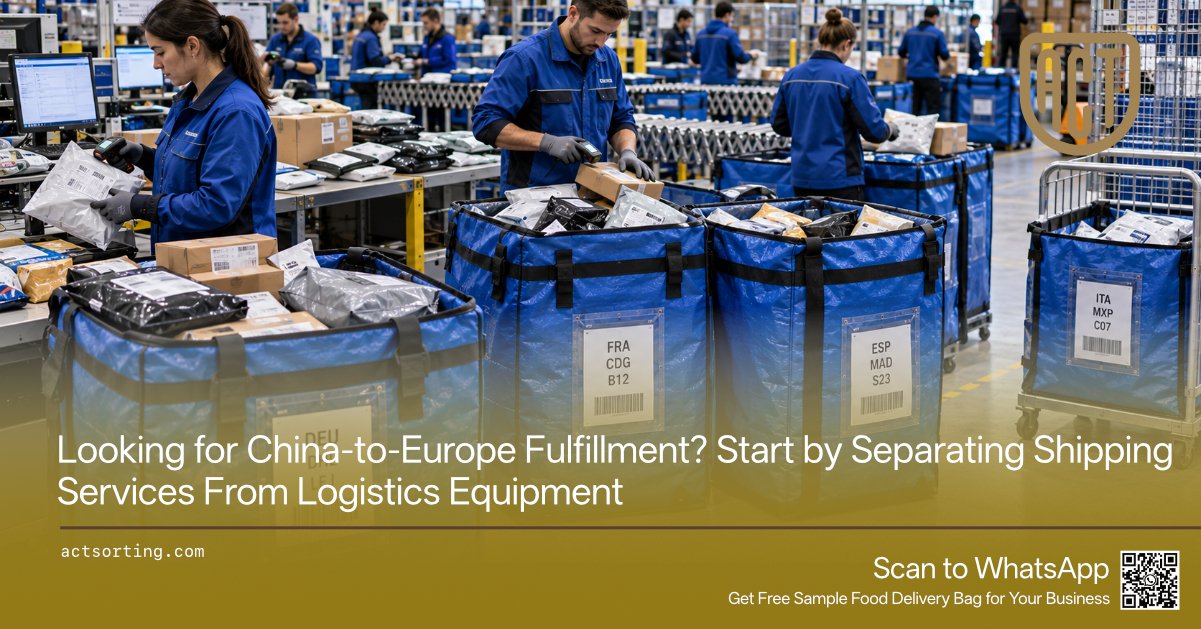
ACTSORTING’s role begins where the physical handling equipment is required. The fulfillment warehouse may use reusable E-commerce Shipping Bags to move hundreds of lightweight orders from picking to packing. A sorting center may use color-coded Parcel Sorting Sacks to separate Spain, France, Germany, and other destinations. A final-mile depot may use Courier Sorting Totes to organize routes before vans leave the station.
The freight forwarder moves the shipment through the network. ACTSORTING manufactures part of the equipment the network uses while doing it.
3. E-commerce Shipping Bags Still Matter Inside Cross-Border Fulfillment Networks
Clarifying that ACTSORTING is not a freight forwarder does not make E-commerce Shipping Bags irrelevant to cross-border commerce. In fact, large e-commerce logistics networks use reusable transport bags extensively before and after the international transportation stage.
Consider a fulfillment center processing thousands of fashion-accessory orders every day. Individual products may weigh only 200 grams or 500 grams. They are small enough to become difficult to manage when left loose during internal handling. Hundreds of small parcels need to move from picking zones to packing stations, from packing stations to destination sorting, and from sorting areas to outbound loading.
Reusable E-commerce Shipping Bags help turn those small parcels into larger controlled handling units. Instead of pushing hundreds of loose poly mailers through a warehouse, workers can group them by destination, carrier, dispatch wave, customer account, or service type.
For example, one Parcel Sorting Sack may contain orders destined for Spain. Another may contain orders assigned to a particular international line-haul departure. A third may contain parcels that have completed customs data checks and are ready for loading.
Transparent document pockets can carry destination labels, warehouse cards, barcode sheets, or internal route information. Different bag colors can represent different countries, carriers, or processing statuses. Reinforced handles allow bags to move between conveyors, carts, staging zones, and loading areas.
ACTSORTING can customize these E-commerce Shipping Bags according to warehouse requirements, including dimensions, PP woven or polyester materials, colors, closures, transparent label areas, reinforced bottoms, handles, QR-code panels, and logo printing.
The bag does not replace the freight service. It supports the warehouse that feeds the freight service.
4. Lightweight Orders Need Better Sorting Before They Ever Reach the Airline or Truck
Fashion accessories are a good example of why physical sorting equipment remains important even when individual parcel weights are low. A typical order may contain jewelry, small leather goods, scarves, phone accessories, or other compact products. The parcel may weigh between approximately 0.2 kg and 2 kg, yet a busy fulfillment center can process thousands of those parcels within a few hours.
Low parcel weight does not mean low operational complexity. Quite the opposite. A large carton containing one industrial component is easy to see and difficult to lose. A 300-gram poly mailer can disappear beneath another bag, enter the wrong sorting lane, or become mixed with another destination batch very easily.
Parcel Sorting Sacks and Courier Sorting Totes create physical separation between these orders. A fulfillment operator can assign one tote to a country, carrier, warehouse route, dispatch cut-off, or shipment status. Workers do not need to remember the destination of hundreds of individual parcels once those parcels have been grouped into the correct transport unit.
Bag size should match the parcel profile. An operation handling small fashion orders may prefer lightweight, tall sorting sacks with wide openings. A warehouse moving boxed accessories may need wider rectangular totes that remain more stable during handling.
ACTSORTING can also add transparent identification areas for barcode sheets or QR-based internal tracking. Permanent bag IDs can help the warehouse track reusable assets, while replaceable route cards identify the current batch.
This is the physical side of fulfillment that software dashboards tend to make invisible. The API may know exactly where Order 481729 is supposed to go, but somebody still has to move the actual parcel from one end of the building to the other without dropping it into the wrong sack.
5. Fulfillment Centers Depend on Reusable Bags, Totes, and Identification Systems
A fulfillment center is not simply a warehouse full of products. It is a flow system. Inventory arrives, gets stored, picked, consolidated, packed, sorted, staged, and dispatched. Every time an order moves between these stages, the facility needs some method of containing and identifying it.
Reusable logistics bags are useful because they can move with the order flow while remaining foldable when empty. This gives them an advantage over rigid bins in operations where storage space and return transport matter.
A fulfillment company serving multiple e-commerce sellers may use different colors for different accounts. Another operation may use one bag color for standard orders and another for priority dispatch. Transparent document pouches can carry temporary shipment information without permanently printing the customer data onto the bag.
QR-code or NFC identification can also support reusable asset management. The permanent tag identifies the tote itself, while the parcels inside continue using their own tracking numbers. These are separate systems and should remain separate. The courier tracking number identifies the shipment to the consumer. The tote ID identifies the warehouse equipment moving that shipment internally.
ACTSORTING supports OEM & ODM customization for these applications. Bag dimensions can match conveyors, carts, shelves, or van spaces. Closures can include zipper, hook-and-loop, flap, or open-top structures. Handles can be positioned according to lifting and dragging methods. Reinforcement can be added to bottom panels and high-stress areas.
For high-volume fulfillment companies, durability matters because the same tote may circulate repeatedly. A disposable bag can be cheaper per unit, but a reusable industrial sorting bag may lower equipment cost over many cycles while reducing packaging waste inside the operation.
This is the customer profile ACTSORTING is designed to serve: businesses that physically process and move large volumes of parcels, not merchants searching for an individual shipping label to Madrid.
6. Parcel Weight Tiers Affect Freight Rates, but They Also Affect Handling Equipment
Cross-border logistics companies often quote rates by chargeable weight bands. A buyer may request pricing at 0.5 kg, 1 kg, 2 kg, 3 kg, and 5 kg because this makes it easier to model average shipping cost across a product catalog.
ACTSORTING does not provide those transportation tariffs, but parcel weight data is still useful when designing logistics equipment.
A fulfillment operation handling mostly sub-1 kg fashion parcels may need a high-capacity sorting bag because many orders can fit inside one tote without creating an excessive lifting weight. The same bag filled with 5 kg orders would become impractical very quickly.
This is why a reusable E-commerce Shipping Bag should be designed around both parcel size and aggregate load. A bag that physically holds 40 orders may not be suitable if those orders create a 60 kg total load. Handle construction, webbing width, bottom reinforcement, and tote dimensions should reflect the maximum realistic filled weight.
Warehouse ergonomics matter too. Very large sacks may reduce the number of trips between sorting areas, but they can become difficult to move safely. Smaller Courier Sorting Totes may create more handling units but allow workers to lift and load them more comfortably.
ACTSORTING can adjust fabric weight, reinforcement, handles, and dimensions according to expected load. PP woven materials may suit high-volume lightweight parcel sorting, while 600D polyester structures may be useful where more shape and repeated handling are required.
The shipping provider uses weight tiers to calculate freight.
The equipment manufacturer uses them to understand what the warehouse is actually asking the bag to carry.
Same number, completely different job.
7. Tracking Numbers and APIs Move Data While Physical Bags Move the Orders
Modern e-commerce fulfillment relies heavily on data integration. Shopify orders can flow automatically into warehouse-management systems. Shipping labels are generated electronically. Tracking numbers return to the storefront. Customers receive delivery updates without manual intervention.
None of this removes the physical parcel.
An API can tell the warehouse that 327 orders are ready for dispatch to Spain, but those 327 packages still need to be picked up from packing stations, grouped correctly, moved into the outbound area, and loaded into the right transport unit.
This is where the digital and physical systems meet.
A reusable Parcel Sorting Sack can carry a large visible barcode corresponding to an internal dispatch batch. Workers scan the tote and associate it with the group of parcels inside. A transparent document pouch can hold a backup destination card. Color coding can provide visual confirmation before the bag enters the outbound lane.
ACTSORTING can manufacture QR-code areas, permanent serial numbering, transparent barcode pockets, and other identification features as part of the bag itself. The customer’s warehouse software or fulfillment platform determines how those codes are used.
ACTSORTING does not provide the Shopify API integration or automated order-processing software. That belongs to the fulfillment or warehouse technology provider. What ACTSORTING can provide is the physical tote that carries the identification point.
This separation is useful for procurement teams. Software requirements should be discussed with WMS, ERP, fulfillment-platform, or carrier-integration vendors. Physical bag requirements should be discussed with the logistics equipment manufacturer.
Trying to make one supplier provide both simply produces a very strange vendor meeting.
8. Reusable Logistics Bags Support High-Volume Fashion and Accessories Fulfillment
Fashion and accessories create a particularly suitable environment for reusable sorting bags. Orders are often lightweight, high in SKU count, relatively compact, and processed in large volumes. Peak periods can multiply daily order counts quickly.
A fulfillment warehouse may need to separate orders by country, carrier, cut-off time, marketplace, brand, returns status, or delivery service. Reusable E-commerce Shipping Bags allow the warehouse to create these categories without depending entirely on fixed shelving or rigid containers.
For example, blue bags may be assigned to one destination market while red bags represent urgent departures. Another customer may print large country codes such as ES, FR, DE, and IT on different sorting sacks. Transparent pockets can then hold detailed dispatch information that changes with every cycle.
The bags can be folded after dispatch and returned to the sorting area with relatively little storage volume. This is useful when demand changes between normal periods and promotional peaks.
ACTSORTING can produce these bags in custom dimensions, materials, colors, and structures. Reinforced webbing can support repeated movement. Zippers or hook-and-loop closures can protect contents during transport between facilities. Open-top designs may be selected where rapid sorting is more important.
Large fulfillment networks may also require standardization across multiple sites. The same bag dimensions, color system, label-pocket placement, and identification format can be repeated across different warehouses.
The value is operational consistency. Workers know what each bag represents. Supervisors can understand the sorting floor more quickly. Procurement teams manage fewer product variations. The physical system becomes easier to scale as order volume grows.
That is the ACTSORTING side of e-commerce fulfillment: not carrying one consumer parcel from Guangzhou to Barcelona, but manufacturing the reusable equipment that helps a fulfillment network process thousands of those parcels efficiently.
9. Buyers Should Choose the Right Partner for Each Part of the Supply Chain
A cross-border e-commerce operation usually needs several different suppliers, even when one logistics company packages many services together.
The seller or brand controls the product and customer relationship. Chinese suppliers manufacture or supply the goods. A fulfillment company may store inventory and process individual orders. A freight or e-commerce logistics provider transports parcels internationally. Customs specialists handle import requirements. Destination carriers complete the final mile. Technology platforms synchronize orders and tracking data.
ACTSORTING belongs in another category: logistics equipment manufacturing.
This distinction helps buyers ask better questions. If the priority is DDP rates for 0.5 kg parcels, speak with a cross-border carrier or freight provider. If the priority is Shopify API integration, speak with a fulfillment technology platform. If the priority is direct delivery through DPD or UPS, speak with a provider holding those carrier contracts.
If the warehouse needs 2,000 reusable sorting bags with custom dimensions, destination colors, QR-code pockets, reinforced handles, and repeated production consistency, speak with ACTSORTING.
Some businesses may need both. A fulfillment company may purchase ACTSORTING bags while separately contracting its international transport lines. A major e-commerce logistics provider may itself become an ACTSORTING customer because its warehouses need reusable sorting equipment.
This is the more accurate way to understand the industry. “Logistics” is not one service. It is several businesses chained together until a parcel appears at someone’s door.
Selecting specialized partners gives buyers better technical depth in each area instead of forcing one company to pretend it controls the entire chain.
10. ACTSORTING Focuses on the Physical Logistics Equipment Behind E-commerce Delivery
ACTSORTING has specialized in reusable logistics textile products since 2013. Its manufacturing facility in Yangchun, Guangdong, China covers more than 12,000 square meters and employs over 400 experienced workers. BSCI and ISO9001 certification support responsible manufacturing and consistent quality management.
The company manufactures E-commerce Shipping Bags, Parcel Delivery Bags, Parcel Sorting Sacks, Courier Sorting Totes, Van Loading Totes, reusable warehouse bags, and other customized logistics products for commercial operations.
OEM & ODM customization can include PP woven fabric, 600D polyester and other materials, dimensions, colors, logos, transparent document pockets, QR-code areas, serial numbering, handles, closure methods, reinforced bottoms, webbing structures, and foldable designs.
ACTSORTING’s customers are typically parcel delivery companies, e-commerce fulfillment centers, warehouse networks, courier operators, 3PL companies, distribution centers, retail logistics operations, and other businesses that physically handle large numbers of orders.
ACTSORTING is not a China-to-Spain DDP parcel line and does not provide individual freight tariffs, customs clearance, tax-inclusive consumer delivery, Shopify fulfillment integration, or last-mile carrier accounts. Those services should be sourced from qualified freight forwarders, fulfillment providers, and cross-border e-commerce logistics companies.
The distinction also explains the purpose of ACTSORTING’s E-commerce Shipping Bags. They are not a shipping service sold to consumers. They are reusable physical equipment designed to help warehouses sort, consolidate, transfer, stage, and deliver e-commerce parcels more efficiently.
For logistics companies building or expanding a fulfillment operation, ACTSORTING can develop bags around the actual workflow. Buyers can provide expected parcel dimensions, weight range, daily order volume, sorting method, warehouse layout, transport process, required identification system, target dimensions, material preference, colors, logo, and quantity.
The result can be a reusable sorting system designed around the physical side of fulfillment.
Because software can create the order, a carrier can transport the order, and an API can report where the order is.
Somebody still needs a reliable way to move 500 of those orders across the warehouse.
That is the problem ACTSORTING is built to solve.
FAQ
Q: Does ACTSORTING provide China-to-Europe DDP dropshipping services?
A: No. ACTSORTING is a logistics equipment manufacturer rather than a freight forwarder or dropshipping fulfillment provider. The company does not provide parcel-level DDP freight rates, customs clearance, tax-inclusive consumer delivery, or international last-mile carrier services.
Q: Does ACTSORTING provide Shopify or API fulfillment integration?
A: No. Shopify API connections, automated order processing, tracking synchronization, and shipping-label generation should be provided by a fulfillment platform, warehouse-management system, or cross-border logistics provider. ACTSORTING can manufacture physical bags with QR-code, barcode, or identification areas that work within those systems.
Q: What are ACTSORTING E-commerce Shipping Bags used for?
A: They are reusable logistics bags used inside warehouses, fulfillment centers, sorting hubs, courier networks, and delivery operations. They can group parcels by destination, route, carrier, dispatch wave, customer account, or processing status.
Q: Can ACTSORTING customize bags for lightweight e-commerce parcels?
A: Yes. Dimensions, materials, colors, closures, handles, reinforcement, label pockets, QR-code areas, logos, and other structures can be customized according to parcel size, aggregate bag weight, warehouse workflow, and expected order volume.
Q: Which businesses are the best fit for ACTSORTING?
A: ACTSORTING primarily serves parcel companies, e-commerce fulfillment centers, 3PL operators, courier networks, warehouse groups, distribution centers, and other commercial logistics operations that require reusable sorting and transport bags in quantity.