
Table of Contents
- The Last 50 Meters Can Become the Slowest Part of Parcel Delivery
- One Delivery Bag Can Consolidate Multiple Parcels for the Same Stop
- Clear Route Identification Helps Drivers Take the Correct Bag From the Van
- Reinforced Handles Make Multi-Parcel Doorstep Delivery Easier to Manage
- Secure Closures Help Prevent Small Parcels From Falling During the Walk
- Apartment Buildings and Offices Create Different Door-to-Door Delivery Challenges
- Foldable Delivery Bags Return to the Van Without Consuming Valuable Space
- OEM & ODM Customization Connects the Bag to the Courier’s Route Workflow
- ACTSORTING Builds Parcel Delivery Bags for Repeated Last-Mile Operations
- Consistent Bulk Production Supports Large Courier and Delivery Fleets
Introduction
A delivery van can arrive at the correct address on time and still lose several minutes before the customer receives the parcel.
The problem often appears during the final movement between the vehicle and the door. One customer may have three cartons and two poly mailers. An apartment building may contain several deliveries for different units. An office tower may require the driver to walk from the loading area through reception and into an elevator before reaching the recipient. Carrying everything by hand becomes awkward, while making several trips back to the van consumes route time.
This is the part of last-mile delivery that route-planning software cannot physically solve. The vehicle has already reached the stop. The parcels are already inside. Someone still needs to move them through the final 20, 50, or 100 meters.
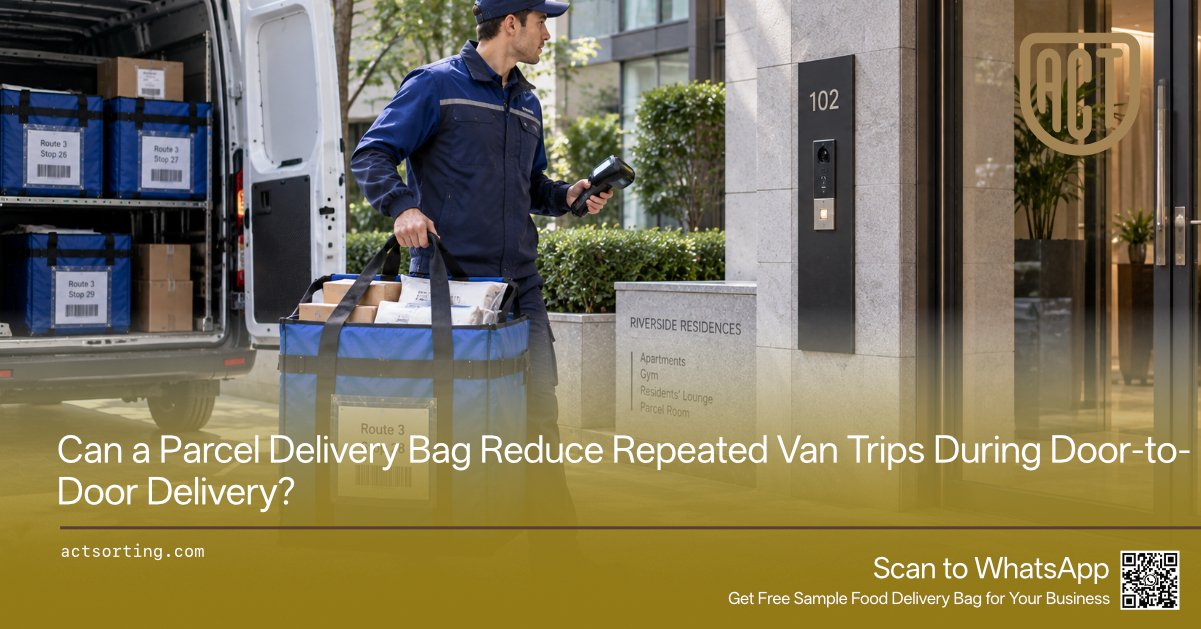
A Parcel Delivery Bag can turn several loose parcels into one manageable delivery unit. Packages assigned to the same customer, apartment building, office floor, or delivery cluster can be placed inside a reusable bag before the driver leaves the vehicle. Reinforced handles make the group easier to carry, a transparent identification pocket keeps the stop information visible, and a secure opening helps prevent smaller parcels from slipping out during movement.
For courier companies, e-commerce delivery fleets, postal operators, 3PL providers, parcel contractors, and Amazon DSP-style operations, the objective is not simply to put packages inside another bag. It is to reduce unnecessary movement between the van and the customer.
ACTSORTING has specialized in commercial logistics bags since 2013. The company operates a manufacturing facility covering more than 12,000 square meters in Yangchun, Guangdong, China, with more than 400 experienced workers. Supported by BSCI and ISO9001 certification, ACTSORTING provides OEM & ODM manufacturing for Parcel Delivery Bags, Last-Mile Delivery Totes, Courier Sorting Totes, Van Loading Totes, Parcel Sorting Sacks, and other reusable logistics solutions.
Customers can customize dimensions, woven materials, reinforced bottoms, handles, transparent route pockets, closures, colors, printing, barcode areas, webbing positions, and folding structures. The result can be developed around what actually happens after the driver parks the van.
1. The Last 50 Meters Can Become the Slowest Part of Parcel Delivery
Last-mile efficiency is often discussed in terms of route planning, vehicle density, stop sequence, and warehouse dispatch. Those factors matter, but the physical handoff at the destination can create its own delay. The driver parks, finds the correct parcels, carries them toward the building, confirms the customer, completes the delivery, and returns to the vehicle before continuing the route.
A single lightweight carton is easy. Problems appear when one stop includes several pieces. The driver may stack cartons against the chest, hook poly mailers around one arm, hold the scanning device in the other hand, and discover halfway to the entrance that one small package is no longer cooperating with the arrangement. The alternative is making two trips to the van.
Multi-unit buildings make the process harder. A driver may have six parcels for three apartments in the same building. Carrying them loosely creates confusion at the elevator or lobby, while returning to the vehicle after each unit wastes the advantage of serving several customers at one location.
A reusable Parcel Delivery Bag creates a simple physical grouping. Parcels belonging to the same stop or building can travel together from van to destination. The driver handles one identifiable unit rather than several independent packages.
ACTSORTING can customize the dimensions and carrying structure around the expected parcel profile. A delivery fleet handling mainly small e-commerce cartons may need a different bag from a courier service carrying larger mixed packages. The objective is to create enough capacity to reduce repeated trips without making the bag itself cumbersome.
2. One Delivery Bag Can Consolidate Multiple Parcels for the Same Stop
One customer does not always mean one parcel. E-commerce orders can arrive from different warehouses or sellers, creating several packages for the same delivery address. Offices, reception desks, apartment buildings, and residential communities can generate even larger parcel groups.
Loose parcels are harder to control because every item remains an independent delivery piece. A driver needs to confirm that all packages have been removed from the vehicle, carry them together, and make sure nothing is left in a lobby, elevator, or building entrance.
A Last-Mile Delivery Tote can consolidate those packages temporarily. Before leaving the vehicle, the driver places the parcels for the stop into one bag. Small cartons and mailers remain inside the same physical unit until the driver reaches the handoff location.
This can also support building-level delivery. Instead of treating six apartment packages as six completely separate movements from the van, the driver can carry one bag into the building and complete several unit deliveries from the same tote. The identification system can remain visible so the driver can confirm which parcels belong to which apartment or customer.
ACTSORTING can customize transparent document pockets, barcode areas, printed route numbers, or removable cards according to the courier’s workflow. Internal dividers can also be considered when the operation needs separation between several customers within one building.
The advantage is better control of the parcel group. The benefit is fewer loose pieces between the vehicle and the door and less reason to return to the van simply because the driver could not carry the entire stop comfortably the first time.
3. Clear Route Identification Helps Drivers Take the Correct Bag From the Van
A delivery bag only saves time if the driver can identify it quickly.
Inside a loaded van, several Parcel Delivery Bags may look identical. If the route information is hidden underneath the bag or attached through a small temporary tag, the driver may need to move multiple totes before locating the correct one.
A large transparent identification pocket creates a fixed location for stop information. Depending on the courier system, the pocket can hold a route card, building number, delivery zone, stop sequence, barcode, QR code, driver assignment, or other temporary information.
Placement matters. A pocket on the side may remain visible when several Van Loading Totes stand next to each other. A front-facing pocket can help during staging and doorstep handling. Some delivery fleets may benefit from identification on more than one panel so the bag remains readable regardless of how it is loaded.
Permanent information can remain separate from daily route information. The bag may carry a fixed asset number, depot code, or company marking while the removable card changes every route.
ACTSORTING can customize the size and position of these identification areas around the customer’s existing documents instead of expecting the delivery company to redesign its route labels around a generic bag.
This makes the physical delivery equipment easier to understand. The driver opens the van, identifies the correct bag, confirms the stop, and begins the delivery rather than moving four similar bags around like an unusually disappointing shell game.
4. Reinforced Handles Make Multi-Parcel Doorstep Delivery Easier to Manage
Handles determine whether a Parcel Delivery Bag remains convenient once it is actually loaded.
Several small packages may not be individually heavy, but their combined weight can become substantial. The driver may also carry the tote through a parking area, lobby, corridor, elevator, or long driveway before reaching the customer.
ACTSORTING can customize reinforced webbing handles according to expected load and carrying method. Longer handles may allow different grip positions, while shorter side handles can provide additional control when lifting the bag from a vehicle.
Webbing attachment is particularly important. The load should be distributed into reinforced sections of the bag instead of concentrating force around a small stitching area. Extended webbing can help transfer weight across the body and reduce stress around the upper panel.
The bag should also remain practical when the driver needs one hand for another task. Scanning devices, phones, access cards, intercom systems, doors, and customer verification all compete for the same limited number of human hands. A properly designed carrying system can make it easier to place the bag down and pick it up repeatedly throughout the stop.
The point is not to turn every delivery bag into a giant high-capacity sack. The product should match the parcel group the driver can reasonably manage. ACTSORTING can develop several coordinated sizes if the fleet handles both normal residential stops and larger building-level deliveries.
5. Secure Closures Help Prevent Small Parcels From Falling During the Walk
A Parcel Delivery Bag may contain cartons, flexible mailers, document envelopes, and small packaged items at the same time. Once the driver begins moving, those parcels shift with every step, turn, elevator entrance, and doorway.
An open tote makes loading fast but may not provide enough containment for every route. Smaller mailers can move upward between larger cartons, while a bag placed temporarily on the ground may tip or be handled from an awkward angle.
Closures can reduce this risk.
ACTSORTING can customize zipper openings, hook-and-loop flaps, covered tops, or other structures depending on how quickly the courier needs to access the contents. A driver making several deliveries inside one apartment building may prefer a closure that opens quickly and can be secured again without complicated fastening.
The opening itself should remain large enough for normal parcels. A secure bag is not useful if employees need to fight the closure every time a carton enters or leaves.
This balance between access and containment is why the product should be designed around the route. A courier carrying mostly poly mailers may need more top security than an operation handling larger cartons. A building-delivery tote may be opened repeatedly during one stop, while a single-customer delivery bag may remain closed until the driver reaches the door.
ACTSORTING’s OEM & ODM approach allows these requirements to influence the design before mass production. The closure becomes part of the delivery process rather than another feature added because the specification sheet looked lonely without it.
6. Apartment Buildings and Offices Create Different Door-to-Door Delivery Challenges
A suburban house, an apartment tower, and an office building may all appear as one stop in the route system, but they require very different physical delivery movements.
At a house, the distance from vehicle to door may be relatively short. The main value of a Parcel Delivery Bag is consolidating several packages and protecting smaller items during the walk.
Apartment buildings add lobbies, access control, elevators, corridors, and multiple delivery units. A driver may carry several customer parcels inside the same building before returning to the vehicle. The bag therefore needs clear internal or external identification and a manageable footprint for elevators and hallways.
Office towers create another pattern. Parcels may be delivered to a central reception desk, mailroom, individual office, or several departments. One building can generate a substantial number of packages, making a larger Courier Sorting Tote useful for moving the group from vehicle to reception.
ACTSORTING can customize bag dimensions around these environments. A tall narrow tote may move more easily through building corridors, while a wider bag may work better for centralized commercial deliveries. Transparent route pockets and internal dividers can help organize multiple recipients inside one building.
This is an important reason to choose a customizable Parcel Delivery Bag rather than treating every last-mile stop as physically identical. The delivery software may show one pin on the map. The driver experiences an actual building.
7. Foldable Delivery Bags Return to the Van Without Consuming Valuable Space
A reusable delivery tote becomes significantly less useful if it occupies the same volume after the parcels have been delivered.
During a route, the number of full bags gradually decreases. Empty equipment should therefore take up less space so the vehicle can remain organized and accommodate failed deliveries, customer returns, pickup parcels, or other route requirements.
Foldable Parcel Delivery Bags solve this problem better than rigid containers in many applications. Once the stop is complete, the driver can collapse the empty tote and return it to a designated section of the van.
ACTSORTING can customize flexible woven construction, fold lines, integrated securing straps, removable supports, and other structures according to the required storage method. Reinforced bottoms and wear zones can remain durable while the non-critical side panels stay flexible enough for compact storage.
This is especially useful for high-density residential routes where a driver may begin the day with many loaded Last-Mile Delivery Totes. As deliveries are completed, empty bags can be stacked or bundled rather than continuing to occupy valuable cargo volume.
Foldability also improves return logistics at the depot. Empty bags can be counted, inspected, stored, and redistributed without requiring the space of rigid plastic totes.
The bag therefore supports both halves of the route: carrying parcels outward and returning efficiently once empty. Reusable logistics equipment spends a surprisingly large amount of time carrying nothing, so designing that part properly is less silly than it sounds.
8. OEM & ODM Customization Connects the Bag to the Courier’s Route Workflow
Different parcel networks create different doorstep-delivery requirements. A postal operator carrying small packets has different needs from an e-commerce contractor handling mixed cartons. An urban courier serving apartments may prioritize compact dimensions, while a commercial route serving offices may need greater capacity.
ACTSORTING’s OEM & ODM process can begin with the actual route information: common parcel dimensions, average parcels per stop, maximum expected load, vehicle layout, delivery environment, carrying distance, closure preference, route label format, and current equipment problems.
From this information, the Parcel Delivery Bag can be customized in dimensions, woven material, lamination, bottom reinforcement, handles, webbing, transparent pockets, closures, colors, internal dividers, printing, route codes, and folding structure.
Existing bags can also provide useful evidence. If handles are failing, reinforcement can be reviewed. If the tote is too wide for apartment corridors, dimensions can change. If drivers cannot see route cards inside the van, the pocket can move. If small parcels fall out during walking, the closure can be redesigned.
This is the practical value of customization. The customer does not need to select a stock tote and redesign the delivery workflow around it.
ACTSORTING can develop the product around the delivery workflow instead.
9. ACTSORTING Builds Parcel Delivery Bags for Repeated Last-Mile Operations
A door-to-door delivery bag is not disposable packaging. It is reusable operating equipment that may move through the depot, van, customer building, doorstep, and back into the delivery network repeatedly.
ACTSORTING has specialized in commercial logistics bags since 2013. Its production facility in Yangchun, Guangdong covers more than 12,000 square meters and employs more than 400 experienced workers. BSCI and ISO9001 certification provide additional support for responsible manufacturing and structured quality management.
For courier and parcel delivery companies, the practical advantage is the ability to connect customization with commercial-scale manufacturing. Bag dimensions, handles, reinforcement, route pockets, colors, closures, webbing, printing, and folded structure can be confirmed during sampling and then carried into bulk production.
ACTSORTING can also develop coordinated bag families. A smaller Parcel Delivery Bag can support normal residential stops, while a larger Last-Mile Delivery Tote handles apartment buildings or commercial destinations with multiple parcels. Both can use the same identification layout, materials, color system, and branding.
This creates a more standardized equipment fleet and makes training easier. Drivers do not need to learn a completely different product every time capacity changes.
The reason to choose ACTSORTING is therefore not simply that the factory can manufacture a reusable parcel bag. It is the ability to translate last-mile operating problems into a repeatable product specification.
10. Consistent Bulk Production Supports Large Courier and Delivery Fleets
A delivery tote system becomes much harder to manage when every depot purchases slightly different bags.
One location uses a different pocket position. Another receives shorter handles. A later batch has different dimensions and no longer fits the same van layout. What began as one standardized tool gradually becomes several products sharing only a vague family resemblance.
Large courier networks need repeatability.
ACTSORTING can use the approved sample and confirmed technical specification as the reference for commercial production. Materials, finished dimensions, tolerances, handle length, webbing, reinforcement, closure, route pocket, colors, printing, folding method, and packaging can be defined before manufacturing.
This matters for repeat orders as well. Delivery fleets grow, peak seasons require additional equipment, new depots open, and existing bags eventually need replacement. New production should remain compatible with the equipment already in use.
ACTSORTING’s manufacturing capacity supports customized bulk orders, seasonal procurement, multi-depot programs, and repeat production. The same core design can also receive controlled variations for different route types without losing the overall equipment standard.
For courier companies, e-commerce delivery fleets, postal operators, DSP-style operations, and 3PL providers dealing with multi-parcel stops, apartment deliveries, repeated van trips, loose mailers, and difficult doorstep handling, the next bag project should begin with the final delivery movement rather than only the warehouse.
Provide common parcel dimensions, average parcels per stop, expected load, vehicle layout, delivery environment, carrying distance, handle requirements, closure preference, route label format, colors, logo, and target quantity to develop a customized Parcel Delivery Bag specification with ACTSORTING.
The van gets the parcel most of the way there.
A well-designed Parcel Delivery Bag helps the driver finish the part that still requires legs.
FAQ
Q: Can a Parcel Delivery Bag carry several packages for one customer?
A: Yes. The dimensions and reinforced carrying structure can be customized around the average parcel group and expected load, allowing multiple cartons, mailers, or small packages for the same stop to travel together.
Q: Is a Last-Mile Delivery Tote useful for apartment buildings?
A: Yes. Drivers can group several parcels for one building inside a reusable tote, carry them through the lobby or elevator, and complete multiple unit deliveries without returning to the vehicle after every customer.
Q: Can ACTSORTING add route labels, barcodes, or QR code pockets?
A: Yes. Transparent route pockets, permanent equipment IDs, barcode areas, QR code positions, depot codes, stop information, and other identification features can be customized according to the courier’s workflow.
Q: Can the Parcel Delivery Bag be folded after the delivery is completed?
A: Yes. Depending on the required structure, ACTSORTING can develop foldable woven bodies, reinforced wear zones, removable supports, and securing straps so empty bags consume less vehicle and depot storage space.
Q: Why choose ACTSORTING for last-mile Parcel Delivery Bags?
A: ACTSORTING has specialized in commercial logistics bags since 2013, operates a 12,000+ square meter manufacturing facility with more than 400 employees, holds BSCI and ISO9001 certification, and supports OEM & ODM development, customized bulk production, multi-depot programs, and repeat orders.