

Table of Contents
- Missing Logistics Bags Create a Larger Cost Than Their Purchase Price
- Reusable Parcel Delivery Bags Need a Clear Identity
- Warehouse and Depot Codes Prevent Bags From Moving Into the Wrong Network
- Transparent Label Holders Support Faster Bag Assignment
- Color-Coded Parcel Sorting Sacks Improve Visual Control
- QR Codes, Barcodes, and RFID-Ready Pockets Strengthen Asset Tracking
- Foldable Courier Sorting Totes Make Empty-Bag Returns More Efficient
- Standardized Designs Simplify Inventory Across Multiple Sites
- OEM & ODM Customization Builds a Better Bag Circulation System
- ACTSORTING Supports Stable Bulk Supply and Repeat Production
Introduction
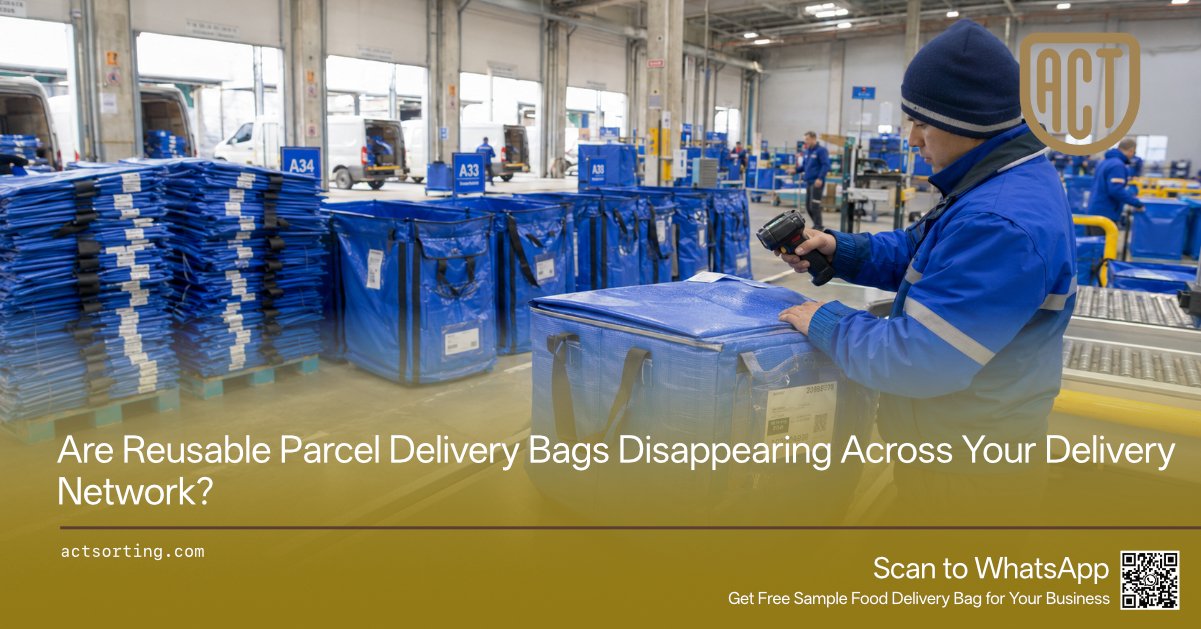
Reusable Parcel Delivery Bags are purchased to reduce packaging waste, improve parcel sorting, and support repeated warehouse and delivery cycles. In theory, the same bag should move from a sorting center to a delivery station, enter a van, complete a route, return empty, and become available for the next shift. The process sounds straightforward until the network expands across several warehouses, regional hubs, delivery depots, drivers, and third-party operators.
Then the bags begin to disappear.
Some remain inside delivery vans overnight. Some return to the wrong warehouse. Some are mixed with another contractor’s equipment. Some lose their identification labels and become anonymous stock. Others are left at temporary staging areas, customer collection points, or partner facilities. Procurement records may show that 8,000 bags were purchased, while the warehouse can physically locate only 6,300. Nobody knows exactly where the remaining units went, so another order is placed.
The replacement cost is only the beginning. Missing bags create shortages before dispatch, force workers to use unsuitable containers, weaken route standardization, and make warehouse inventory data unreliable. During peak seasons, delivery stations may have enough parcels, workers, and vehicles but not enough usable Parcel Delivery Bags to organize them properly.
A better reusable bag system needs more than durable fabric. Each bag needs a visible identity, a clear home location, a practical return process, and a design that supports scanning, counting, folding, storage, and redistribution. Warehouse codes, permanent printing, transparent label holders, QR codes, barcodes, color systems, and RFID-ready pockets can help logistics companies maintain better control over reusable assets.
ACTSORTING has specialized in industrial logistics bags since 2013. The company operates a manufacturing facility covering more than 12,000 square meters in Yangchun, Guangdong, China, with more than 400 experienced workers. ACTSORTING manufactures Parcel Delivery Bags, Parcel Sorting Sacks, Courier Sorting Totes, Last-Mile Delivery Totes, Van Loading Totes, and DSP Delivery Supplies for parcel carriers, e-commerce fulfillment centers, courier networks, postal operators, warehouse groups, and Amazon DSP-style delivery stations across Europe and North America.
Supported by BSCI and ISO9001 certification, ACTSORTING provides OEM & ODM manufacturing services covering fabrics, dimensions, colors, logos, warehouse codes, transparent label holders, barcode windows, closures, handles, reinforced structures, folding designs, packaging, and large-volume repeat production.
A reusable bag only creates value when the delivery network can find it, identify it, return it, and use it again.
1. Missing Logistics Bags Create a Larger Cost Than Their Purchase Price
When a reusable Parcel Delivery Bag goes missing, procurement usually sees the problem as a replacement cost. One unit disappears, so one unit must eventually be purchased again. The actual operating cost is usually much larger.
A missing bag reduces available sorting capacity. If a delivery station expects 500 bags for the morning dispatch but can locate only 430, workers must search storage areas, check vans, borrow stock from another route, or use temporary sacks that do not match the normal system. Each workaround consumes labor before the first vehicle leaves.
The shortage may also disrupt route identification. Standard Parcel Sorting Sacks may have specific colors, label pockets, printed numbers, and dimensions. Temporary replacement bags may not follow the same design. Workers then need handwritten labels, adhesive tape, or verbal instructions to keep routes separate. These improvised systems are more likely to create loading errors.
Inventory reporting becomes unreliable as well. One site may believe it has 700 Courier Sorting Totes because that number appears in the purchasing record, while only 520 are physically available. Another warehouse may unknowingly hold bags belonging to neighboring stations. Managers cannot plan replenishment accurately because nobody has a trustworthy count.
Consider a network with 20 delivery stations, each losing an average of only five reusable bags per month. That becomes 1,200 missing units in one year. The business pays for replacement stock, additional shipping, emergency purchasing, warehouse investigation, and the operational disruption created by shortages.
The problem becomes more visible during Black Friday, Christmas, Prime Day, major promotions, or regional parcel surges. A company may discover that its theoretical bag inventory looks sufficient, but the bags are distributed incorrectly across depots or cannot be located quickly enough.
ACTSORTING can manufacture Parcel Delivery Bags with permanent site codes, serial number areas, printed ownership information, large identification panels, transparent asset cards, barcode pockets, and color-coded structures. These features make each bag easier to assign and trace.
The material and construction still need to support repeated use. Reinforced woven fabrics, reliable handles, strong seams, and protected bottoms help the bag remain in circulation longer. However, physical durability alone cannot prevent asset loss. A bag may survive 500 handling cycles and still disappear after cycle twelve because nobody knows which depot owns it.
The real value of a reusable Parcel Delivery Bag comes from both product life and circulation control. A durable bag that stays inside the system lowers replacement frequency, protects standardized operations, and gives procurement teams a more accurate picture of available equipment.
2. Reusable Parcel Delivery Bags Need a Clear Identity
A reusable logistics bag without permanent identification is easy to lose. Once the removable route card is taken out, the bag may look identical to thousands of other totes circulating across the network.
This is particularly risky when parcel delivery companies work with regional hubs, subcontracted fleets, temporary warehouses, or shared loading areas. Bags from different operators may sit beside each other during transfer. If the only identification is a paper card, one missing label can turn company-owned equipment into anonymous warehouse stock.
A clear identity begins with permanent information. The Parcel Delivery Bag can carry the company logo, warehouse code, depot number, asset category, return instructions, serial number area, or printed ownership statement. These details remain visible even when route labels are removed.
For example, a courier network may use a code such as UK-LON-04-01572. The first section identifies the country, the second identifies the city, the third identifies the depot, and the final number identifies the individual bag. A simpler system may use only a warehouse code and batch number. The correct level depends on how closely the customer wants to track each unit.
ACTSORTING can apply permanent identification through screen printing, heat-transfer printing, sewn labels, transparent ID windows, printed fabric panels, or other customized methods. The location should remain visible during stacking, folding, and van loading.
The bag’s identity should be separate from its temporary route assignment. A route card may change every day, but the ownership code remains fixed. This allows warehouse workers to understand both where the bag belongs permanently and which route it serves during the current shift.
The design also needs to survive repeated folding and abrasion. A printed code placed directly on a high-friction bottom panel may wear too quickly. An ownership label hidden beneath a handle may be difficult to scan. ACTSORTING can position permanent identification on protected upper or side panels according to the handling method.
A clear identity improves recovery. If a bag reaches the wrong depot, workers can identify its original location and return it. If empty totes are collected from delivery vans, the warehouse can sort them by ownership. If several contractors share a facility, equipment is less likely to become mixed.
The advantage is better visibility. The benefit is lower asset loss, easier depot reconciliation, and more accurate inventory. The evidence appears when fewer bags remain in the vague administrative category known as “probably somewhere in the network.”
3. Warehouse and Depot Codes Prevent Bags From Moving Into the Wrong Network
Multi-site logistics systems often struggle with equipment migration. Bags leave one warehouse, travel through regional hubs, enter delivery vans, return through another depot, and gradually settle in the wrong location.
This does not always look like a loss because the bag still exists somewhere inside the company. The problem is that the original site cannot use it. One warehouse develops a shortage while another unknowingly accumulates excess stock. Procurement may order more bags even though the network already owns enough units overall.
Warehouse and depot codes create a visible home location for every Parcel Delivery Bag. A large printed code can tell workers where the bag should return after use. Color panels can support regional identification, while smaller route labels handle daily assignments.
For example, a national delivery network may assign blue bags to northern depots and green bags to southern depots. Each bag then carries a more specific code such as N-07 or S-12. When empty bags return to a central hub, workers can sort them quickly without checking a long database record.
ACTSORTING can customize large warehouse codes on the front, side, or top panel. The code may be printed in contrasting colors for fast recognition. Transparent pockets can hold additional depot cards, while barcodes or QR codes provide digital confirmation.
The same system helps during inter-site transfers. If one warehouse temporarily lends 300 Courier Sorting Totes to another location for a holiday surge, the original ownership remains visible. After the peak ends, the receiving site can identify which bags need to be returned.
Depot coding also supports subcontractor management. An Amazon DSP-style network may have several delivery partners operating from the same station. Bags can carry contractor codes, fleet numbers, or service areas to prevent equipment from moving into another operator’s stock.
The size and placement of the code should match the warehouse environment. Small text may work on a spreadsheet but fail inside a busy loading bay. Workers need to identify the home location from several meters away, especially when totes are stacked or staged in rows.
The practical advantage is faster sorting of empty equipment. The wider benefit is a more balanced inventory across the network. Instead of purchasing new bags whenever one depot runs short, managers can locate and redistribute existing stock.
A delivery network already knows where every parcel should go. Applying the same basic idea to reusable bags is not exactly revolutionary, but apparently it still needs saying.
4. Transparent Label Holders Support Faster Bag Assignment
Permanent identification tells workers who owns the bag. Temporary labels tell them what the bag is doing today.
A Parcel Delivery Bag may serve Route 14 in the morning, a return collection in the afternoon, and a different delivery zone the next day. Transparent label holders allow warehouse teams to change these assignments without printing directly on the bag.
The holder can carry route cards, driver IDs, vehicle numbers, warehouse transfer documents, barcode sheets, stop ranges, dispatch waves, or return instructions. The information stays attached to the tote as it moves through sorting, staging, loading, delivery, and empty return.
Poor pocket design can create problems. If the holder is too small, documents fold or become difficult to scan. If it is too deep, the route number disappears below the visible area. If the opening faces the wrong direction, cards may fall out when the bag is dragged. If the transparent material becomes cloudy, scanners may struggle to read barcodes.
ACTSORTING can customize the size, orientation, position, material, and opening direction of transparent label holders. Small card windows may suit simple route codes. Larger pockets can hold A4 transfer documents or delivery manifests. Some customers need label holders on two sides so the bag remains identifiable from both the staging lane and the van shelf.
The pocket should work with the handles and closure. A flap should not cover the label. A lifting strap should not bend the barcode sheet. A side pocket should remain visible after the bag is loaded beside another tote.
Transparent holders can also support bag asset cards. A permanent card may contain the serial number, home depot, inspection date, or ownership information. A second temporary pocket can carry daily route data.
This layered identification improves control. Workers can see both the fixed identity and current assignment without opening the bag. Supervisors can check staging lanes faster. Drivers can confirm the correct route group before loading.
The benefit is fewer misplaced totes and more accurate bag assignment. The evidence appears when workers spend less time rewriting lost labels, checking unknown bags, or asking nearby colleagues whether anyone remembers where a particular blue sack came from.
5. Color-Coded Parcel Sorting Sacks Improve Visual Control
Color is one of the fastest forms of warehouse communication. Workers can recognize a color category before they are close enough to read a printed code or scan a barcode.
Color-coded Parcel Sorting Sacks can identify regions, depots, parcel statuses, service levels, routes, contractors, or ownership groups. The exact system depends on the customer’s network.
A company may use blue for standard outbound delivery, green for returns, red for priority shipments, gray for failed deliveries, and yellow for same-day routes. A multi-region network may assign different base colors to geographical areas. A shared warehouse may use colored webbing or edge binding to distinguish contractors while keeping the main bag body consistent.
ACTSORTING can customize body fabric, webbing, edge binding, handles, printed panels, and closure components according to the required visual system. Customers may provide approved color samples, Pantone references, existing bags, or brand guidelines.
Color consistency matters across repeat orders. If one batch arrives in dark navy and another in bright royal blue, workers may wonder whether the difference represents a new category. Multi-site networks need the same visual rules at every location.
Material type also affects appearance. The same shade may look different on PP woven fabric, laminated fabric, polyester webbing, zipper tape, and printed ink. These components should be reviewed together during sampling.
Color should support, not replace, detailed identification. A blue bag may indicate standard outbound delivery, while its transparent card holder displays Route 46 and Vehicle 12. The color provides quick general recognition, and the label provides exact information.
This system is particularly useful when empty bags return from delivery routes. Workers can separate them by category or home depot before checking individual codes. Temporary employees also learn visual rules more quickly than complex lists of bag numbers.
The advantage is faster recognition. The benefit is less mixing, easier training, and more efficient empty-bag sorting. The evidence appears in cleaner staging areas and fewer units drifting between categories.
Humans are very good at noticing that one red bag is sitting inside a row of blue bags. It would be wasteful not to exploit one of the species’ more reliable talents.
6. QR Codes, Barcodes, and RFID-Ready Pockets Strengthen Asset Tracking
Visual identification improves bag control, but larger networks may need digital tracking as well. QR codes, barcodes, and RFID-ready pockets can connect each reusable Parcel Delivery Bag to an asset management system.
A barcode or QR code can identify the bag, home depot, purchase batch, inspection history, assigned route, or current location. Workers may scan the bag when it leaves the warehouse, enters a van, returns empty, moves between sites, or requires repair.
This creates a clearer circulation record. Managers can see which depots return bags slowly, which routes experience high loss, and which assets remain outside the normal cycle for too long. Procurement teams gain better data for replenishment rather than relying only on purchasing records.
ACTSORTING can provide printed barcode areas, transparent scanning windows, sewn label panels, protected QR code positions, or pockets designed to hold customer-provided RFID tags. The factory does not need to supply the tracking system itself to make the bag compatible with one.
Placement is important. A barcode on the bottom may become scratched. A QR code hidden beneath a flap slows scanning. An RFID tag placed too close to metal vehicle components may perform differently depending on the application. Customers should test the preferred tracking technology within the real warehouse and delivery environment.
The tag or code also needs to survive folding, abrasion, moisture, and repeated handling. A replaceable transparent pocket may suit operations where labels change. Permanent printed codes work better when each bag needs a fixed identity.
Digital tracking does not eliminate the need for clear visual design. Workers still need colors, depot codes, and readable route cards when scanners are unavailable or the operation is moving quickly. The strongest system combines human-readable identification with machine-readable records.
The advantage is better data. The benefit is lower asset loss, more accurate depot inventory, improved maintenance planning, and clearer accountability. The evidence comes from tracking how many bags leave, how many return, and where delays occur.
When a delivery network scans a five-dollar parcel twelve times but never records the reusable tote carrying fifty parcels, the equipment policy may deserve a small rethink.
7. Foldable Courier Sorting Totes Make Empty-Bag Returns More Efficient
The return journey determines whether a reusable bag truly becomes reusable. If empty bags are difficult to store, load, or transport, they remain inside vans, accumulate at depots, or move slowly back to the original warehouse.
Foldable Courier Sorting Totes reduce the volume of empty equipment. After the parcels are delivered, drivers can collapse the bag, stack it with other empty units, and create space for returns, failed deliveries, or customer pickups.
At the depot, folded bags can be bundled by route, warehouse code, contractor, or ownership group. Hundreds of empty Parcel Sorting Sacks can fit onto pallets or shelves in a much smaller area than rigid containers.
This improves inter-site redistribution. If one delivery station has excess stock and another faces a shortage, folded bags require less transport capacity. A central hub can collect empty units from several routes, sort them by depot code, and return them in compact loads.
ACTSORTING can customize folding structures, integrated straps, bundle loops, folded dimensions, pallet quantities, and packing methods. The bag needs to collapse efficiently without weakening its seams or becoming unstable during loading.
Material selection matters. A fabric that is too stiff may resist folding, while a fabric that is too soft may collapse during parcel loading. The design can balance foldability with practical structure through reinforced openings, removable panels, edge binding, and targeted support.
Permanent ownership codes should remain visible even when the bag is folded. This allows warehouse teams to sort empty units without reopening every tote. Colored webbing or printed side panels can also support fast return classification.
The advantage is lower empty-return volume. The benefit is faster bag circulation, less van congestion, and reduced warehouse storage pressure. The evidence appears in shorter return cycles and fewer bags remaining inside vehicles between shifts.
A reusable bag trapped in the back of a van for three weeks is technically still reusable, in the same way an unread book is technically educational. Circulation is what turns potential value into actual value.
8. Standardized Designs Simplify Inventory Across Multiple Sites
Bag tracking becomes much harder when every warehouse uses different sizes, colors, closures, label holders, and identification methods. Procurement records may list dozens of similar models that cannot be exchanged easily between sites.
Standardization reduces this complexity. A logistics network may approve several core products: a small Courier Sorting Tote, a medium Parcel Delivery Bag, a large Parcel Sorting Sack, and a rectangular Van Loading Tote. Each model can follow the same visual and identification system.
For example, every bag may use the same upper-front transparent label holder, permanent depot code position, ownership logo, barcode area, and color logic. The dimensions differ according to capacity, but workers still recognize the family of products.
This makes inventory easier to count and redistribute. Warehouses can report stock by model and depot code. Replacement bags remain compatible with existing shelves, vans, route systems, and training materials. One site can lend stock to another without introducing unfamiliar equipment.
ACTSORTING can maintain approved dimensions, tolerances, materials, colors, printing, pockets, handles, closures, reinforcement, and packaging across repeat production. This consistency is essential for long-term bag programs.
Standardization also simplifies inspection. Warehouse teams can define expected wear points, repair criteria, and retirement conditions for each model. Damaged bags can be removed from circulation according to a common rule instead of local opinion.
New warehouse launches become easier because the site receives an existing equipment system. Workers can be trained using the same color codes, label formats, and bag identities already used elsewhere.
The advantage is fewer product variations. The benefit is clearer purchasing, easier inventory management, faster cross-site transfers, and stronger asset control. The evidence appears when procurement can answer basic questions such as how many usable bags exist, where they are located, and which model needs replenishment.
Without standardization, a multi-site bag inventory can slowly become a textile museum containing seventeen slightly different answers to the same operational problem.
9. OEM & ODM Customization Builds a Better Bag Circulation System
A useful reusable bag program should be designed around the entire circulation cycle, not only the outbound journey. The supplier needs to understand how the bag is assigned, loaded, transported, emptied, folded, counted, returned, stored, inspected, and reused.
ACTSORTING can begin an OEM & ODM project from existing samples, technical drawings, depot maps, route documents, van measurements, tracking requirements, current loss records, or photographs of the existing equipment.
The design may include permanent warehouse codes, removable route labels, transparent barcode windows, QR code panels, RFID-ready pockets, color-coded webbing, ownership printing, return instructions, folding straps, reinforced handles, and abrasion-resistant bottoms.
For example, a customer losing bags between five regional depots may need a visible home-site code on two sides, a permanent QR code position, different colored webbing for each region, and an integrated strap that keeps empty bags folded during return transportation.
Another customer may need each Van Loading Tote to carry a unique serial number while route cards change daily. The product can combine permanent printed identification with a separate transparent assignment pocket.
The sample should be tested through the full cycle. Workers should assign it, scan it, load parcels, place it inside a van, unload it, fold it, bundle it, scan it again, and return it to storage. This reveals whether labels remain visible, handles stay accessible, and codes survive real handling.
Once approved, the technical specification should control bulk production. Material, dimensions, colors, code positions, pocket sizes, printing, closures, handles, reinforcement, folded size, and packaging need to remain consistent.
The advantage is a product built around circulation. The benefit is lower asset loss, shorter return cycles, better inventory data, and more reliable reusable equipment availability. The evidence appears in the percentage of bags returning to their assigned depot within the expected period.
OEM & ODM should not stop after selecting a logo color. The real work begins when the bag leaves the factory and enters a network full of vehicles, shifts, warehouses, contractors, and human beings who are very capable of putting things in surprising places.
10. ACTSORTING Supports Stable Bulk Supply and Repeat Production
ACTSORTING has manufactured industrial logistics bags since 2013. The company produces Parcel Delivery Bags, Parcel Sorting Sacks, Courier Sorting Totes, Last-Mile Delivery Totes, Van Loading Totes, and DSP Delivery Supplies for parcel carriers, courier fleets, e-commerce fulfillment centers, postal operators, warehouse groups, 3PL providers, retail distribution systems, and Amazon DSP-style delivery stations.
Its manufacturing facility in Yangchun, Guangdong covers more than 12,000 square meters and employs more than 400 experienced workers. BSCI and ISO9001 certification support responsible manufacturing and stable quality management.
For reusable bag circulation projects, customers can provide current bag samples, required dimensions, average load, warehouse and depot codes, route card formats, barcode or QR code requirements, RFID tag dimensions, preferred colors, logo artwork, closure preferences, expected order quantity, and current bag-loss problems.
ACTSORTING can customize fabric material, dimensions, body colors, webbing colors, permanent printing, transparent label holders, barcode windows, QR code panels, RFID-ready pockets, warehouse codes, asset number areas, closures, handles, bottom reinforcement, folding straps, packaging, and carton labels.
Large-volume production consistency is essential. A bag tracking system becomes unreliable if later batches place codes in different positions, use different colors, or change label holder dimensions. The approved sample and technical specification should remain the production reference for repeat orders.
ACTSORTING can support initial development, pilot batches, bulk production, new depot launches, seasonal expansion, replacement stock, and long-term standardized bag programs. Stable manufacturing capacity allows customers to expand the same system across multiple warehouses and delivery stations.
The company’s OEM & ODM capability also allows customers to improve existing designs. If current bags disappear because ownership labels are too small, the identification panel can be enlarged. If empty totes remain in vans because they are difficult to fold, integrated straps can be added. If depots cannot scan bags quickly, the barcode or QR code location can be redesigned.
For logistics networks facing repeated bag loss, depot shortages, inaccurate reusable asset records, slow empty returns, or mixed equipment between contractors, the solution should begin with a clear circulation system.
Provide the target dimensions, bag type, depot structure, tracking method, identification requirements, return process, expected quantity, and current pain points to receive a customized manufacturing proposal.
A reusable Parcel Delivery Bag should not become a recurring purchase because the network keeps losing it. It should return, fold, scan, and re-enter service until its actual working life is complete.
FAQ
Q: Can ACTSORTING add permanent serial numbers or depot codes to Parcel Delivery Bags?
A: Yes. Bags can include printed serial number areas, warehouse codes, depot IDs, ownership information, batch numbers, logos, and other permanent markings according to the customer’s tracking system.
Q: Can QR codes, barcodes, or RFID tags be used with Courier Sorting Totes?
A: Yes. ACTSORTING can provide printed code areas, transparent scanning windows, sewn identification panels, and RFID-ready pockets designed to hold customer-provided tracking tags.
Q: Are foldable Parcel Sorting Sacks easier to return between warehouses?
A: Yes. Foldable bags consume less vehicle and storage space when empty. Integrated straps, visible depot codes, and standardized folded dimensions can make collection, sorting, and redistribution more efficient.
Q: Can different colors identify warehouses, contractors, or bag categories?
A: Yes. Customers can customize body fabric, webbing, edge binding, handles, printed panels, and category markings to create a consistent color-coded system across multiple sites.
Q: Can ACTSORTING maintain the same identification design for repeat orders?
A: Yes. Approved colors, dimensions, code positions, label holders, pockets, printing, handles, closures, folding structures, and packaging can remain as production references for future bulk orders.