
Table of Contents
- Weather Exposure Begins Before the Delivery Van Leaves
- Wet Parcel Bags Create More Than a Packaging Problem
- Laminated Woven Materials Help Control Moisture and Dirt
- Covered Openings Protect Parcels During Outdoor Staging
- Clear Label Holders Must Remain Readable in Bad Weather
- Reinforced Bottoms Matter on Wet Concrete and Metal Ramps
- Practical Handles Improve Control on Slippery Loading Bays
- Foldable Weather-Ready Totes Simplify Storage and Return Trips
- OEM & ODM Customization Matches Different Regional Climates
- ACTSORTING Supports Reliable Bulk Production for Delivery Networks
Introduction
Parcel delivery does not happen entirely inside a clean, temperature-controlled warehouse. Bags are moved through open loading bays, parked beside vans, dragged across damp concrete, exposed to rain during route preparation, and sometimes left temporarily on wet pavements while drivers reorganize a vehicle. In colder regions, the same Parcel Delivery Bag may also encounter snow, road salt, slush, and repeated movement between heated warehouses and freezing outdoor conditions.
These conditions create risks that are easy to underestimate during purchasing. A bag may perform well during an indoor sample review but behave very differently after its fabric becomes wet, its transparent label pocket is covered with droplets, or its bottom absorbs dirt from a loading bay. Parcels may remain physically inside the bag, yet cartons soften, route cards become difficult to scan, closures lose efficiency, and workers handle the equipment more slowly because the wet surface is harder to grip.
For parcel delivery companies, e-commerce fulfillment centers, courier fleets, regional distribution hubs, postal operators, and Amazon DSP-style delivery stations, weather exposure affects both package protection and warehouse productivity. A suitable Parcel Delivery Bag should help shield parcels during temporary outdoor handling, keep route information visible, resist abrasion on wet surfaces, remain practical to carry, and dry or clean without becoming unusable after one difficult shift.
ACTSORTING has specialized in industrial logistics bags since 2013. The company operates a manufacturing facility covering more than 12,000 square meters in Yangchun, Guangdong, China, supported by more than 400 experienced workers. Its product range includes Parcel Delivery Bags, Parcel Sorting Sacks, Courier Sorting Totes, Last-Mile Delivery Totes, Van Loading Totes, and DSP Delivery Supplies for commercial delivery operations across Europe and North America.
Supported by BSCI and ISO9001 certification, ACTSORTING provides OEM & ODM manufacturing services covering fabric materials, laminated surfaces, custom dimensions, colors, logo printing, transparent label holders, weather-protective flaps, zipper and hook-and-loop closures, handle positions, reinforced bottoms, folding structures, and large-volume repeat production.
The goal is not to claim that a textile bag can turn a loading bay into a sealed building. It is to reduce the damage, confusion, and wasted handling that occur when ordinary logistics equipment meets ordinary bad weather.
1. Weather Exposure Begins Before the Delivery Van Leaves
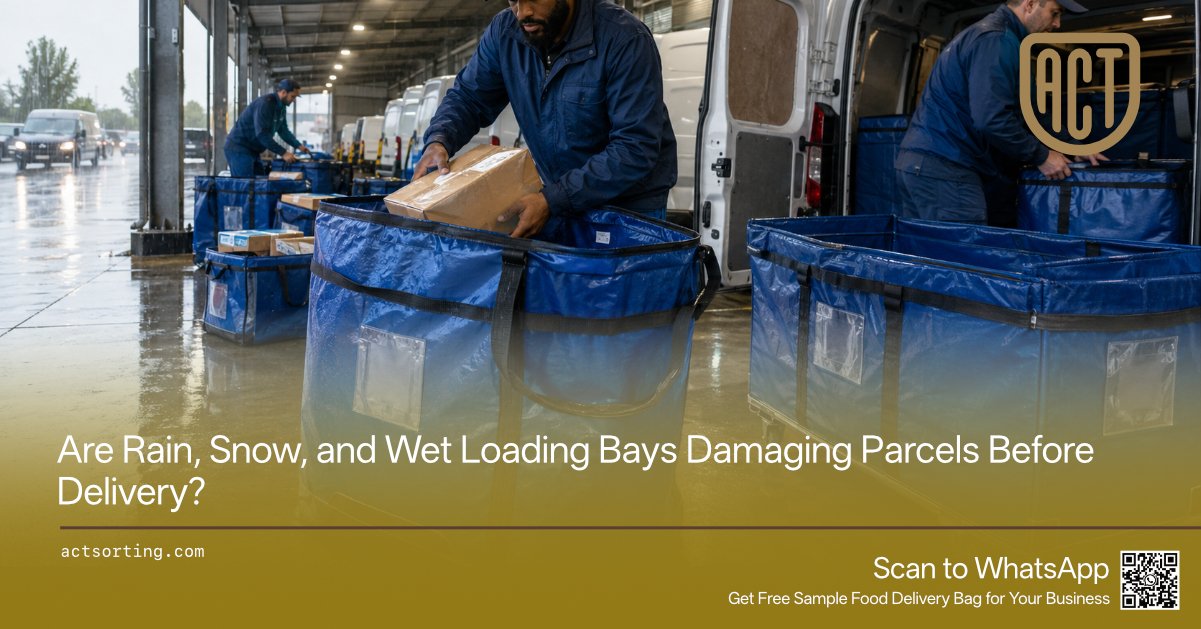
Many parcel protection problems begin at the delivery station rather than on the road. During busy morning dispatch, bags may wait beside open loading doors while vans are positioned. Workers move Parcel Sorting Sacks from indoor lanes to outdoor staging areas, scan route labels, rearrange vehicle loads, and temporarily place bags on concrete while another route clears the dock.
A short period of rain can affect hundreds of bags at once. Water collects on exposed openings, runs down the fabric, reaches paper labels, and transfers dirt from the floor onto the bottom panels. If the staging area is crowded, workers may not have enough covered space to move every route bag back indoors.
Snow and slush create another type of problem. A Van Loading Tote may be dragged across wet ramps and then placed directly onto a vehicle shelf. Moisture and road dirt enter the van, where parcels continue moving for several hours. In colder climates, repeated freezing and thawing can also affect low-quality coatings, transparent plastics, and closure components.
A weather-aware Parcel Delivery Bag cannot remove these conditions, but it can reduce exposure. Laminated woven fabric provides a smoother surface that is easier to wipe clean than untreated textile material. Covered openings help limit direct rain entry. Reinforced bottom panels reduce the effect of wet floor abrasion. Protected transparent pockets keep route documents more readable.
ACTSORTING can customize Parcel Delivery Bags according to the amount of outdoor exposure in the customer’s operation. A fully indoor fulfillment center may need only basic dirt resistance. A courier depot with open loading bays may benefit from laminated fabric and covered label holders. A last-mile fleet operating in frequent rain may require a larger flap, more secure closure, and additional bottom protection.
The advantage is more reliable performance when the loading environment changes. The benefit is fewer wet cartons, fewer unreadable route cards, and less time spent moving parcels into replacement bags. The evidence appears on days when bad weather arrives and the dispatch process continues without every worker suddenly searching for plastic sheets and adhesive tape.
2. Wet Parcel Bags Create More Than a Packaging Problem
A wet Parcel Delivery Bag does not only threaten the packages inside. It affects handling, scanning, storage, cleaning, and reuse.
When woven fabric becomes saturated, the bag may feel heavier and less stable. Workers grip handles more carefully, especially when gloves or hands are already wet. The bag may transfer water and dirt onto warehouse floors, van shelves, other totes, and workers’ clothing. If equipment is folded and stored before drying, odor, staining, and material deterioration may develop over time.
Paperboard cartons are particularly vulnerable. A parcel may not be directly soaked, but repeated contact with damp bag surfaces can soften the outer box. Labels may lift, corners may deform, and customers may receive packaging that looks damaged even when the product remains intact. This creates complaints, extra inspection, and questions about whether the shipment was mishandled.
Wet route information causes a separate operational delay. A paper card inside an unprotected holder may wrinkle or become unreadable. Scanners struggle with water droplets and cloudy plastic. Workers remove the card, wipe it, replace it, or manually confirm the route. Each step is small, but it repeats across many bags.
ACTSORTING can use laminated PP woven materials, coated fabrics, protected document windows, and customized closure systems to improve resistance to temporary weather exposure. These options should be selected according to the actual environment rather than described carelessly as completely waterproof in every possible condition. A bag moving through light rain needs a different solution from one expected to remain outdoors for extended periods.
The bag design should also support cleaning and drying. Smooth laminated surfaces are easier to wipe. Wide openings allow air circulation after use. Foldable structures can be opened for inspection instead of trapping moisture inside tightly compressed layers.
The practical value is a shorter recovery process after wet-weather operations. Workers spend less time separating damp equipment, cleaning dirty bags, replacing damaged labels, or explaining why one route arrived in packaging that looked as if it had crossed a river without a bridge.
3. Laminated Woven Materials Help Control Moisture and Dirt
Material selection determines how a Parcel Delivery Bag responds to rain, dirt, abrasion, and repeated cleaning. Standard woven fabric may provide strength and flexibility, but an added laminated surface can improve moisture resistance and make the bag easier to maintain.
Lamination creates a smoother outer layer that helps water remain on the surface rather than immediately entering the weave. It also reduces the amount of warehouse dust, mud, and road dirt trapped between fibers. After a wet shift, workers can wipe the surface more easily before the bag returns to storage or another route.
The correct material still depends on the operation. A lighter laminated PP woven fabric may suit high-volume Parcel Sorting Sacks that need to remain foldable and easy to handle. A denser woven structure may be better for Courier Sorting Totes exposed to repeated floor dragging. Coated bottom sections may provide additional protection without making the entire bag unnecessarily stiff.
Material weight alone does not guarantee performance. Lamination quality, seam construction, coating adhesion, folding behavior, and edge protection all matter. A poorly applied surface may crack after repeated folding or separate around stress points. The sample therefore needs to be tested through actual loading, folding, wet exposure, wiping, and abrasion.
ACTSORTING can customize fabric type, material weight, lamination, color, printing, and reinforced wear zones. Customers may provide an existing sample, required performance, preferred material, or photographs of current weather-related failures.
The advantage of laminated woven material is controlled exposure rather than absolute isolation. It helps reduce water penetration during temporary outdoor handling and makes dirt easier to remove. The benefit is cleaner equipment, better carton protection, and more practical reuse.
Evidence appears after repeated operating cycles. The bag remains foldable, the surface can be cleaned, the printed logo remains visible, and the material continues supporting commercial loads without peeling or becoming brittle.
A logistics material does not need a dramatic name. It needs to survive the exact combination of rain, folding, dragging, scanning, and impatient human handling waiting for it outside the factory.
4. Covered Openings Protect Parcels During Outdoor Staging
The opening is the most vulnerable area during rain exposure. Even a water-resistant fabric cannot protect parcels effectively if the top remains completely open while the bag waits beside a loading dock.
Open-top Parcel Sorting Sacks are useful in fast indoor sorting because workers can insert packages without touching a closure. Outdoor staging changes the requirement. Rain can fall directly onto parcels, while wind may push water beneath loose edges.
ACTSORTING can customize several closure structures according to the balance between access speed and weather protection. A flap can cover the opening during temporary staging and fold back during loading. Hook-and-loop sections can keep the flap positioned without requiring a slow full closure. Zippers provide stronger containment when bags move between facilities or remain inside open vehicles.
The flap dimensions matter. A narrow cover may leave the corners exposed. A poorly positioned flap may interfere with handles or hide the route label. The opening must still be wide enough for common cartons, and workers should not need several complicated steps each time they access the bag.
For Last-Mile Delivery Totes, repeated access is important. A driver may open the bag dozens of times during one route. A full zipper may provide protection but become inconvenient if every stop requires complete opening and closing. A broad hook-and-loop flap may offer a more practical balance for certain fleets.
Water movement should also be considered. The closure should direct rain away from the opening rather than allow it to collect in folds. Stitching and binding should avoid creating obvious channels toward the interior.
The advantage is reduced direct exposure. The benefit is better protection for cartons, mailers, and route documents during loading delays or short outdoor staging. The evidence is visible when workers open the bag after a rain period and find parcels in a more acceptable condition.
The right closure is not the most complicated one. It is the one workers will actually use while the loading bay is busy, the driver is waiting, and rain has chosen that exact moment to become enthusiastic.
5. Clear Label Holders Must Remain Readable in Bad Weather
Route identification becomes more difficult when transparent pockets are wet, scratched, fogged, or filled with damp paper. A bag can be assigned correctly and still enter the wrong van if workers cannot read its label quickly.
Transparent label holders should protect route cards from direct rain while remaining visible for scanning. The opening direction is important. A pocket that opens upward may collect water. A side-opening holder may provide better protection, depending on the bag position and handling method. A protective flap can cover the pocket without blocking the barcode during normal use.
ACTSORTING can customize pocket dimensions, orientation, location, transparent material, and protective structure. Small card holders may carry route numbers or driver IDs. Larger windows can hold barcode sheets, transfer documents, or A4 manifests.
Placement should match the workflow. A front upper pocket remains visible in staging lanes. A side pocket may be easier to scan after the Van Loading Tote enters a vehicle shelf. Some customers require holders on two surfaces so the bag remains identifiable from different directions.
The transparent material must remain flexible during folding and resist cracking in colder conditions. It should also tolerate repeated wiping. A pocket that becomes permanently cloudy after several cleaning cycles no longer performs its basic job.
Permanent printing can provide backup identification. A warehouse code, route group, serial number, or depot ID remains visible if the removable card is damaged. Color-coded bodies or webbing add another visual layer.
The advantage is clearer identification during poor weather. The benefit is fewer wrong-route bags, faster scanning, and less manual confirmation. The evidence appears when workers can still read route information without removing cards, wiping every pocket repeatedly, or holding the bag beneath a warehouse light at an angle known only to veteran employees.
6. Reinforced Bottoms Matter on Wet Concrete and Metal Ramps
Wet surfaces increase both abrasion and handling difficulty. A Parcel Delivery Bag dragged across damp concrete picks up grit, dust, and small particles that act like abrasive material against the bottom panel. Metal ramps and van floors create additional wear, especially when the bag is heavily loaded.
The lower corners usually fail first because weight and friction concentrate there. Once the material begins to wear, moisture enters more easily, the weave separates, and cartons may press directly against weakened sections.
ACTSORTING can reinforce bottom panels using denser woven materials, laminated layers, coated wear zones, double-layer structures, edge binding, and extended webbing. The exact design depends on average load, dragging distance, floor condition, and desired working life.
Targeted reinforcement is often better than increasing the weight of the entire bag. Workers still need lightweight Courier Sorting Totes that can be folded, lifted, and stored efficiently. Strengthening the bottom and corners protects the most vulnerable areas without turning the product into a rigid container.
Bottom shape also affects stability. A well-proportioned rectangular base helps the bag sit more evenly on wet surfaces and inside vehicles. A completely soft bottom may sag around irregular parcels, increasing friction at isolated points.
The material should also be easier to clean. Smooth coated or laminated surfaces allow workers to remove mud and road residue before the bag returns to service. If dirt remains trapped in the weave, repeated folding can spread it across other surfaces.
The advantage is improved resistance in high-contact areas. The benefit is fewer holes, fewer wet parcels, lower replacement frequency, and less emergency repacking. The evidence is a bottom panel that remains functional after repeated use rather than slowly becoming a collection of repairs, tape, and warehouse folklore.
A logistics bag spends a surprising amount of its life on the floor. Designing the bottom as an afterthought is therefore an impressive way to misunderstand the product’s daily reality.
7. Practical Handles Improve Control on Slippery Loading Bays
Wet loading areas make handling more difficult. Workers may wear gloves, surfaces become slippery, and bags are moved quickly around vans, ramps, and staging lanes. A poorly positioned or undersized handle increases the risk of dropped loads and awkward lifting.
Handle length should allow a secure grip without forcing the worker’s hand against the bag body. Webbing width affects comfort and control. Thin straps may cut into gloves or twist under load. Handles that sit too low cause the bag to tilt, while handles hidden beneath flaps or against vehicle walls become difficult to reach.
ACTSORTING can customize handle quantity, position, length, width, reinforcement, and attachment pattern. Top handles support lifting from the floor. Side handles help workers pull Van Loading Totes from shelves. Lower loops can provide extra control when two workers move a larger Parcel Sorting Sack.
Extended webbing can distribute force across a wider area of the bag body. Cross-stitching and reinforcement panels protect high-stress attachment points. Reflective webbing or strips may also improve visibility in darker loading areas, depending on customer requirements.
The handle material should tolerate moisture without becoming excessively slippery or slow to dry. The structure must remain practical when workers wear different types of gloves in winter or wet conditions.
The advantage is more controlled movement. The benefit is fewer dropped bags, less awkward lifting, and faster handling on wet surfaces. The evidence appears when workers can use the intended grip without turning the tote, gathering several loose straps, or carrying it in a way the designer clearly never imagined.
Ergonomic details are often ignored because they do not look dramatic in a quotation. Workers notice them immediately, usually within the first five minutes and with language procurement reports tend not to reproduce.
8. Foldable Weather-Ready Totes Simplify Storage and Return Trips
Weather-ready construction should not remove the storage advantage of textile logistics bags. After delivery, empty Last-Mile Delivery Totes still need to fold, stack, return to the depot, and wait for another route.
Rigid weather-resistant containers provide protection but occupy the same space when empty. Foldable Parcel Delivery Bags can offer a more flexible alternative for operations where temporary rain exposure is more common than prolonged outdoor storage.
ACTSORTING can combine laminated woven materials, covered openings, reinforced bottoms, and foldable structures. The bag can collapse after use while maintaining practical resistance during active handling.
Drying and cleaning need to be considered. The opening should allow air circulation after a wet shift. Removable bottom panels or dividers can help workers inspect and dry the interior. Smooth surfaces can be wiped before the bag is folded.
Integrated straps may keep empty totes compact during van returns. Permanent warehouse codes remain visible when folded, allowing depots to sort reusable equipment without opening every bag. Standard folded dimensions also make pallet and shelf storage more predictable.
The advantage is weather protection without permanent storage pressure. The benefit is easier empty returns, lower warehouse footprint, and more flexible peak-season capacity. The evidence appears when wet-weather bags can be cleaned, dried, folded, and returned to service instead of becoming bulky equipment that occupies half the depot.
A foldable tote should protect parcels when open and politely disappear into compact storage when empty. This is a modest expectation, though warehouse equipment frequently behaves as if space were an unlimited natural resource.
9. OEM & ODM Customization Matches Different Regional Climates
A delivery operation in rainy Manchester does not face the same conditions as one in dry inland Spain, snowy Ontario, or humid coastal Florida. Weather exposure varies by climate, building design, route type, vehicle, and loading process.
This is why weather-related customization should begin with the actual environment. Customers should consider annual rainfall, snow exposure, outdoor staging time, loading bay coverage, floor conditions, average parcel type, cleaning process, and required product life.
ACTSORTING can develop Parcel Delivery Bags from existing samples, drawings, photographs, material requirements, route information, van dimensions, or descriptions of current weather-related problems.
A customer may report that labels become unreadable during rain. The solution may involve a covered side-opening document pocket and permanent printed route codes. Another customer may experience worn, dirty bottoms from outdoor dragging, requiring a coated double-layer base. A cold-weather fleet may need transparent materials and closures tested for repeated folding at lower temperatures.
Custom options include PP woven materials, laminated surfaces, coated fabrics, body dimensions, flap structures, zippers, hook-and-loop closures, transparent pockets, reflective details, webbing positions, reinforced bottoms, colors, logo printing, warehouse codes, internal dividers, and packaging.
The sample should be tested through realistic exposure. Workers should load the normal parcels, place the bag on wet surfaces, use the closure, scan the label, wipe the material, fold it, and inspect how quickly it dries. A brief spray of water during a showroom demonstration is not the same as a full morning beside an open loading bay.
The advantage is a product matched to regional conditions. The benefit is more consistent handling, lower weather-related damage, and fewer improvised protective measures. The evidence appears when the same bag design continues working through the local rainy season, winter dispatch, or humid summer operation.
OEM & ODM manufacturing should solve the customer’s environment, not merely provide a blue version and a red version of a generic sack.
10. ACTSORTING Supports Reliable Bulk Production for Delivery Networks
ACTSORTING has manufactured industrial logistics bags since 2013. Its product range includes Parcel Delivery Bags, Parcel Sorting Sacks, Courier Sorting Totes, Last-Mile Delivery Totes, Van Loading Totes, and DSP Delivery Supplies for parcel carriers, e-commerce fulfillment centers, courier fleets, postal operators, 3PL providers, warehouse groups, retail distribution systems, and Amazon DSP-style delivery stations.
The manufacturing facility in Yangchun, Guangdong covers more than 12,000 square meters and employs more than 400 experienced workers. BSCI and ISO9001 certification support responsible production management and consistent quality systems.
For weather-exposed operations, customers can provide current bag samples, fabric requirements, expected load, rainfall or snow conditions, outdoor staging time, closure preference, label dimensions, van measurements, color references, logo artwork, target quantity, and photographs of existing failures.
ACTSORTING can customize laminated fabrics, coated wear zones, dimensions, body colors, logo printing, transparent weather-protected label holders, zipper or hook-and-loop closures, flaps, handles, webbing, reinforced bottoms, folding straps, warehouse codes, packaging, and carton labels.
Bulk production consistency is essential. Later batches should use the same material, lamination, finished dimensions, pocket position, closure, handles, reinforcement, color, printing, and folded structure as the approved design. This is particularly important for multi-site networks using standardized equipment across several regions.
ACTSORTING can support sample development, pilot orders, customized bulk production, seasonal procurement, new depot launches, repeat replenishment, and long-term logistics bag programs.
For delivery networks facing wet cartons, unreadable labels, dirty bags, worn bottoms, slippery handles, or inefficient wet-weather workarounds, the next order should begin with the real environment rather than a generic size and logo request.
Provide the expected dimensions, parcel type, material preference, weather conditions, loading method, closure requirements, label format, color, logo, order quantity, and current operational pain points to receive a customized manufacturing proposal.
Bad weather is unavoidable. A delivery network does not need to make it more expensive by using bags designed as though every loading bay exists under permanent blue skies.
FAQ
Q: Are ACTSORTING Parcel Delivery Bags completely waterproof?
A: Material and structure can be customized for improved water resistance, including laminated woven fabrics, protective flaps, coated sections, and secure closures. Performance depends on the selected design, exposure time, closure, and operating conditions, so requirements should be confirmed before production.
Q: Can transparent label holders be protected from rain?
A: Yes. ACTSORTING can customize pocket size, opening direction, placement, transparent material, and protective flaps to help route cards and barcode sheets remain more readable during temporary weather exposure.
Q: Can reinforced bottoms be added for wet loading bays?
A: Yes. Options include denser woven materials, laminated layers, coated wear zones, double-layer bottoms, reinforced corners, edge binding, and extended webbing based on load and floor conditions.
Q: Are weather-resistant Parcel Sorting Sacks still foldable?
A: Yes. Laminated and reinforced bags can be developed with foldable structures, integrated straps, removable components, and compact folded dimensions for storage and empty returns.
Q: Can ACTSORTING support different specifications for different regions?
A: Yes. Materials, closures, label protection, reinforcement, colors, dimensions, and other features can be adjusted for regional climates while maintaining common branding and identification standards across a logistics network.