

Table of Contents
- Pickup-Point Handoff Pressure When Floor Bags Must Stand, Seal, and Leave Clean
- Measurable Standing Height from Bag Body, Shelf Clearance, and Operator Reach
- Reinforced PP Woven Bodies and Lower Wear Protection
- Multi-Face Webbing Handles for Loaded Lifts Around Pickup Staging
- Clear Front ID Windows for Pickup-Point and Route Cards
- Drawcord Closures, Metal Grommets, and Tamper-Evident Seal Interfaces
- Removable Rigid Bases: Structure, Retention, and Removal Design
- Fold Actions and Sample Validation for Empty Bags
- Folded Dimensions, Packing Density, and Empty Return
- What Buyers Should Send Manufacturers for This Pickup-Point Build
Pickup-Point Handoff Pressure When Floor Bags Must Stand, Seal, and Leave Clean
Pickup points and last-mile depots run a different rhythm from high-speed chute halls. Parcels arrive in mixed waves, sit on the floor or low racks for short staging windows, then hand off to drivers, locker attendants, or store staff who need a bag that is already labeled, sealable, and liftable without hunting for a cage. Soft sacks that collapse into a puddle force crews to reshuffle cartons before every move. Rigid tubs stand well but stay bulky after the wave, eating aisle space and return-truck volume when empties should vanish.
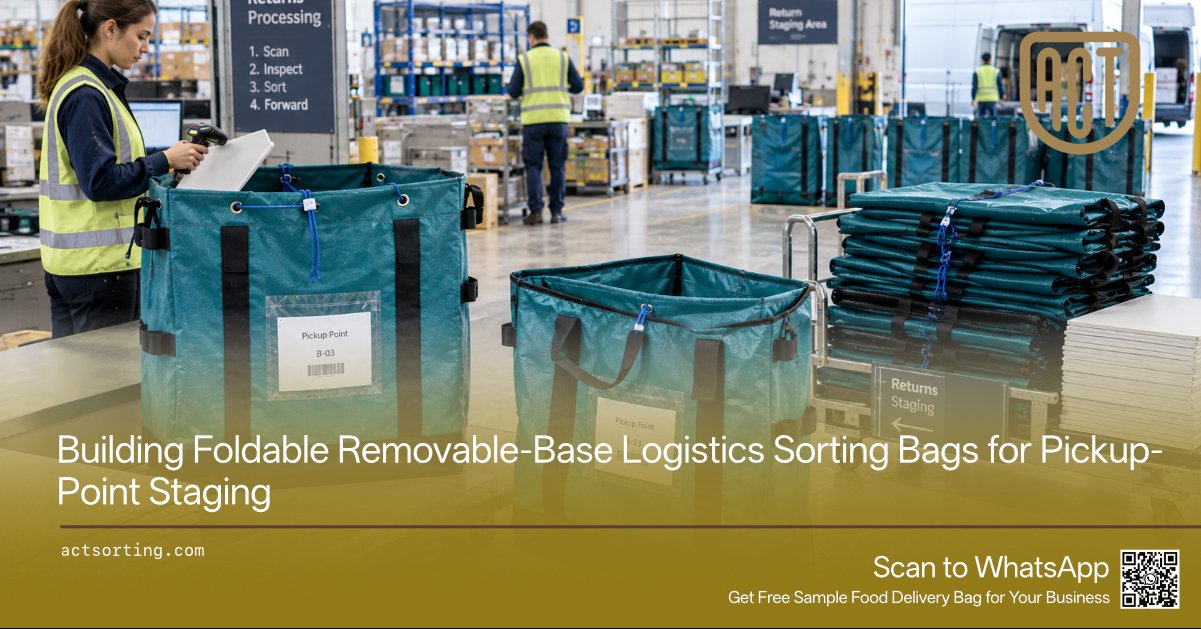
This product family follows one use path: floor or lane staging at a measured standing height → quick ID check → gathered and sealed mouth for short custody moves → multi-angle lift onto carts or van shelves → unload at the next station → board removed, textile walls folded, empties stacked for return. Logistics Sorting Bags built for that path are not generic open mouths borrowed from hub discharge. Standing shape, mouth closure, handle map, and empty fold have to be specified together so the filled unit and the empty pack both work on the same depot floor.
Networks comparing Parcel Sorting Bags for pickup-point programs should start from that handoff pressure, not from a catalog photo alone. When the bag must be recognizable from a walking distance, compatible with the network’s own ties, and compact after emptying, the structure has to answer all three jobs in one build. ACTSORTING develops reusable sorting equipment around dimensions, materials, handling features, and identification details—structural choices that make a foldable, removable-base pickup-point bag workable in that setting.
Measurable Standing Height from Bag Body, Shelf Clearance, and Operator Reach
Standing height should be written as measurable parameters, not as a universal “hip-height” product rule. Different depots have different operator stature ranges, shelf pitches, roll-cage inner heights, and van-rack clearances. The brief that travels to production therefore needs bag body height, mouth height when the bag is filled and gathered, shelf clear height above the staging lane, roll-cage or cart inner dimensions, and the reach space crews actually use when inserting or reading cards. A customer may note that a closed mouth near hip level on a specific crew sample is a useful reference for one site; that note is a site constraint, not a design law for every warehouse.
OEM dimensioning begins with the operator’s hardware: shelf pitch, cage base, van rack depth, door header clearance, and how many filled units sit in a handoff lane at once. Finished outer size should be quoted in the closed or gathered state the mouth will use, because a drawcord gather changes silhouette once the cord is pulled. Interior usable volume is a second figure—board thickness, webbing intrusion, and fold gussets all take space from the nominal outer box. Width and depth should follow the floor-lane paint, cart footprint, or rack bay the bag will occupy when staged beside a pickup counter.
Buyers should send photos of the staging lane and vehicle shelf with a measuring tape in frame, plus notes on whether bags stand alone on the floor or nest against a wall. ACTSORTING can develop Parcel Sorting Bags to those clearances rather than forcing a single stock proportion onto every depot. Where a network has already approved one primary height for most sites, a short-run exception for low van shelves or locker bays is often cleaner than endless near-duplicates. Limits are real: a height that clears a locker bay may crowd a low van shelf, so multi-site fleets should lock the primary dimension set against the tightest recurring clearance before sampling.
Reinforced PP Woven Bodies and Lower Wear Protection
Pickup-point bags live on concrete, painted floors, and truck beds. A reinforced PP woven body is a common industrial choice for tear resistance and a visible grid texture that reads as warehouse equipment rather than retail soft goods. Color is an operations lever here: teal, cyan, and other high-visibility industrial tones can mark a pickup-point or return family when the network’s taxonomy already owns those hues. Color choice belongs in the same brief as webbing contrast; it should not be treated as a fixed costume for every program.
The lower band does different work from the body face. A black reinforced strip with a denser weave or a coated face protects the zone that scrapes floors, collects dock moisture, and takes corner impacts when bags are dragged a short distance onto carts. The visual height of that band—often a short lower segment rather than a full-height panel—marks a wear zone for crews and gives procurement a clear inspect or repair area. Vertical black webbing with box or X stitch patterns spreads lift loads into the body instead of concentrating stress on a single seam line. Industrial stitch density at webbing anchors matters more than advertising thicker fabric alone.
Optional metal rivets or foot pads at the corners create discrete contact points where the bag pivots on hard floors. They can reduce direct abrasion on the woven corner, but they also add cost, weight, and a small fold penalty, and their effect on service life depends on floor type, drag frequency, and pad geometry—so they earn a place only when floor drag is routine and sample wear is checked. Thicker coatings or denser lower panels likewise change scuff behavior, fold thickness, and unit cost; they should be selected against the depot’s floor condition rather than assumed to extend life by a fixed margin. When ACTSORTING quotes reinforced woven Logistics Sorting Bags, useful inputs are floor condition, how often bags are slid versus lifted, and whether the lower band must match a network wear color. Heavier lower protection survives abrasive docks better and packs thicker; lighter bodies pack denser for empty return and show scuffs sooner on raw concrete.
Multi-Face Webbing Handles for Loaded Lifts Around Pickup Staging
Loaded pickup-point bags rarely move with one neat two-hand lift from the front. Crews pull from a lane, rotate onto a cart, pass around a counter, or share a heavy unit between two people at a van door. Front dual webbing handles cover the primary face pull; perimeter upper and lower loop handles on the sides—and often around the bag—give grip options when the approach angle changes. Lower loops help when the bag sits on the floor; upper loops help when it sits on a cart deck or when a second person steadies the top during a short carry.
Handle design is structure, not decoration. Webbing width, stitch length into reinforced panels, and whether loops are closed rings or open lifts all change how load enters the woven body. Too few grips force awkward one-side lifts that twist the mouth and stress a single seam column. Too many soft loops can snag on cage mesh or cart hardware. Contrasting black webbing on a lighter body improves grip finding under mixed depot lighting without claiming a strength number the buyer has not tested.
Sample evaluation should include the lifts the depot actually uses: one-person short carry, two-person side carry, cart pull by a lower loop, and van-shelf insertion by the front pair. ACTSORTING lists handle layout among customization levers for sorting-bag programs; for pickup-point fleets the brief should map each handle group to a named move rather than asking for “more handles” in the abstract. Limits stay visible: multi-face webbing adds material and stitch time, and poorly placed loops can block the ID window or interfere with drawcord travel. The right map is the smallest set that covers the real lift angles without cluttering the seal face.
Clear Front ID Windows for Pickup-Point and Route Cards
Handoff errors at pickup points often start as identification failures. A transparent front document window that holds a white card—pickup-point name, bay number, route code, or wave label—lets staff confirm destination before the mouth is sealed. Permanent branding and asset marks should sit outside that window so ownership remains visible after the card is swapped. Temporary cards change by wave; the pocket geometry should not.
Placement height matters for floor-staged bags. A window that sits too low disappears behind cart lips; one that sits too high can fold into the drawcord gather and become unreadable once the mouth is closed. Card insert direction—top slot versus side slot—should match glove habits at the counter. Pocket size must fit the largest card stock the network already prints, with a little clearance so humid or curled cards still seat. Exclusion zones keep logos, barcodes, and NFC marks from covering the card face.
Conceptual “pickup point” style labels belong in the buyer’s card program; they are not a manufacturer’s fixed catalog text. What the manufacturer delivers is a clear window, stable stitch border, and enough face area for the card the network will actually use. ACTSORTING includes transparent route label pockets among identification options for Parcel Sorting Bags; buyers should send card dimensions, insert direction, and photos of the staging sightline so the pocket lands where walking crews can read it. When card and body disagree, or when the window is buried under a gathered mouth, crews fall back to verbal guessing—the ID layer has already failed its job.
Drawcord Closures, Metal Grommets, and Tamper-Evident Seal Interfaces
These three parts do different jobs and should not be collapsed into one phrase. A drawcord closure gathers the mouth into a compact neck so the top can be closed quickly for a short custody move. Metal grommets provide eyelet positions through the mouth tape and reinforce the fabric against tear-out when cord or seal hardware is pulled. A tamper-evident seal—typically a plastic or cable-style tie the network already buys—is a separate component whose job is to show whether the mouth was reopened after sealing. Pulling the cord tight is not the same as achieving a seal that resists unnoticed reopening.
How the seal restricts reopening depends on the path it takes through the mouth. In a common design-to-validate layout, the drawcord gathers the mouth, then the seal body passes through one or more facing grommets—and often through a captive cord loop or a second fixed eyelet—so the gathered neck cannot be opened wide without cutting or breaking the seal. Eyelet count, spacing around the mouth, cord diameter, grommet inner diameter, and the seal’s head and strap size must work as one interface. A seal that only circles loose cord without locking opposing eyelets may gather the look of a closed mouth while still allowing the neck to be pulled open. Reinforced mouth tape around the grommet line reduces tear-out when seals are yanked during receiving.
Compatibility is measurable, not assumed. Networks that already buy seals in bulk should send physical seal samples—or precise head and strap dimensions—with the bag RFQ so eyelets and cord channels can be sized against that hardware. Color-matched cords do not prove fit; eyelet geometry and seal path do. Until a physical seal sample is fitted and opened under glove conditions on a prototype mouth, the arrangement remains a design to validate—not a proven tamper-resistant system. ACTSORTING can configure openings and closures—including drawcord-style gathers—around the handling habit of the station. For sealable pickup-point Logistics Sorting Bags, the productive brief names the seal geometry the network already runs, whether seals are single-use or reusable, and whether the cord must remain captive when the seal is cut.
Removable Rigid Bases: Structure, Retention, and Removal Design
A removable rigid base board keeps the bag standing with a flat footprint while parcels are staged, counted, or briefly held at a pickup point. Soft bases settle into irregular piles; cartons lean, labels hide, and the next lift starts with a reshuffle. The board answers that standing problem without turning the entire unit into a permanent hard tub. For empty return, the primary scheme is to remove the board as a separate part so the textile walls can fold independently; boards then stack as flat plates or travel kit-packed beside the folded textile. That remove-then-fold path is the default empty-state design described in this family.
Board structure choices are concrete. Thickness and material affect weight, edge wear on the woven sleeve, and how flat the board stays after humidity and truck vibration. A board that is too thin flexes under mixed cartons and recreates soft-base sag; a board that is too thick survives well but raises empty packing height and shipping weight. Edge finish matters so sharp corners do not cut the lower woven pocket. Retention method—sleeve pocket, Velcro stay, or friction fit—must hold during filled lifts yet release quickly for empty crews. Loose boards that slide out mid-carry become trip hazards and lost parts. Removal design should make the release step obvious under gloves: a clear pull edge, a marked release tab, or a sleeve mouth that does not fight the board when the bag is empty.
Tradeoffs belong in the purchase file. Removable boards improve staging posture and then add a second part to track, clean, and return. Some depots band boards with the folded textile; others store boards in a parallel rack. ACTSORTING can develop reinforced-base and removable-support options within sorting-bag programs; buyers should state board material preference, whether removal is the empty-return rule, and how boards are counted back with textiles. Section 8 covers fold actions and sample validation; Section 9 covers folded dimensions and packing density. This section’s job is the board itself—how it supports standing use, how it is retained, and how it is designed to come out cleanly.
Fold Actions and Sample Validation for Empty Bags
Empty fold is a textile action, and the sample must prove the method the buyer will actually run. Under the primary scheme, the rigid board is removed first; short sidewalls fold inward; longer walls collapse into a flat textile pack; the board stacks separately or is kit-banded with the textile afterward. That sequence keeps the board flat and unbent as a plate and lets the soft body compress without fighting a rigid insert. Training aids and photos should show the remove step clearly so dock crews do not skip it and force a half-standing empty into the return cart.
An alternate scheme appears when a customer RFQ requires folding with the board retained inside the bag. A typical drawing sequence for that alternate is: open the empty bag; fold the short sidewalls inward; press the walls down around the board perimeter while the board itself stays flat and unbent, with wall fabric gathering around the board edges. That retain-board fold is not assumed for every construction. Panel layout, free fabric allowance, crease placement, and board thickness must be validated on a real prototype; if the only way to flatten is to kink the board or fight a fixed stiffener, the structure has failed that brief and needs a panel revision—or a return to the remove-board primary scheme.
What the manufacturer must deliver for sample sign-off is fold geometry that makes the approved method possible: crease or panel layout that prefers inward short-wall folds, enough free fabric for the chosen path, and no fixed stiffener that forces the board to bend. Retention straps or bands for the folded pack belong in the same sample conversation. Validation should be photographed: board removed and textile flattened for the primary scheme; and, if the alternate is in scope, open empty, mid-fold, and fully flattened with the board retained flat. Time the fold under glove conditions; a method that looks elegant in a drawing but takes too long will be skipped on a busy dock. ACTSORTING’s foldable sorting constructions exist to balance standing use with compact empty return; the sample sign-off should name which scheme is approved and lock that sequence next to the drawing so production and replenishment share the same panel behavior.
Folded Dimensions, Packing Density, and Empty Return
Empty return is where pickup-point programs win or lose space. After unload, the valuable state is a measured textile pack plus a controlled board stack—not a row of half-standing mouths blocking the aisle. Under the primary remove-board scheme, the woven body compresses on its own; boards then stack as flat plates on a pallet or shelf. Programs that leave boards inside for the next shift keep standing posture ready but pay for it in return logistics volume and must still prove the retain-board fold on sample if that is how empties travel. Programs that remove boards must label, count, and reconcile two part types so textile bags do not return without their mates.
Packing definitions should be explicit in the purchase file: folded textile outer dimensions after the approved fold, board stack height per count, banded kit outer size if textile and board travel together, and whether empties ship as separated streams. Those numbers come from measuring the signed sample—not from a slogan about space saving. Permanent owner marks should remain readable on the folded textile so return crews do not open every pack to see who owns it. Card windows will be empty on return; that is expected—wave cards stay with the active route, not with the collapsed asset.
ACTSORTING’s parcel sorting bag category includes foldable and reinforced constructions buyers can use as a starting platform for empty-return design. For removable-base pickup-point fleets, the commercial question is packing density after the approved fold and board rule. Soft Logistics Sorting Bags without boards pack tighter still, but they surrender the standing staging benefit this build exists to provide. Some load heights and board thicknesses will never flatten as thin as a soft sack; that packing truth should appear in the freight plan before the first container sails. The right density target is the thinnest pack that still preserves the board inventory and the wall geometry the next wave needs when the bag is rebuilt.
What Buyers Should Send Manufacturers for This Pickup-Point Build
Before asking ACTSORTING for a quote or sample on this pickup-point build, buyers get faster, cleaner replies when the brief already carries the decisions that map to the sections above. Product outer dimensions in the closed or gathered state, plus bag body height and mouth height when filled, lock Section 2 clearances against shelves, roll cages, and operator reach. Board material preference and a clear remove-or-retain rule for empty return lock Sections 7–9; if the alternate retain-board fold is required, say so and plan for prototype validation rather than assuming every panel set can wrap a flat board. Handle positions—or photos of the lifts crews actually use—lock Section 4. Physical seal samples (or exact head and strap dimensions), clear card-pocket size and insert direction, expected load as a buyer requirement to discuss on sample, and folded packing targets (textile pack size, board stack, kit vs separate streams) lock Sections 5, 6, and 9.
If some of those items are still open, ACTSORTING can advise on typical options for Logistics Sorting Bags and Parcel Sorting Bags—mouth styles, retention methods, webbing maps, and fold schemes—once the staging photos and use path are clear. Reference photos of the lane and vehicle shelf with a measuring tape in frame, a size drawing, or an existing bag sample for reverse engineering all shorten the path from RFQ to a handling sample. Environmental notes help too: floor abrasion, dock moisture, and night lighting on the ID window.
A practical next step is to send that package—or as much of it as is ready—and request a sample that is staged, sealed with the buyer’s tie, lifted, unloaded, and folded under the depot’s real clearances, then locked as the master for replenishment. When dimensions, board rules, handle map, seal interface, ID pocket, load expectation, and folded packing sit in one brief, custom OEM work lands as a pickup-point bag that matches how the station already moves parcels—from floor staging through sealed handoff to dense empty return.
FAQ
Q: Why use a removable rigid base instead of a permanently sewn hard bottom?
A: A removable board supports standing staging and flat footprints during pickup-point handoff, then leaves the textile free to fold independently for empty return under the primary remove-board scheme. A permanently fixed hard bottom keeps posture but usually costs more return volume. Choose removable when empty density matters as much as standing shape; choose fixed only when boards would be lost or skipped too often to manage as a second part.
Q: What is the difference between a drawcord closure, metal grommets, and a tamper-evident seal?
A: The drawcord gathers the mouth. Metal grommets set eyelet positions and reinforce the mouth against tear-out. A tamper-evident seal is separate hardware that shows whether the mouth was reopened—typically by locking through facing grommets and related cord or fixed points so the neck cannot open wide without cutting the seal. Fit must be validated with the buyer’s physical seal on a prototype mouth; drawcord gather alone is not proven tamper evidence.
Q: How should multi-face handles be specified for pickup-point lifts?
A: Map each handle group to a real move—front dual grips for primary pulls, side upper loops for cart-height carries, lower loops for floor starts and two-person side lifts. Approve stitch reinforcement into the body panels on the sample. Avoid adding loops that snag cages or cover the ID window.
Q: What fold behavior should a sample prove for foldable sidewalls with a rigid board?
A: For the primary empty-return scheme, prove that the board removes cleanly and the textile folds flat on its own. If the customer requires the alternate retain-board fold, prove that short walls fold inward and longer walls gather around the board perimeter while the board stays flat and unbent—on a real prototype, not from the drawing alone. Photograph open, mid-fold, and flattened states, and time the method under normal depot gloves. If the only way to flatten is to kink the board, revise the panel layout or return to remove-board empty return before bulk production.
Q: What information helps ACTSORTING quote this pickup-point bag configuration?
A: Product dimensions and filled mouth height, board material and remove-or-retain rule, handle positions or lift photos, seal samples or dimensions, clear card-pocket size, expected load as a requirement to discuss, folded packing targets, staging and shelf clearance photos, and color/webbing needs. If parts of that list are still open, ACTSORTING can advise once the use path is clear. Reference photos, size drawings, or an existing sample all support a sampleable OEM brief for logistics and parcel sorting bags.