

Table of Contents
- Parcel Security Problems Often Begin Between Handoffs
- Open Delivery Bags Make Small Parcels Easier to Lose or Mix
- Secure Closures Help Maintain a Clear Chain of Custody
- Route Identification Should Work Together With Physical Security
- High-Value and Sensitive Parcels Need Better Containment
- Bag Design Should Support Fast Access Without Staying Permanently Open
- Vehicle Loading and Building Delivery Create Different Security Risks
- OEM & ODM Customization Can Match Different Delivery Security Levels
- ACTSORTING Builds Parcel Delivery Bags Around Real Delivery Workflows
- Standardized Bulk Production Supports Consistent Security Across Fleets
Introduction
Parcel delivery security is often discussed in terms of tracking numbers, driver apps, scan events, and proof of delivery. Those systems are important, but every parcel still spends part of its journey inside a physical vehicle, tote, sack, or delivery bag. If that physical container remains open, poorly identified, or easy to access during multiple handoffs, the digital tracking system is protecting information while the actual parcel is sitting inside a bag anyone can reach.
The risk is not always dramatic theft. More often, the problem is smaller and more ordinary: a poly mailer slips out during loading, one customer’s parcel is mixed into another route bag, a building delivery tote is left open in a lobby, or a courier removes several packages at once and later cannot confirm which one belonged to which stop. These are chain-of-custody problems caused by weak physical organization.
A well-designed Parcel Delivery Bag can reduce these gaps by combining secure closures, visible route identification, controlled openings, reinforced handles, and a structure that keeps parcel groups physically separated during sorting, van loading, doorstep delivery, and return. For courier companies, postal operators, e-commerce delivery fleets, 3PL providers, and Amazon DSP-style operations, the objective is not to turn every tote into a locked container. It is to reduce unnecessary exposure and make every handoff clearer.
ACTSORTING has specialized in commercial logistics bags since 2013. The company operates a manufacturing facility covering more than 12,000 square meters in Yangchun, Guangdong, China, with more than 400 experienced workers. Supported by BSCI and ISO9001 certification, ACTSORTING provides OEM & ODM manufacturing for Parcel Delivery Bags, Courier Sorting Totes, Last-Mile Delivery Totes, Van Loading Totes, Parcel Sorting Sacks, and customized reusable logistics equipment. Bag dimensions, woven materials, closures, route pockets, webbing, reinforcement, colors, printing, and internal separation can all be developed around the customer’s actual delivery process.
1. Parcel Security Problems Often Begin Between Handoffs
A parcel normally passes through several people and locations before reaching the final recipient. It may move from sorting lane to staging area, from staging to vehicle, from vehicle to driver, from driver to building reception, and finally from reception to the customer. Each transfer creates another moment when the parcel is physically exposed.
Digital scans show where a parcel should be, but they do not automatically prevent one small mailer from falling out of an open sack or being placed into the wrong tote. This is especially relevant in high-density delivery operations where dozens of packages move through the same staging area at once.
A Parcel Delivery Bag can create a clearer physical boundary around each route, stop group, or building delivery. Parcels remain inside one identified unit until the next controlled handoff. The bag can then be opened, checked, and closed again as the route progresses.
ACTSORTING can customize the product around the number of parcels per bag, delivery sequence, vehicle layout, and handling frequency. Some customers may need a simple covered opening, while others require zipper closure, hook-and-loop flaps, or additional securing points. The correct design depends on how frequently employees access the contents and how much containment the route requires.
The value is not complicated security technology. It is reducing the number of moments when parcels sit exposed without a clear physical boundary.
2. Open Delivery Bags Make Small Parcels Easier to Lose or Mix
Large cartons are easy to notice. Small poly mailers, envelopes, accessory boxes, and lightweight parcels are much easier to lose inside a busy delivery workflow.
An open Parcel Sorting Sack may contain several large cartons with smaller mailers placed on top. When workers move the bag, those small parcels can shift toward the opening. A tote that tips inside the van may allow one item to fall between neighboring bags. If several route groups are parked together, a loose parcel can then enter the wrong physical cluster.
This creates a problem that may remain invisible until the driver reaches the customer and discovers that one package is missing.
A secure top structure helps contain smaller parcels during movement. The closure does not necessarily need to be fully sealed at all times, but it should allow workers to secure the tote after loading, during vehicle movement, and whenever the bag is left temporarily unattended.
ACTSORTING can customize zipper openings, hook-and-loop flaps, covered tops, draw-style structures, or other closure methods according to the customer’s workflow. The opening can remain wide enough for efficient loading while providing better containment once the route bag is complete.
This balance matters because a bag that is extremely secure but slow to open can reduce productivity. The objective is controlled access rather than maximum inconvenience.
3. Secure Closures Help Maintain a Clear Chain of Custody
Chain of custody simply means knowing who had control of the parcel at each stage and reducing unnecessary opportunities for access.
A secure Parcel Delivery Bag can support this process by creating a clear transition between open and closed states. Warehouse employees load the assigned route group, verify the contents, and close the bag before it leaves staging. The driver receives the closed tote, opens it when required, removes the correct parcels, and closes it again before continuing.
This creates a more disciplined physical workflow than leaving every tote permanently open.
ACTSORTING can also develop closure structures that support simple external seals or numbered tags if the customer’s operation uses them. The exact securing method should be defined by the courier company’s internal process rather than treated as a universal requirement.
The important point is that the bag design should make controlled closing practical. If the opening is difficult to align or the closure becomes inconvenient when the tote is partially full, employees are more likely to leave it open.
Good security design therefore needs to work with human behavior. A theoretically secure closure that nobody uses is mostly decorative engineering.
4. Route Identification Should Work Together With Physical Security
Physical security and route identification are closely connected.
A securely closed bag is not useful if employees cannot tell which route it belongs to. Drivers may need to open several totes simply to find the correct parcel group, creating unnecessary access and slowing dispatch.
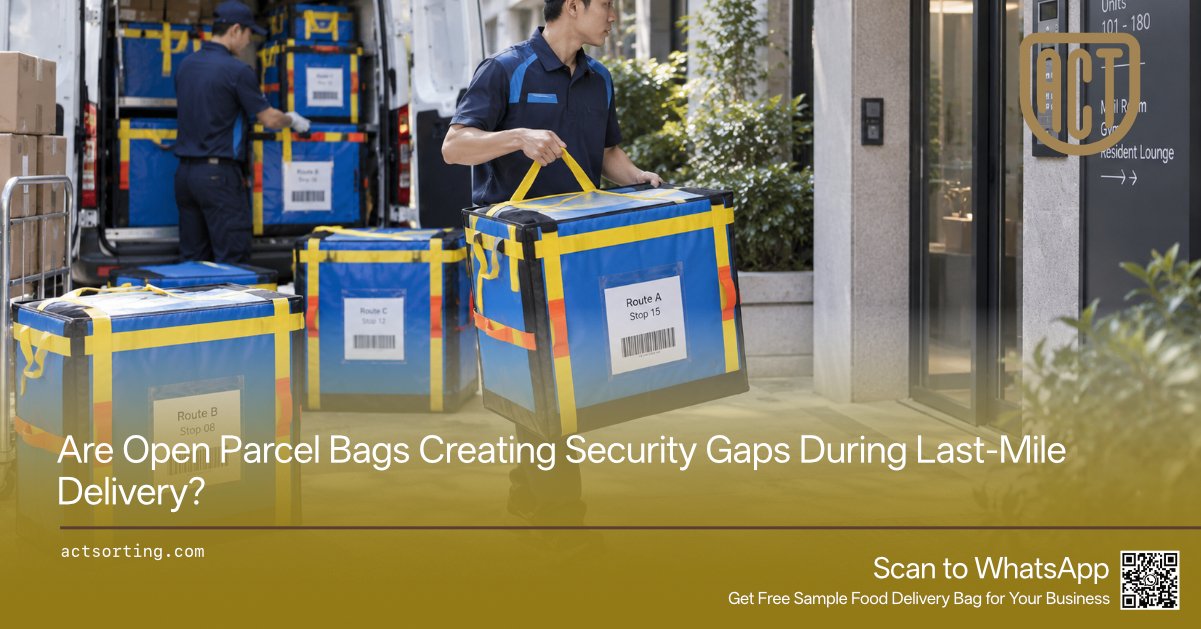
Large transparent route pockets can reduce this problem. The bag can display route number, stop sequence, building name, driver assignment, barcode, QR code, depot information, or other operational data before anyone opens it.
ACTSORTING can customize pocket size, position, opening direction, and quantity according to the customer’s actual route documents. A front-facing pocket may work well during warehouse staging, while a side-facing pocket may remain more visible inside delivery vans.
Permanent equipment identification can remain separate from temporary route information. One printed area may carry the bag asset number or depot code, while the transparent pocket holds daily route data.
This separation creates a clearer system. Employees know which physical bag they are handling and which delivery assignment it currently belongs to. Fewer unnecessary openings mean better containment and faster route verification.
For multi-depot networks, keeping the same label position across every Parcel Delivery Bag also reduces training friction. Drivers know where to look regardless of bag size or route type.
5. High-Value and Sensitive Parcels Need Better Containment
Not every parcel carries the same operational risk.
Some routes include electronics, replacement parts, business documents, premium retail products, pharmacy-related packages, or other shipments that the delivery company may prefer to keep more tightly controlled during transport. Even when the parcel itself is sealed, leaving it inside an open delivery sack creates unnecessary exposure.
A more secure Last-Mile Delivery Tote can provide another physical layer around these parcels during staging and vehicle movement. The tote keeps the delivery group together, reduces casual access, and allows workers to verify the route information without exposing the contents.
Internal separation can also help. A removable divider or dedicated section may isolate higher-value parcels from normal cartons within the same tote, depending on the operator’s procedure.
ACTSORTING can customize closure structure, divider layout, reinforced panels, identification pockets, and carrying configuration according to the required use. The goal is not to claim the bag replaces regulated security containers or formal tamper-evident packaging. It does not. The value lies in improving normal operational containment.
For commercial delivery networks, that distinction matters. The bag supports security discipline without pretending to become a vault with webbing handles.
6. Bag Design Should Support Fast Access Without Staying Permanently Open
Delivery drivers need speed. Any security feature that significantly slows every stop will quickly become unpopular.
The challenge is therefore designing a bag that closes securely enough for transport but opens quickly when the driver reaches the correct destination.
A full zipper may provide strong containment but take longer to operate if the driver accesses the tote repeatedly. A large flap with hook-and-loop fastening may offer faster access. A partial zipper or covered opening may provide a useful compromise for certain routes.
ACTSORTING can develop the opening according to access frequency. A warehouse transfer bag opened only at destination can use a different closure from a Last-Mile Delivery Tote opened twenty times during one route.
Handle position also affects access. Long straps that fall across the opening create unnecessary interference. Webbing, closures, pockets, and bag shape should therefore be designed together instead of added independently.
The same principle applies to partially loaded bags. A closure should still work after several parcels have been removed. If the structure depends on the tote remaining completely full, security deteriorates as the route progresses.
This is where OEM & ODM development becomes useful. The customer can test the sample under real route conditions rather than judging it only while the bag is sitting neatly on a table.
7. Vehicle Loading and Building Delivery Create Different Security Risks
Security needs change throughout the route.
Inside the warehouse, the main risk may be parcel mixing. Inside the van, parcels can shift during movement or become difficult to distinguish between route groups. During building delivery, the driver may temporarily leave the bag in a lobby, corridor, reception area, or elevator while handling several recipients.
A useful Parcel Delivery Bag should support these different environments.
Inside the vehicle, structured sides or a reinforced bottom can help the tote maintain its position. Visible route pockets help the driver identify the correct bag before opening it. Secure closures keep small parcels contained during vehicle movement.
Inside apartment or office buildings, the bag may need comfortable handles, compact dimensions, and a closure that can be reopened quickly at each recipient. If one building contains several deliveries, internal organization can help keep the parcels separated without requiring the driver to return to the van.
ACTSORTING can customize dimensions around van shelves, corridors, elevators, and typical parcel volumes. A large commercial building tote may need more capacity, while an apartment delivery bag may need a narrower footprint.
The software may treat both as one stop. The physical environment absolutely does not.
8. OEM & ODM Customization Can Match Different Delivery Security Levels
Courier networks do not all need the same level of containment.
A low-risk internal sorting tote may only need a simple flap. A hub-transfer bag may require a more secure zipper. A high-value delivery program may require additional securing points and more controlled identification. A building-delivery tote may prioritize fast repeated access while still keeping parcels enclosed during movement.
ACTSORTING can begin development from the customer’s existing workflow, current bag samples, damaged products, route photographs, parcel profile, and security requirements. The final specification can include dimensions, woven material, laminated surfaces, reinforcement, zipper structure, hook-and-loop closures, route pockets, divider systems, handle layout, colors, printing, and folding method.
This allows different bag types to share the same visual and operational language while using different security levels.
For example, a courier network may use one open-access Parcel Sorting Sack inside the warehouse, one secured Van Loading Tote for transport, and one smaller Last-Mile Delivery Tote for multi-parcel building stops. All three can use the same route pocket position, color system, depot code, and branding.
Choosing ACTSORTING therefore does not mean forcing every workflow into one universal bag. It means developing coordinated equipment around several stages of the delivery process.
9. ACTSORTING Builds Parcel Delivery Bags Around Real Delivery Workflows
ACTSORTING has specialized in commercial logistics bag manufacturing since 2013. Its production facility in Yangchun, Guangdong covers more than 12,000 square meters and employs more than 400 experienced workers. BSCI and ISO9001 certification provide additional support for structured manufacturing and quality management.
For parcel delivery projects, the practical value lies in converting operating problems into product specifications.
If small parcels fall out, the opening and closure can be reviewed. If bags are difficult to identify inside vans, route pocket placement can change. If drivers leave the tote open because the zipper is inconvenient, another access structure can be tested. If high-value parcel groups require more separation, internal organization can be added.
This is why ACTSORTING’s customization goes beyond printing a logo onto a standard woven bag. Material, reinforcement, dimensions, handles, closures, route identification, folding, and internal organization can all be coordinated during sampling.
The approved sample can then become the manufacturing reference for bulk production.
The reason to choose ACTSORTING is therefore straightforward: the company can develop the bag around the delivery process and then reproduce that solution at commercial scale.
10. Standardized Bulk Production Supports Consistent Security Across Fleets
A security process becomes weaker when every depot uses different equipment.
One warehouse may use zipper totes, another open sacks, and a third may use bags with route pockets in completely different positions. Drivers transferring between sites need to relearn basic handling, while procurement teams manage several overlapping specifications.
Standardization reduces that friction.
ACTSORTING can use the approved sample and confirmed specification as the reference for bulk and repeat production. Dimensions, material, closure, pocket position, handle length, reinforcement, colors, printing, folding structure, and packaging can be defined before manufacturing.
This allows courier companies to build a consistent Parcel Delivery Bag system across multiple warehouses or route types. Different capacities can still follow the same security and identification logic.
Repeat production matters just as much. Peak seasons require additional bags. New depots open. Existing equipment reaches the end of its working life. Replacement stock should follow the same structure so employees do not need to adapt to a new product every time procurement places another order.
For courier companies, postal operators, e-commerce fleets, 3PL providers, and last-mile contractors dealing with open route bags, loose small parcels, unclear handoffs, or inconsistent equipment across depots, the next Parcel Delivery Bag project should begin with the chain of custody.
Define where the bag is loaded, when it should be closed, who opens it, how often it is accessed, what type of parcel it carries, where route information must remain visible, and how the empty bag returns to the network. Those details can then become a manufacturable specification.
Parcel security does not begin only at the customer’s door.
It begins every time someone decides whether the bag should still be open.
FAQ
Q: Can ACTSORTING customize secure closures for Parcel Delivery Bags?
A: Yes. Zipper closures, hook-and-loop flaps, covered openings, and other closure structures can be customized according to access frequency, parcel type, delivery stage, and customer requirements.
Q: Can Parcel Delivery Bags include barcode or route identification pockets?
A: Yes. Transparent pockets can be customized in size, position, orientation, and quantity for route cards, barcodes, QR codes, depot information, driver assignments, and other delivery documents.
Q: Are secure delivery bags suitable for apartment and office deliveries?
A: Yes. Dimensions, handles, closures, internal dividers, and route identification can be developed for multi-parcel building deliveries where drivers need to carry several customer orders through one property.
Q: Can ACTSORTING develop different security levels within one bag program?
A: Yes. Warehouse sorting bags, van transport totes, and last-mile delivery bags can use different closure and containment structures while maintaining the same colors, identification system, branding, and overall equipment standard.
Q: Why choose ACTSORTING for custom Parcel Delivery Bags?
A: ACTSORTING has specialized in commercial logistics bags since 2013, operates a 12,000+ square meter manufacturing facility with more than 400 employees, holds BSCI and ISO9001 certification, and supports OEM & ODM development, sampling, customized bulk production, multi-depot programs, and repeat orders.