

Table of Contents
- Hotel Linen Delivery Often Includes More Sorting Than Washing
- One Bag Per Floor or Department Creates a Clearer Dispatch System
- Route-Based Laundry Delivery Bags Reduce Repacking Before Vehicle Loading
- Large Identification Panels Help Hotels Receive Linen Faster
- Stable Bag Shapes Improve Van Loading and Back-of-House Staging
- Capacity Planning Prevents Overfilled Linen Bags and Unstable Loads
- Separate Bag Systems Can Support Clean Linen, Returns, and Rewash
- OEM & ODM Customization Connects the Bag to the Hotel Linen Workflow
- ACTSORTING Builds Laundry Delivery Bags Around Commercial Operations
- Standardized Bulk Production Supports Hotel Groups and Multi-Site Laundry Networks
Introduction
Commercial laundry operations often spend enormous effort optimizing washing, drying, finishing, and folding, only to lose time during the final movement of clean linen.
A hotel linen order may already be perfectly prepared when it leaves the laundry facility, but the delivery process can still involve several additional handling stages. Clean sheets are packed into one container, moved into a dispatch area, transferred into a vehicle, unloaded at the hotel, separated again by floor or department, and finally placed onto carts for housekeeping teams.
The same linen may therefore be sorted several times after it has already been processed correctly.
For hotel laundry providers, linen rental companies, commercial laundries, resort groups, serviced apartments, hospitals, and other high-volume textile operations, the issue is not simply transportation. It is whether the delivery equipment preserves the sorting work that has already been completed.
A well-designed Laundry Delivery Bag can become the physical unit connecting the laundry facility with the final hotel destination. Instead of dispatching anonymous bags of clean linen and asking hotel staff to separate everything again, operators can assign bags by hotel, floor, department, route, linen category, or replenishment batch before the vehicle leaves the laundry.
ACTSORTING has specialized in commercial logistics bags since 2013. The company operates a manufacturing facility covering more than 12,000 square meters in Yangchun, Guangdong, China, with more than 400 experienced workers. Supported by BSCI and ISO9001 certification, ACTSORTING provides OEM & ODM manufacturing for Laundry Delivery Bags, Hotel Linen Delivery Bags, Laundry Pickup Bags, reusable sorting bags, and other commercial transport solutions.
Customers can customize dimensions, fabric, handles, reinforced bottoms, rigid base panels, transparent identification areas, colors, route coding, hotel logos, closures, and packaging. The purpose is not simply to move linen from one building to another. It is to preserve order structure from the laundry dispatch area all the way to the hotel floor.
1. Hotel Linen Delivery Often Includes More Sorting Than Washing
A commercial laundry may process thousands of sheets, pillowcases, towels, bath mats, restaurant textiles, and staff uniforms during one production cycle. Once those items are washed and finished, they still need to return to the correct hotel, department, and operating area.
The difficulty is that clean linen often looks almost identical once folded. White sheets from one hotel floor look very similar to white sheets from another. Towels for one housekeeping zone can easily be mixed with another replenishment batch. If the laundry packs everything into generic bags and relies on the hotel to separate the contents later, part of the sorting work is simply transferred downstream.
That creates extra labor at both ends. Laundry employees may count and repack linen before dispatch, while hotel staff repeat the process after delivery. During peak check-in periods, that delay becomes more noticeable because housekeeping teams need replenishment quickly rather than another pile of unidentified bags waiting in a service corridor.
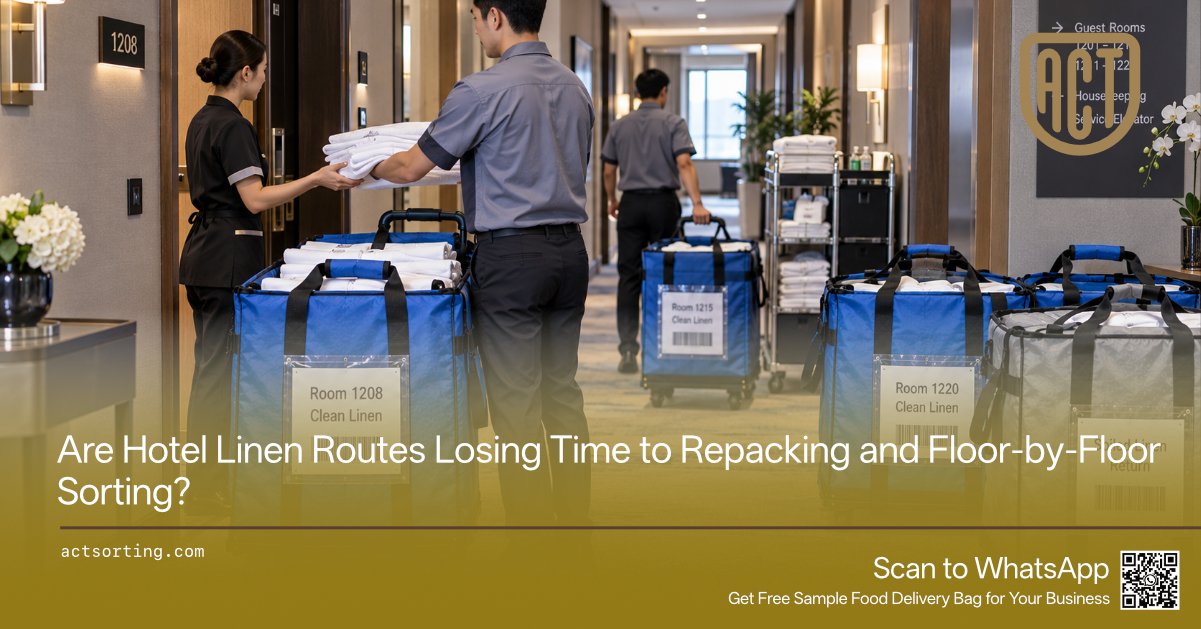
A better Hotel Linen Delivery Bag system keeps the sorting decision attached to the linen. One bag can represent Floor 3, another Floor 4, another the spa, another the restaurant, and another housekeeping storage. The bag becomes the physical boundary of the replenishment batch.
ACTSORTING can customize large identification areas, printed department names, route cards, color coding, and reusable equipment IDs so the purpose of each Laundry Delivery Bag remains visible throughout transportation. The value is not complicated technology. It is removing one unnecessary sorting step from a workflow that already contains enough repetitive work.
2. One Bag Per Floor or Department Creates a Clearer Dispatch System
Many hotel linen operations organize finished textiles by property but not necessarily by final destination inside the property. The hotel then receives several large mixed bags and redistributes the contents internally.
A floor-based or department-based bag system moves that separation upstream.
Instead of packing all guest-room linen together, the laundry can prepare Floor 5, Floor 6, restaurant, spa, banquet, and housekeeping reserve as separate identified units. Each Laundry Delivery Bag follows a defined destination before the vehicle is loaded.
This approach can be useful for larger hotels, resorts, serviced apartments, and multi-building properties where internal transport distances are significant. The bag can move from the commercial laundry to the hotel receiving area and then continue directly toward the relevant service elevator or department.
The system also creates clearer accountability. If Floor 8 reports missing towels, staff can check the Floor 8 delivery unit rather than recounting an entire hotel shipment. The bag does not replace inventory software or linen management systems, but it gives the digital allocation a physical structure employees can see immediately.
ACTSORTING can customize the same bag family in several capacities so high-volume departments receive larger units while smaller departments use more compact bags. Label placement, handle structure, color coding, and branding can remain consistent across sizes.
This creates a standardized delivery language: employees know what the bag represents before they open it.
3. Route-Based Laundry Delivery Bags Reduce Repacking Before Vehicle Loading
Commercial laundry dispatch areas often become temporary sorting zones. Finished linen arrives from packing, route teams separate it by customer, drivers organize it by delivery sequence, and bags are sometimes reopened or transferred simply because the original packaging does not match the route plan.
That is avoidable when the Laundry Delivery Bag itself is prepared as the route unit.
A commercial laundry serving several hotels can assign each bag to a specific customer and department before staging. Bags are then grouped in vehicle loading order rather than treated as generic sacks that must be interpreted later.
For example, Hotel A may have six bags divided by housekeeping zones, while Hotel B has four bags divided by guest rooms, restaurant, and spa. The dispatch team stages these units by route sequence, and the driver loads them accordingly.
Large transparent route pockets can carry delivery sheets, barcodes, stop numbers, hotel department information, or internal batch cards. Permanent bag IDs can remain separate from temporary route information.
ACTSORTING can customize the position of these identification areas so labels remain visible when bags are arranged side by side inside the vehicle. This matters because a perfectly readable top label becomes fairly useless once another bag is stacked in front of it.
The operational benefit is fewer last-minute transfers and less searching during loading. The finished linen leaves the facility in the same physical grouping intended for the customer.
4. Large Identification Panels Help Hotels Receive Linen Faster
Hotel receiving teams often deal with several suppliers at the same time. Food deliveries arrive, maintenance materials arrive, guest supplies arrive, and clean linen arrives alongside them.
A generic bag with a small handwritten tag does very little to help the receiving team understand where it belongs.
A large identification panel can make a Hotel Linen Delivery Bag immediately recognizable. The panel can display the hotel name, department, floor, delivery route, linen category, order number, barcode, or other operational information.
ACTSORTING can customize transparent pockets according to the customer’s existing paperwork rather than forcing the laundry company to redesign its documentation around a fixed pocket size.
The placement can also follow the receiving process. A side-facing pocket may remain visible when several bags are standing in a row. Front and side identification can help when bags are viewed from different directions. Permanent printing can identify the laundry provider while removable cards carry the daily delivery information.
This reduces unnecessary opening and checking. Hotel staff can move the correct bag toward housekeeping, banquet, restaurant, spa, or another destination immediately after receiving.
For high-volume properties, that seemingly minor improvement can prevent clean linen from sitting in the wrong back-of-house area while staff search for the person who knows what the label means.
5. Stable Bag Shapes Improve Van Loading and Back-of-House Staging
Soft linen is easy to compress, which is useful during transport, but completely unstructured laundry sacks can become difficult to organize.
A flexible bag filled with towels may spread outward. Another filled with folded sheets may lean. Several bags loaded together can gradually occupy more vehicle floor space than expected and hide each other’s labels.
A reinforced or rigid bottom gives the Laundry Delivery Bag a more predictable footprint while allowing the upper structure to remain flexible.
This helps during three important stages: dispatch staging, vehicle loading, and hotel receiving. Bags can stand upright in defined rows, identification panels remain visible, and employees can arrange the vehicle according to route order.
ACTSORTING can customize removable or integrated bottom panels depending on the customer’s cleaning, folding, and storage requirements. Reinforced lower corners and webbing can also protect high-contact areas where bags repeatedly touch vehicle floors, loading docks, and hotel service areas.
The goal is not to turn a textile bag into a rigid box. It is to add enough structure that the bag behaves consistently when full.
That consistency improves space planning. Drivers know approximately how many bags fit into a row. Hotels can stage incoming linen without every unit collapsing into its neighbor. Empty bags can still remain easier to return and store than fully rigid containers.
6. Capacity Planning Prevents Overfilled Linen Bags and Unstable Loads
Commercial laundry teams understandably want to maximize the amount of linen inside each bag. Fewer bags mean fewer pieces to move, count, and store.
There is a point where this stops being efficient.
An oversized or overfilled Laundry Delivery Bag becomes harder to lift, more difficult to close, less stable inside the vehicle, and more likely to place excessive stress on the handles and seams. Clean folded linen can also lose its organization when employees compress too much into one container.
The correct capacity depends on textile type.
Towels are dense. Duvet covers and bedding consume substantial volume. Staff uniforms behave differently again. A hotel linen operator may therefore benefit from two or three standardized bag sizes rather than one enormous universal sack.
ACTSORTING can develop dimensions according to average folded linen volume, expected load, vehicle layout, hotel receiving areas, and employee handling requirements. Larger bags can use stronger webbing and reinforced bottoms, while smaller bags retain the same visual and identification system.
This makes capacity part of the workflow rather than just a product specification.
A housekeeping department receiving ten correctly sized bags may operate more efficiently than receiving six bags that require two employees and a theological discussion before anyone agrees to lift them.
7. Separate Bag Systems Can Support Clean Linen, Returns, and Rewash
Hotel laundry logistics rarely consists only of clean outbound linen.
The same route may collect soiled linen, return damaged textiles, transport rejected items for rewash, or bring back empty reusable bags. If all of these movements use identical bags, employees depend heavily on tags to understand the contents.
A visible bag system can separate these flows.
Different colors, webbing colors, printed markings, or removable status cards can identify clean delivery, soiled collection, rewash, damaged linen, or empty equipment. The exact categories should match the operator’s workflow rather than creating unnecessary complexity.
This is especially valuable when the same vehicle handles both delivery and collection during one hotel stop. Drivers can immediately distinguish what is entering the hotel from what is returning to the laundry facility.
ACTSORTING can manufacture coordinated Laundry Delivery Bags and Laundry Pickup Bags using the same core dimensions while changing colors, printing, pocket layout, or closures according to status.
The benefit is a clearer closed-loop system. Clean linen moves outward, used linen moves inward, and exceptional items such as rewash remain visibly separated.
This physical separation complements the customer’s internal SOP and helps prevent clean and return flows from becoming one ambiguous collection of textile bags in the vehicle.
8. OEM & ODM Customization Connects the Bag to the Hotel Linen Workflow
A 100-room business hotel does not need the same linen delivery system as a 1,000-room resort with restaurants, spa facilities, banquet halls, and several housekeeping zones.
The bag specification should reflect the property and the commercial laundry workflow serving it.
ACTSORTING can begin development from current bag samples, route photos, linen volume, hotel department structure, van dimensions, existing labels, common handling problems, and target order quantity.
Bag dimensions can be customized around actual folded textile volume. Long reinforced handles can support repeated carrying. Velcro handle sleeves can keep paired handles together during route work. Rigid or reinforced bottoms can improve stability. Transparent pockets can match hotel delivery documents. Colors and printing can support property, route, floor, or department identification.
Closure options can also vary. Some clean linen deliveries may require covered tops, while other internal transport workflows prioritize fast access. The useful specification depends on where the bag moves and how frequently employees open it.
This is the practical value of ACTSORTING’s OEM & ODM model. Customization is not limited to putting a hotel logo onto a stock laundry sack. The entire bag can be developed around the way linen moves from finishing table to delivery van to hotel department.
9. ACTSORTING Builds Laundry Delivery Bags Around Commercial Operations
ACTSORTING has focused on commercial logistics bag manufacturing since 2013. The company’s production facility in Yangchun, Guangdong covers more than 12,000 square meters and employs more than 400 experienced workers. BSCI and ISO9001 certification provide additional support for responsible production and structured quality management.
For hotel linen and commercial laundry projects, the practical advantage is the ability to combine product development with large-volume manufacturing.
Customers can standardize dimensions, handle lengths, bottom structures, route pockets, hotel identification, colors, printing, closures, and packaging before moving into bulk production. If a field test shows that one bag is too tall for a van shelf or a label pocket becomes hidden during loading, the specification can be adjusted before larger rollout.
ACTSORTING can also support related bag families rather than isolated products. A commercial laundry may use one design for clean hotel linen, another for soiled collection, and a third for residential pickup while maintaining common construction and identification logic.
This matters because equipment becomes easier to train around when it follows recognizable rules. Drivers, sorting teams, hotel staff, and procurement departments all encounter a more consistent system.
The reason to choose ACTSORTING is therefore not simply that the factory can make a laundry bag. It is that the bag can be developed as part of a repeatable commercial workflow.
10. Standardized Bulk Production Supports Hotel Groups and Multi-Site Laundry Networks
A successful linen delivery system becomes more valuable when the same operating logic can be reproduced across customers and locations.
A hotel group may want standardized bags across several properties. A commercial laundry may expand into another city. A linen rental company may win a new regional account and need thousands of additional bags using the same dimensions, route pockets, and color system.
Production consistency becomes essential at that point.
ACTSORTING can use the approved sample and confirmed specification as the reference for bulk and repeat manufacturing. Materials, dimensions, handle length, webbing, bottom panel, identification pocket, color, logo, route markings, closure, and packaging can be controlled as part of the product specification.
This allows replacement orders and expansion orders to remain compatible with the existing fleet. Drivers do not receive a new bag that unexpectedly occupies more vehicle space. Hotel teams do not need to learn a new label position. Sorting staff can continue using the same route logic.
For hotel linen operators, commercial laundries, resorts, serviced apartments, uniform services, and multi-site hospitality groups, this standardization can be more valuable than adding another decorative feature to the bag.
The best Laundry Delivery Bag is the one that preserves the sorting work already completed upstream.
If linen leaves the commercial laundry divided by property, floor, department, and route, the bag should keep that structure intact until the textiles reach the people who actually need them.
That is how a delivery bag stops being packaging and starts becoming part of the linen logistics system.
FAQ
Q: Can ACTSORTING customize Hotel Linen Delivery Bags by hotel floor or department?
A: Yes. Colors, printed floor or department names, transparent route pockets, permanent property codes, barcodes, QR code areas, and other identification features can be customized around the hotel’s linen distribution system.
Q: Can Laundry Delivery Bags use a rigid bottom while keeping flexible sidewalls?
A: Yes. Removable or integrated bottom support can create a stable footprint for staging and vehicle loading while the textile sidewalls remain flexible for linen capacity and empty storage.
Q: Can different bag colors separate clean linen, soiled linen, and rewash?
A: Yes. ACTSORTING can produce coordinated bag systems using different body colors, webbing colors, printed status markings, or removable identification cards to support separate laundry flows.
Q: Can ACTSORTING produce different capacities within the same laundry bag program?
A: Yes. Several sizes can share the same material, handle design, label position, branding, and operational color system while providing different capacities for bedding, towels, uniforms, or department-specific deliveries.
Q: Why choose ACTSORTING for hotel and commercial laundry bag projects?
A: ACTSORTING has specialized in commercial logistics bags since 2013, operates a 12,000+ square meter manufacturing facility with more than 400 employees, holds BSCI and ISO9001 certification, and supports OEM & ODM development, customized bulk production, repeat orders, and standardized multi-site laundry bag programs.