

Table of Contents
- One Euro Pallet Size Can Still Create Several Cover Design Problems
- Woven PP Covers Work Best When Reusability and Adjustment Matter
- Reinforced PVC Covers Need More Than Just a Heavier Fabric
- Insulated Pallet Covers Must Control Heat Loss Around Seams and Corners
- Adjustable Height Requires More Than Adding Extra Fabric
- A Slightly Oversized Base Makes Installation Easier on Real Loads
- Straps, Hook-and-Loop Fasteners, and Gussets Solve Different Problems
- Identification, QR Codes, and Document Pouches Support Pallet Control
- Prototype Testing Should Happen Before Any Large Production Order
- ACTSORTING Develops Reusable Pallet Covers Around Real Logistics Workflows
Introduction
A standard Euro pallet measures 800 × 1,200 mm, but that does not mean every pallet load needs the same cover. The pallet footprint may be standard while the load above it changes constantly. One shipment may reach approximately 1,600 mm in height, another 1,800 mm, and a third may have cartons that lean slightly beyond the pallet edge. A reusable pallet protection cover therefore needs to do more than match the dimensions on a drawing.
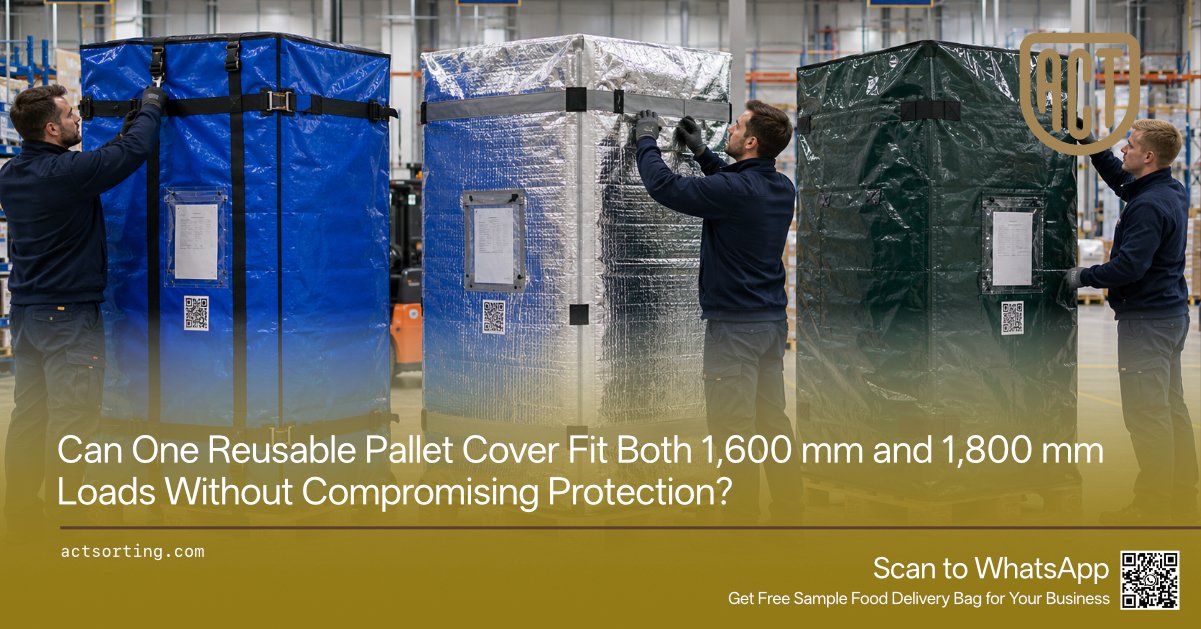
A recent European sourcing inquiry presented exactly this problem. The buyer was developing three reusable pallet cover systems based on the same Euro pallet platform: a reinforced woven PP cover with tension straps and adjustable fastening, a multilayer insulated pallet cover, and a reinforced PVC cover intended for heat-welded construction. The objective was not simply to manufacture three large rectangular covers. Each version had to solve a different operational problem while remaining practical for repeated industrial use.
For the woven PP version, flexibility, low weight, abrasion resistance, and adjustable tightening were important. For the PVC version, the buyer required a much heavier construction, approximately 600–650 g/m² with 1000D reinforcement, together with welded seams suitable for demanding handling environments. The insulated version introduced an entirely different challenge: maintaining thermal performance around corners, seams, openings, and adjustable areas where poorly designed construction can create thermal bridges.
The same project also raised questions that many logistics procurement teams eventually encounter. How much extra clearance should be added around an 800 × 1,200 mm pallet? Can one cover realistically accommodate both 1,600 mm and 1,800 mm load heights? Which adjustment method works best: straps, hook-and-loop fasteners, drawstrings, or gussets? Should prototypes be tested before production? How should QR codes, document pouches, individual numbering, colors, and logos be integrated without weakening the cover?
ACTSORTING has focused on reusable industrial logistics textile products since 2013. Its production facility in Yangchun, Guangdong, China covers more than 12,000 square meters and is supported by more than 400 experienced workers. With BSCI and ISO9001 certification, ACTSORTING provides OEM & ODM development for reusable logistics covers, woven transport products, insulated covers, Parcel Sorting Sacks, Courier Sorting Totes, and other customized industrial textile solutions.
A reusable pallet cover looks simple when it is folded on a table. The real engineering begins when workers try to pull it over an uneven pallet, tighten it around the load, move the pallet with a forklift, expose it to warehouse abrasion, and then use the same cover again next week.
1. One Euro Pallet Size Can Still Create Several Cover Design Problems
The 800 × 1,200 mm Euro pallet footprint gives manufacturers a useful reference, but designing the cover at exactly 800 × 1,200 mm would usually create problems in real use. Palletized loads rarely form a perfect vertical box. Cartons shift, stretch wrap creates bulges, corner protectors add thickness, and some products extend slightly beyond the pallet edge. If the cover base is manufactured too tightly, warehouse workers may struggle to pull it over the load or damage the lower corners during installation.
A practical reusable pallet protection cover therefore normally requires controlled clearance around the base. The exact allowance depends on material stiffness, seam construction, load profile, and how the cover is installed. A flexible woven PP cover can tolerate less clearance than a stiff multilayer insulated cover or heavy reinforced PVC construction, but none of them should be designed as if every pallet leaves the warehouse with laser-cut geometry.
Height creates an even bigger problem. A buyer may want one cover to handle loads around 1,600 mm and 1,800 mm. Simply manufacturing an 1,800 mm cover and allowing 200 mm of loose fabric to hang around the shorter load is technically possible, but the result may bunch around the pallet base, interfere with handling, reduce wind resistance during transport, or create an untidy fit. If straps are added without considering the excess material, tightening can concentrate the loose fabric in one area rather than distributing it evenly.
A better design treats dimensional adjustment as part of the structure. ACTSORTING can develop adjustable lower sections, overlapping panels, vertical hook-and-loop zones, tension straps, drawstring channels, or gusset systems depending on how much variation the customer needs to accommodate. The objective is to keep installation easy while allowing the finished cover to sit close enough to the load that it does not flap, sag, or interfere with forklift and pallet handling.
The most useful dimensional specification therefore includes more than nominal length, width, and height. Procurement teams should define the pallet footprint, typical load overhang, minimum and maximum load height, required lower clearance, fastening position, and how much tolerance can be accepted after sewing or welding. A cover that matches the Euro pallet on paper can still fail completely on the warehouse floor if these real operating conditions are ignored.
2. Woven PP Covers Work Best When Reusability and Adjustment Matter
Reinforced woven PP is particularly attractive for reusable pallet covers because it provides a useful balance between strength, low weight, flexibility, foldability, and cost. A commercial specification of at least approximately 250 g/m², as requested in this project, creates a much more substantial structure than lightweight promotional woven bags and is more suitable for repeated warehouse handling.
The main advantage of woven PP is that the cover can remain relatively easy for one worker to handle even at Euro pallet scale. When empty, the cover can be folded and stacked, reducing return transport and storage volume. When in use, reinforced woven construction provides good resistance against tearing and abrasion from cartons, pallet edges, warehouse floors, and repeated installation.
The fabric alone is not enough, however. Stress concentrates around the lower corners, lifting points, strap anchors, fastening zones, and areas where workers pull the cover over the pallet. These locations should receive additional reinforcement through webbing, double-layer panels, stronger edge binding, or reinforced stitching patterns. If the tension straps are simply sewn onto one thin outer layer, repeated tightening can eventually tear the fabric around the attachment point.
For a cover intended to accommodate different load heights, woven PP also works well with adjustable fastening systems. Horizontal webbing straps can compress excess material around the load. Industrial hook-and-loop zones can create overlapping adjustment panels. Buckles allow repeated tightening and release without damaging the fabric. An adjustable gusset can provide a cleaner appearance when the required height range is larger.
The best configuration depends on worker behavior. If warehouse staff repeatedly install and remove the cover, a simple buckle-and-webbing system may be easier than a complicated multi-step closure. If the cover needs to fit loads with different widths or irregular carton profiles, wider adjustment zones become more valuable.
The evidence should come from prototype cycles rather than theoretical tensile values alone. A woven PP prototype should be fitted over real palletized goods, tightened, moved, removed, folded, and installed repeatedly. The buyer should check whether strap anchors deform, whether the lower corners wear prematurely, whether the cover remains easy to position, and whether the adjustment system still works after repeated tensioning.
3. Reinforced PVC Covers Need More Than Just a Heavier Fabric
A reinforced PVC pallet cover serves a different purpose from a woven PP version. With a requested weight around 600–650 g/m² and 1000D reinforcement, the structure is intended for harsher environments where water resistance, abrasion resistance, and long-term mechanical durability are more important than minimal weight.
The critical production question is not simply whether the factory can source heavy PVC. Seam construction determines whether the finished cover actually performs like a protective barrier. Conventional sewing places needle holes through the material. For applications requiring stronger water resistance, heat welding or high-frequency welding can create a more continuous connection between panels.
Corner design deserves special attention because this is where several panels meet and where the cover receives repeated impact during installation. Poorly designed welded corners may become excessively stiff, while weak overlap zones may open after repeated folding. Weld width, material overlap, temperature control, and reinforcement geometry should therefore be validated during prototype production.
Heavy PVC also changes the handling characteristics of the cover. A full Euro pallet cover manufactured in 600–650 g/m² material is substantially heavier and less flexible than woven PP. An excessively complicated adjustment system can make installation difficult. Handles or gripping tabs may therefore be useful at selected positions to help workers pull the cover over tall pallet loads.
The lower edge is another wear zone. Workers may drag part of the cover across the floor during installation or removal. Reinforced lower bands or strategically placed wear panels can extend service life. If buckles and tension straps are required, the webbing anchors should spread load across larger reinforced zones rather than concentrating force on one welded point.
For buyers, the value of this construction is long-term protection in demanding environments. The heavier cover can better resist repeated outdoor handling, moisture, dirt, loading dock contact, and mechanical abrasion. But increasing PVC weight without designing the seams, corners, adjustment system, and handling method correctly simply produces a heavier problem.
4. Insulated Pallet Covers Must Control Heat Loss Around Seams and Corners
An insulated pallet cover is not simply a woven cover with silver material added inside. Once temperature protection becomes part of the requirement, every seam, corner, closure, and adjustable section affects performance.
A common multilayer structure may combine a reflective aluminium-facing layer, closed-cell EPE foam or thermal wadding, and a waterproof PE lining. Each layer has a different job. The reflective surface helps reduce radiant heat transfer, the EPE or wadding creates a thermal barrier, and the lining protects the insulation while providing a cleaner internal surface.
The problem appears where these layers are interrupted. If two insulated panels meet at a corner but the insulating core stops before the seam, the uncovered area becomes a thermal bridge: a local path where heat can move through the structure more easily. Similar problems occur around zippers, hook-and-loop closures, strap openings, bottom edges, and overlapping height-adjustment sections.
Several construction methods can reduce this effect. Insulation layers can overlap beyond the structural seam instead of stopping directly at it. Corner panels can use staggered seams so the outer and inner joints do not align. Internal insulating flaps can cover closure lines. Wider overlap zones can be added behind hook-and-loop panels. At the lower edge, the insulating layer can continue close to the pallet deck while avoiding locations where it would be crushed or torn repeatedly.
The adjustment system must also be considered thermally. A large open gusset may provide excellent dimensional flexibility but create a weak thermal zone if it is made from only one outer fabric layer. A better insulated gusset uses multilayer construction or an internal insulating overlap that remains continuous when the cover is expanded.
ACTSORTING can develop the prototype construction around the buyer’s target temperature range, required protection period, ambient conditions, pallet contents, and transportation method. The customer should not evaluate the insulated cover only by measuring material thickness. A thick cover with poorly designed seams can perform worse than a thinner structure with better continuity.
Prototype testing should include representative loads and realistic exposure conditions. Temperature loggers can be placed at the center, corners, upper area, and near closure points to identify weak zones. Those measurements give procurement teams meaningful evidence for design refinement before larger production begins.
5. Adjustable Height Requires More Than Adding Extra Fabric
The requirement to cover both approximately 1,600 mm and 1,800 mm pallet loads sounds simple because the difference is only 200 mm. In practice, that 200 mm must go somewhere when the cover is used on the shorter load.
One solution is an adjustable lower skirt. The cover can be manufactured for the maximum height while horizontal hook-and-loop strips or tension straps allow the lower section to fold upward when the load is shorter. This keeps the upper structure unchanged and concentrates dimensional adjustment near the base.
Another option is a vertical gusset system. Extra material can remain folded when not required and expand when the load height increases. This creates a cleaner appearance but requires more sewing or welding complexity. For insulated pallet covers, the gusset also needs thermal continuity, making construction more demanding.
Horizontal webbing straps provide another practical approach. The maximum-height cover is installed over the load and then tensioned around one or more levels. This does not physically shorten the cover, but it controls loose material and keeps the cover closer to shorter loads. The method works particularly well with flexible woven PP.
Drawstrings can tighten the lower opening quickly, although they generally provide less controlled compression than webbing straps. They may be useful as a secondary lower closure rather than the only adjustment mechanism.
ACTSORTING would normally evaluate the required adjustment range alongside the material type. Woven PP tolerates folding and gathering well. Heavy PVC is stiffer and may require carefully positioned folds or gussets. Multilayer insulated construction requires adjustment areas that do not crush the thermal core or leave large uninsulated gaps.
The correct system also depends on how quickly workers need to fit the cover. A theoretically elegant design with several buckles, gussets, straps, and flaps may become unpopular if every pallet takes several minutes to prepare. A commercial design has to survive the warehouse’s impatience.
6. A Slightly Oversized Base Makes Installation Easier on Real Loads
Manufacturing a cover to the exact 800 × 1,200 mm pallet footprint may look precise, but workers need installation clearance. A loaded pallet may include corner boards, stretch wrap, carton deformation, or small overhangs. Even dimensional tolerances in the palletized goods can make a theoretically exact cover difficult to install.
A slightly larger base provides practical fitting clearance. The challenge is determining how much. Too little clearance creates installation friction and increases corner wear. Too much produces a loose lower section that may move during transport or interfere with pallet handling.
The allowance should therefore be combined with the tightening system. The cover can be manufactured with enough additional circumference to slide over the load comfortably, while webbing straps, hook-and-loop adjustment, or a lower drawstring removes excess looseness after installation.
The lower edge should also avoid interfering with forklift access. If material hangs too far below the pallet deck, forks can catch and tear the cover. Reinforcing the lower perimeter and defining a controlled finished position above critical forklift entry points reduces this risk.
For reusable covers, ease of installation directly affects service life. When a cover is too tight, workers pull aggressively from the corners and seams. Repeated force damages exactly the parts of the cover that are already under the greatest structural stress. A slightly more forgiving fit reduces this unnecessary strain.
During prototype testing, the cover should be installed by normal warehouse employees rather than only by the product development team. Ideally, they should test it on several pallet loads with realistic variation. If workers naturally find the cover easy to fit and tighten without instructions turning into a small engineering manual, the dimensions are probably moving in the right direction.
7. Straps, Hook-and-Loop Fasteners, and Gussets Solve Different Problems
Adjustment systems should be selected according to what needs to change. Webbing straps, hook-and-loop fasteners, drawstrings, and gussets are not interchangeable decorations.
Tension straps with buckles are useful when the cover needs to compress around varying load profiles. They can create strong mechanical tightening and remain effective even when cartons do not form a perfectly rectangular stack. Adjustable buckles also allow workers to release and retighten the cover repeatedly.
Industrial hook-and-loop fasteners are useful for overlapping panels. They provide a broad adjustment range without loose strap ends and can be especially practical on vertical openings or height-adjustment flaps. Their performance depends heavily on fastener quality, stitching area, contamination, and the number of repeated opening cycles expected.
Drawstrings work well around lower edges where workers need quick circumferential tightening. They are relatively simple and lightweight, but they provide less precise load compression. Cord locks and eyelet reinforcement must also be durable enough for industrial handling.
Adjustable gussets physically add or remove usable volume. They are valuable when the dimensional variation is too large to manage cleanly through straps alone. However, they introduce additional panels, seams, and fastening zones. On insulated covers, every gusset must also be treated as part of the thermal envelope.
A project may use more than one system. For example, an adjustable gusset can manage the 200 mm height difference while horizontal tension straps stabilize the cover around the load. A lower drawstring can control the base, while a hook-and-loop flap protects the primary opening.
ACTSORTING’s role in an OEM & ODM project is to help reduce unnecessary complexity. More hardware does not automatically create a better industrial product. Every extra buckle and closure adds cost, assembly time, potential failure points, and worker steps. The best structure is the simplest system that reliably controls the actual pallet variations.
8. Identification, QR Codes, and Document Pouches Support Pallet Control
Reusable pallet covers often circulate through warehouses, transport vehicles, customer sites, and return logistics. Once dozens or hundreds of identical covers enter a network, identification becomes important.
A transparent document pouch can hold shipping papers, pallet identification, handling instructions, destination information, or temporary route documentation. The pocket should be positioned where workers can access it without removing the cover and where it will not be crushed against neighboring pallets.
Permanent numbering provides another layer of control. Each reusable cover can receive a unique serial number so the operator can track assignment, cleaning, repair history, or return cycles. This becomes useful when reusable covers are treated as logistics assets rather than disposable packaging.
QR codes can connect the physical cover to a digital record. A permanent code may identify the cover itself, while a replaceable document card identifies the current pallet load. The two systems should not be confused. One belongs to the reusable asset; the other belongs to the shipment.
For environments where abrasion and repeated cleaning are expected, the QR code should be protected or placed in a low-wear location. A printed code directly on a lower corner may disappear long before the cover reaches the end of its useful life. A protected label panel on the upper side is usually more practical.
Logo printing and custom colors can also support asset recognition. Different cover colors may identify warehouses, product categories, customers, thermal requirements, or internal processes. However, color coding should remain controlled across repeat production so different batches do not create visual confusion.
ACTSORTING can integrate these features during manufacturing instead of treating them as afterthoughts. Pocket dimensions, QR areas, serial numbering positions, printing, and logo placement can all be included in the approved technical specification before mass production.
9. Prototype Testing Should Happen Before Any Large Production Order
For a project involving three different material systems, prototype validation is not optional decoration. It is where design assumptions meet the warehouse floor.
A useful development program can include two physical prototypes for each construction, giving the buyer a total of six units for comparative testing. Having more than one prototype per model allows the customer to test repeated use, compare consistency, or run different operational trials without relying on a single sample.
The woven PP prototypes should be tested for fitting speed, strap adjustment, abrasion, lifting, folding, and repeated installation. Workers should try the cover on both approximately 1,600 mm and 1,800 mm loads to confirm that the adjustment system actually works rather than merely existing in the drawing.
The PVC prototypes should be inspected around welded seams, corners, buckle anchors, and lower wear zones. The cover should be folded and unfolded repeatedly to identify areas where heavy material or welded joints become too stiff.
The insulated prototypes need an additional thermal test. Temperature sensors can compare the center of the pallet with corners, seam lines, closure zones, and the adjustable section. If one location consistently changes temperature faster, the design may contain a thermal bridge that should be corrected before production.
Dimensional fitting is also critical. The prototypes should be installed on several real Euro pallets because pallet loads vary even when the base is standardized. Workers should check lower clearance, forklift access, tightening, excess material, document pouch visibility, and removal speed.
After testing, every approved modification should be added to a controlled technical specification. Material weight, layer structure, dimensions, tolerances, strap positions, buckle types, hook-and-loop zones, weld or sewing construction, printing, pouches, numbering, and packaging should all become part of the final production standard.
A prototype that only appears in photographs proves very little. The useful prototype is the one that has been pulled over a pallet, tightened by an impatient warehouse worker, moved around by a forklift, folded badly, opened again, and still works.
10. ACTSORTING Develops Reusable Pallet Covers Around Real Logistics Workflows
ACTSORTING supports OEM & ODM development for reusable pallet protection systems used in warehousing, transport, distribution, cold-chain handling, and repeated pallet circulation. Since 2013, the company has developed industrial textile logistics products from its manufacturing facility in Yangchun, Guangdong, China, covering more than 12,000 square meters and supported by over 400 experienced employees. BSCI and ISO9001 certification provide additional support for responsible manufacturing and quality management.
For an 800 × 1,200 mm Euro pallet project, ACTSORTING can develop different constructions according to the required protection level. Reinforced woven PP covers can focus on lightweight handling, foldability, tension straps, buckles, and flexible adjustment. Heavy reinforced PVC covers can prioritize abrasion resistance, water protection, welded construction, and demanding industrial use. Multilayer insulated covers can combine aluminium-facing materials, EPE foam or wadding, waterproof lining, and seam designs intended to reduce thermal bridging.
Customization can include pallet footprint, minimum and maximum load height, colors, company logos, individual numbering, QR codes, document pouches, tension straps, industrial hook-and-loop fasteners, drawstrings, adjustable gussets, reinforced lower edges, and other workflow-specific features.
Before large-scale manufacturing, the recommended process is to confirm the operating conditions, produce physical prototypes, conduct fitting and durability tests, revise the structure, and then freeze the technical specification for mass production. For insulated products, thermal testing should also be included whenever temperature performance is part of the commercial requirement.
Pricing, MOQ, development cost, and production lead time depend on the final material structure and customization. A 250+ g/m² woven PP cover, a 600–650 g/m² reinforced PVC cover, and a multilayer insulated cover require very different materials, manufacturing processes, labor, packing volume, and quality checks. Quotations should therefore be based on confirmed specifications rather than treating all three as variations of the same product.
For procurement teams developing reusable pallet protection systems for European logistics operations, ACTSORTING can evaluate drawings, pallet dimensions, target load heights, materials, thermal requirements, fastening preferences, branding, identification systems, expected quantities, and prototype requirements before preparing the production proposal.
The Euro pallet may be standardized. The load above it usually is not. A reusable pallet cover succeeds when it can handle that difference without making workers fight the product every time they fit it.
FAQ
Q: Can one reusable pallet cover fit both 1,600 mm and 1,800 mm loads?
A: Yes, but the 200 mm difference should be managed through a planned adjustment system such as an adjustable lower skirt, gusset, hook-and-loop overlap, tension straps, or a combination of these features. Simply adding 200 mm of loose material may create poor fit and handling problems.
Q: What material is suitable for a reusable woven pallet cover?
A: Reinforced woven PP around 250 g/m² or above can be evaluated for repeated commercial use where low weight, foldability, abrasion resistance, and adjustment are important. The final material should be selected according to load profile, handling frequency, and expected service life.
Q: How can thermal bridging be reduced in an insulated pallet cover?
A: Thermal bridging can be reduced through overlapping insulation layers, staggered seams, insulated internal flaps, reinforced corner construction, and continuous multilayer treatment around adjustment areas and closures. Prototype temperature testing is recommended to locate weak zones.
Q: Can reusable pallet covers include QR codes and individual numbering?
A: Yes. ACTSORTING can integrate permanent serial numbers, protected QR code areas, logos, custom colors, transparent document pouches, and other identification features. Permanent asset identification can also be separated from replaceable shipment documentation.
Q: Should prototypes be produced before a bulk pallet cover order?
A: Yes. Physical prototypes allow buyers to test fit, adjustment, forklift clearance, tightening, abrasion, repeated installation, durability, and thermal performance before committing to large production. Projects involving several material constructions should ideally validate each model separately.