
Table of Contents
- Grocery Picking Becomes More Complicated When One Worker Handles Several Orders
- Rolling Grocery Bags Can Turn Customer Orders Into Separate Mobile Picking Units
- Wheels Reduce Repeated Cart-to-Bag Transfers During Grocery Fulfillment
- Clear Order Identification Helps Prevent Mixed Customer Orders
- Internal Dividers Support Better Organization of Mixed Grocery Products
- Stable Bases Matter When Heavy Products Are Added During Picking
- Rolling Grocery Bags Can Move Directly From Picking to Staging
- OEM & ODM Customization Connects the Bag to the Store Picking Process
- Why Grocery Fulfillment Operators Choose ACTSORTING
- Stable Bulk Production Supports Standardized Multi-Store Picking Programs
Introduction
Online grocery fulfillment begins long before the order reaches a delivery van.
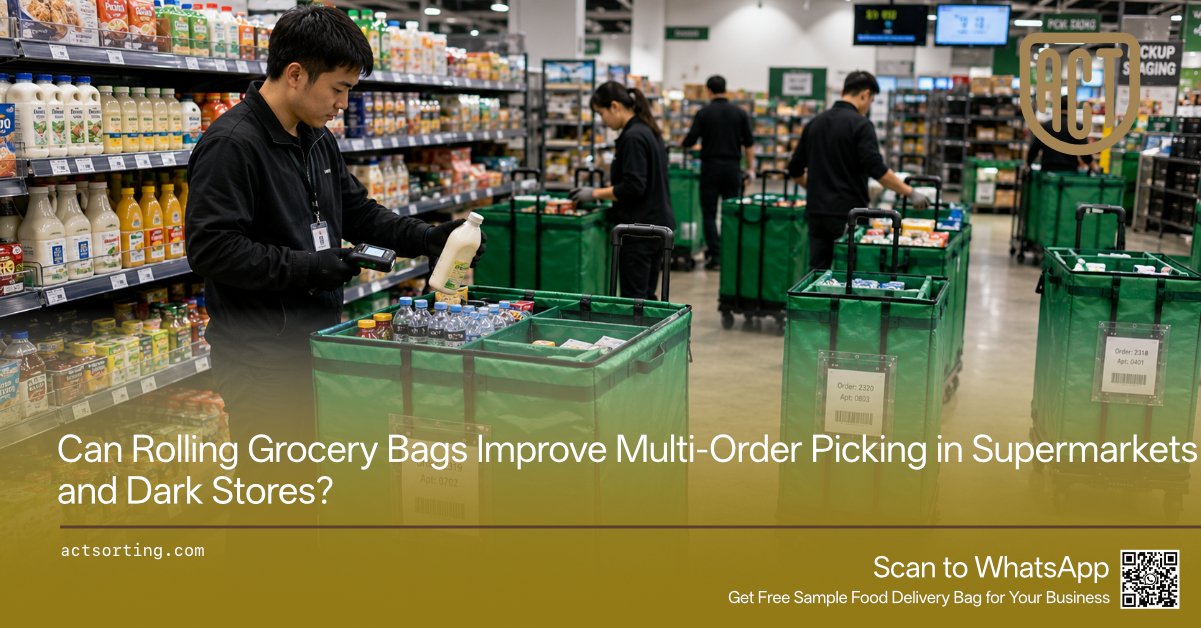
The first operational challenge appears inside the store or dark store, where employees need to collect dozens of different products while keeping every customer order accurate and separate. One worker may pick several orders during the same trip through the aisles, collecting bottled drinks, packaged foods, household products, produce, and other items from different departments.
Traditional picking usually depends on carts, baskets, totes, or several reusable bags placed together. The employee moves through the store, separates orders, returns to the staging area, transfers the groceries again, labels each group, and prepares them for pickup or delivery.
Every additional transfer creates another opportunity for products to become mixed, forgotten, damaged, or placed into the wrong customer order.
A Rolling Grocery Bag can become part of the picking process itself.
Instead of using the bag only after fulfillment is complete, retailers can develop wheeled grocery totes that move with the picker. Each bag becomes a clearly identified customer order or picking group. Once the picking process is finished, the same Rolling Grocery Bag can move toward staging without requiring the groceries to be transferred into another container.
For supermarket chains, dark stores, online grocery platforms, retail fulfillment centers, and grocery delivery companies, this can simplify the physical connection between picking, consolidation, staging, and dispatch.
ACTSORTING has specialized in commercial logistics bags since 2013. The company operates a manufacturing facility covering more than 12,000 square meters in Yangchun, Guangdong, China, supported by more than 400 experienced employees.
With BSCI and ISO9001 certification, ACTSORTING provides OEM & ODM manufacturing for Rolling Grocery Bags, reusable grocery delivery bags, sorting totes, parcel logistics bags, and other customized commercial bag solutions.
Rolling Grocery Bag projects can include custom dimensions, woven materials, laminated surfaces, wheel structures, telescopic handles, reinforced bases, lifting handles, transparent order pockets, internal dividers, closures, colors, logos, store identification, and bulk manufacturing requirements.
The objective is not simply to give a grocery bag wheels.
It is to remove unnecessary handling between the moment an employee picks the first product and the moment the completed order leaves the store.
1. Grocery Picking Becomes More Complicated When One Worker Handles Several Orders
Single-order picking is easy to understand. The employee receives one customer order, collects the products, returns to staging, and completes the order before starting another.
The process is simple but can require employees to travel through the same supermarket aisles repeatedly.
Batch picking improves travel efficiency by allowing one worker to collect products for several customer orders during the same picking trip. The employee may collect products for Order A, Order B, Order C, and Order D while moving through one section of the store.
The challenge is keeping those products separate.
A box of cereal for one customer can easily enter the wrong basket. Two customers may order similar products in different quantities. Small products can move between compartments. Bottled drinks take up more room than expected and force workers to rearrange the picking equipment halfway through the route.
The more orders one employee handles simultaneously, the more important physical separation becomes.
Traditional grocery carts may use plastic totes or baskets to divide orders. This can work well, but once picking is complete, the products may need to be transferred again into reusable grocery bags for staging, curbside pickup, or delivery.
That additional transfer consumes time and creates another point where order accuracy can be affected.
A Rolling Grocery Bag offers another option.
Several clearly identified wheeled bags can represent individual customer orders or picking groups. Workers collect groceries directly into the bag that will continue through the next stage of fulfillment.
ACTSORTING can customize bag dimensions according to the number of products typically included in online orders. Different colors, large transparent label pockets, printed numbers, or route markings can help employees identify the correct order while moving through the store.
This is one reason grocery fulfillment operators choose ACTSORTING. The product can be developed around the company’s picking method rather than being treated only as packaging used after picking is complete.
The operational value comes from reducing the number of times the same groceries need to change containers.
Every product transfer may take only a few seconds. Across thousands of items, humans somehow manage to turn those seconds into entire shifts.
2. Rolling Grocery Bags Can Turn Customer Orders Into Separate Mobile Picking Units
A digital grocery order exists inside the fulfillment software, but employees still need a physical place to put the products.
The closer the physical container matches the digital order, the easier it becomes to maintain order integrity.
A Rolling Grocery Bag can represent one customer order from the picking stage onward.
The employee scans the order, attaches or inserts the relevant order card into the transparent identification pocket, and begins collecting products directly into that bag. As the worker moves through the store, the customer’s products remain inside the same physical unit.
For larger batch-picking workflows, several Rolling Grocery Bags may be used together or organized according to the retailer’s equipment system.
The important point is that each bag has a visible identity.
ACTSORTING can customize transparent pockets for barcodes, QR codes, order numbers, customer references, pickup times, route information, or store-specific documents.
Permanent printed numbers can also identify reusable equipment, while removable cards provide information about the current customer order.
Color coding may support the system further.
One color may represent home delivery, another curbside pickup. Different webbing colors may identify picking zones or store departments. The exact logic should follow the customer’s existing workflow.
This makes the bag more than a container.
It becomes the physical representation of the digital order.
When picking is complete, the employee does not need to ask which products belong together. The entire Rolling Grocery Bag already represents the order.
This can simplify later verification and staging.
Choosing ACTSORTING allows retailers to develop the identification system, bag dimensions, colors, handles, and wheel structure as part of one customized product.
The result is a mobile customer-order unit rather than a generic wheeled shopping bag.
3. Wheels Reduce Repeated Cart-to-Bag Transfers During Grocery Fulfillment
A common grocery fulfillment workflow uses one type of equipment for picking and another type for staging or delivery.
Employees may pick products into a cart containing several plastic baskets. After completing the route, they return to the fulfillment area and transfer each basket into reusable grocery bags.
The transfer is understandable because the picking cart belongs to the store while the bag follows the customer order.
However, this means workers touch the same products again.
A Rolling Grocery Bag can reduce this separation between picking equipment and order container.
If the bag is designed for commercial picking, employees can move it through suitable store areas while collecting products. The same bag later moves toward staging.
The benefit becomes particularly visible with larger grocery orders.
Transferring several bottles of water, packaged drinks, household products, and boxes from a picking trolley into another bag creates unnecessary lifting. If those products were already loaded into a suitable Rolling Grocery Bag, the employee can simply move the completed unit.
The wheel structure needs to support this process.
A commercial model requires stable movement when the load gradually increases during picking. The bag may begin almost empty and become significantly heavier by the time the employee reaches the final aisle.
ACTSORTING can customize the wheeled base, bottom reinforcement, handle structure, and bag dimensions according to the expected order profile.
A supermarket mainly handling normal household orders may need one specification. A wholesale-style grocery operation with heavier beverage loads may require stronger lower support.
This is where the difference between a commercial Rolling Grocery Bag and a consumer shopping trolley becomes important.
A consumer product usually follows one shopper.
A commercial bag may circulate through picking, staging, delivery, return, cleaning, and storage repeatedly.
Choosing ACTSORTING allows the product to be developed around that repeated operating cycle.
4. Clear Order Identification Helps Prevent Mixed Customer Orders
Batch picking creates efficiency only if the products remain assigned to the correct customer.
When several orders travel through the store together, visual identification becomes critical.
A small handwritten label may be sufficient during a quiet shift. During a busy evening fulfillment window, employees need faster confirmation.
ACTSORTING can customize large transparent label holders on Rolling Grocery Bags so workers can see order information without opening the bag or searching for a tag.
The pocket can be designed around the customer’s existing barcode sheet, QR code, printed ticket, or picking document.
Position matters.
If the label is placed too low, products or neighboring bags may hide it. If it sits behind the telescopic handle, scanning becomes awkward. If the bag has identification on only one side, employees may need to rotate it during staging.
ACTSORTING can develop front, side, or multiple label positions depending on the workflow.
Color can also provide a second layer of confirmation.
For example, blue handles might represent delivery orders while green handles indicate curbside pickup. Another retailer may use different bag colors for specific store zones.
Color should support the digital system rather than replace scanning.
The worker sees the color first, checks the order number second, and scans when required.
This reduces the chance that an obviously incorrect bag moves through the workflow unnoticed.
Permanent equipment codes can also help retailers manage reusable assets. One Rolling Grocery Bag may carry a fixed store number and bag ID while its temporary customer-order card changes several times every day.
This combined system helps distinguish “which bag is this?” from “which order is this bag handling now?”
Choosing ACTSORTING allows both forms of identification to be designed into the product from the beginning.
The benefit is a clearer physical workflow with fewer ambiguous bags sitting around waiting for somebody experienced enough to remember what they are.
5. Internal Dividers Support Better Organization of Mixed Grocery Products
Grocery orders contain products that behave very differently inside one bag.
Bottles are dense and rigid. Produce can be relatively fragile. Boxes maintain their shape. Flexible packaged goods move easily. Small items can disappear beneath larger products.
Simply creating a large Rolling Grocery Bag does not automatically create good internal organization.
ACTSORTING can customize removable or fixed divider systems according to the customer’s product mix.
One section may hold beverages or heavier packaged goods. Another section can contain lighter products. Small items can remain in a more visible area rather than sliding underneath large cartons.
This can also help during batch picking.
A retailer may use dividers to create temporary order sections or product-category areas according to its operating model.
Removable structures provide flexibility.
When a larger single order requires the entire bag capacity, the divider can be adjusted or removed. For smaller orders, the same interior can be divided into more controlled sections.
The divider material should remain lightweight enough for repeated commercial use. It also needs to work with the bag’s folding, cleaning, and storage requirements.
ACTSORTING can customize divider size, position, material, attachment, and relationship with the reinforced base.
The opening should support the same internal structure.
A wide rectangular opening gives pickers a clearer view of the compartments and makes products easier to place without disturbing other groceries.
The benefit is better product organization during picking and easier verification at staging.
This is another area where ACTSORTING’s OEM & ODM capability becomes useful.
The manufacturer can develop the inside of the Rolling Grocery Bag around the retailer’s order profile instead of offering one empty compartment and leaving employees to negotiate the consequences.
6. Stable Bases Matter When Heavy Products Are Added During Picking
A grocery picking bag does not receive its entire load at once.
The weight increases gradually.
A worker may begin with cereal and packaged food, then add canned products, milk, beverages, detergent, or bottled water later in the picking route.
As the center of gravity changes, the Rolling Grocery Bag needs to remain stable.
A weak or narrow base can cause the bag to lean as heavy products accumulate. An unstable bag is harder to pull and more difficult to park beside shelves or staging racks.
The lower structure therefore matters throughout the entire picking process.
ACTSORTING can develop reinforced rectangular bases using stronger woven materials, support panels, additional webbing, protected corners, and wheel integration according to the expected load.
Heavy products should generally remain lower inside the bag, so the bottom receives significant concentrated pressure.
The wheel structure also needs to remain aligned as the load increases.
A Rolling Grocery Bag that moves smoothly while empty but becomes difficult to control after several beverage packs are added has passed an unusually generous definition of testing.
Commercial development needs to consider the loaded condition.
ACTSORTING can work from average and maximum grocery order weights, common product categories, operating surfaces, and store layouts when defining the lower structure.
The advantage is better stability during picking.
The benefit is smoother rolling, easier parking, and more predictable handling as the grocery order grows.
This type of targeted structural design also helps avoid unnecessary weight in the upper bag body.
Strength is added where the load actually goes.
7. Rolling Grocery Bags Can Move Directly From Picking to Staging
The transition between picking and staging is one of the strongest reasons to integrate a Rolling Grocery Bag into the fulfillment process.
When the same bag remains with the order, the employee does not need to unload and rebuild the customer’s grocery group after returning from the store aisles.
The completed bag can move directly toward the appropriate staging area.
A curbside order moves to pickup staging. A delivery order moves to its route group. A customer scheduled for a later collection window may move into another designated area.
The transparent order pocket remains attached throughout the process.
This provides continuity.
One physical order enters picking, becomes complete, moves to staging, and eventually reaches pickup or delivery without changing containers unnecessarily.
For dark stores, where most orders are processed digitally, this can be particularly useful. The fulfillment facility can develop standardized Rolling Grocery Bags as part of the internal equipment fleet.
Dimensions can be selected according to aisle width and staging density.
The telescopic handle can retract when the bag is parked, helping reduce interference between neighboring orders. Stable rectangular bases allow bags to stand in organized rows.
ACTSORTING can also customize printed staging zones, store codes, route areas, or color systems according to the retailer’s operation.
The advantage is continuity between stages.
The benefit is less product transfer, fewer opportunities for order mixing, and a simpler physical workflow.
Choosing ACTSORTING allows these requirements to be considered before the sample is produced.
The bag can be designed for what happens before and after picking, not only for the few minutes when an employee is pulling it through an aisle.
8. OEM & ODM Customization Connects the Bag to the Store Picking Process
Different grocery retailers use different picking methods.
Some employees pick one order at a time. Others batch several orders. Some stores use wide supermarket aisles, while dark stores may have narrower warehouse-style layouts. Some businesses handle mostly packaged groceries, while others process large beverage volumes.
A useful Rolling Grocery Bag should reflect these differences.
ACTSORTING’s OEM & ODM process can begin with practical operating information:
How many orders does one employee pick at once? What is the average order size? What is the maximum expected load? How wide are the aisles? How are bags staged? What barcode or label system is already used? Do employees need internal dividers? How does the completed order reach the delivery vehicle?
From this information, the product can be customized in dimensions, material, wheel configuration, telescopic handle, lifting handles, reinforced base, opening structure, dividers, transparent order pockets, colors, logos, store codes, and packaging.
A dark store may prioritize a narrow Rolling Grocery Bag that moves easily through dense picking aisles. A large supermarket may need more capacity. A delivery-focused operation may require stronger lifting handles because the bag frequently enters vans.
ACTSORTING can develop the sample from drawings, reference photographs, existing products, store dimensions, or current operational pain points.
The sample should then be tested using normal grocery products.
Employees should pick with it, turn through aisles, add heavy products, scan the label, park the bag in staging, lift it where necessary, and evaluate whether the design fits the real workflow.
This testing is the practical value of customization.
Choosing ACTSORTING means the customer does not need to purchase a generic Rolling Grocery Bag first and discover afterward which parts interfere with the picking operation.
9. Why Grocery Fulfillment Operators Choose ACTSORTING
A commercial grocery program needs manufacturing support beyond the first sample.
ACTSORTING has specialized in commercial logistics bags since 2013. The company operates a production facility covering more than 12,000 square meters in Yangchun, Guangdong, China, with more than 400 experienced employees.
BSCI and ISO9001 certification support responsible production and structured quality management.
For grocery fulfillment operators, ACTSORTING can support product development from initial requirements through customized sampling, structural adjustment, bulk production, and future replenishment.
Rolling Grocery Bags can be customized around store workflows rather than consumer shopping habits.
The company can adapt the wheeled base for expected loads, adjust dimensions for picking aisles, develop transparent order identification, add internal dividers, reinforce the bottom, customize handle structures, and integrate branding.
This combination is one reason grocery operators choose ACTSORTING.
The product can support several parts of the operation at once: picking, order separation, staging, movement, delivery, reusable circulation, and storage.
The factory’s manufacturing scale also matters for chain-store programs.
A successful pilot may begin with several stores and later expand across a regional or national network. Procurement needs the same product specification to remain available as the program grows.
ACTSORTING can support that transition from sample to commercial volume.
The company is not simply manufacturing a red bag with wheels.
It is helping turn a reusable bag into standardized grocery fulfillment equipment, which admittedly sounds less glamorous but is considerably more useful to the people paying for it.
10. Stable Bulk Production Supports Standardized Multi-Store Picking Programs
A grocery chain may develop an effective picking workflow in one pilot location and then decide to introduce it across multiple stores.
At that point, product consistency becomes essential.
If one batch of Rolling Grocery Bags is wider than another, aisle movement changes. If label pockets move to another position, training instructions become inaccurate. If wheel configuration changes, employees experience different handling. If the base structure varies, loaded stability becomes inconsistent.
ACTSORTING can use the approved sample and confirmed technical specification as the reference for bulk manufacturing.
Material, dimensions, tolerances, wheel structure, telescopic handle, lifting handles, bottom reinforcement, divider configuration, transparent pockets, colors, printing, and packaging can be confirmed before production.
This helps grocery companies establish a standardized equipment system across locations.
Employees transferring between stores encounter familiar bags. Training materials remain relevant. Store managers understand how much staging space each unit requires. Replacement stock fits the existing workflow.
Repeat production is equally important.
Online grocery demand changes over time. New stores may join the fulfillment program. Peak seasons require additional capacity. Existing Rolling Grocery Bags eventually need replacement.
A manufacturing partner capable of reproducing the approved specification allows the retailer to expand without redesigning the equipment every time.
ACTSORTING’s 12,000+ square meter production facility and workforce of over 400 employees support customized bulk orders, multi-store rollouts, seasonal procurement, and repeat manufacturing.
For supermarkets, dark stores, grocery delivery companies, and retail fulfillment centers dealing with repeated cart-to-bag transfers, mixed customer orders, inefficient batch picking, or crowded staging areas, the next Rolling Grocery Bag project should begin with the picking workflow.
Provide the average order size, maximum load, picking method, aisle dimensions, common grocery products, staging layout, wheel requirements, handle requirements, divider needs, label format, colors, logo, and target quantity to receive a customized proposal from ACTSORTING.
The shortest grocery fulfillment process is usually the one that avoids handling the same products more times than necessary.
A well-designed Rolling Grocery Bag can start removing those extra movements before the order ever reaches the delivery van.
FAQ
Q: Can a Rolling Grocery Bag be used during supermarket order picking?
A: Yes. A commercial Rolling Grocery Bag can be customized for grocery picking, allowing products to be collected directly into a reusable wheeled order unit that can later move into staging or dispatch.
Q: Is a Rolling Grocery Bag suitable for batch picking?
A: It can support batch-picking workflows when order identification, bag capacity, dividers, colors, and store procedures are designed appropriately. ACTSORTING can customize these features according to the retailer’s fulfillment method.
Q: Can ACTSORTING add barcode or QR code order pockets?
A: Yes. Transparent identification pockets can be customized for barcode sheets, QR codes, customer order cards, store documents, route information, and other picking or staging requirements.
Q: Can internal dividers be customized for grocery picking?
A: Yes. Removable or fixed divider systems can separate heavy products, smaller groceries, different product categories, or order sections according to the customer’s workflow.
Q: Why choose ACTSORTING for Rolling Grocery Bag projects?
A: ACTSORTING has specialized in logistics bags since 2013, operates a 12,000+ square meter factory with over 400 employees, holds BSCI and ISO9001 certification, and supports OEM & ODM development, customized bulk manufacturing, multi-store programs, and repeat orders.