
Table of Contents
- The Real Cost of a Rolling Grocery Bag Starts After the First Delivery
- Frequent Replacement Creates Hidden Costs for Grocery Operations
- Durable Materials Help Rolling Grocery Bags Survive Daily Commercial Use
- Reinforced Structures Protect High-Wear Areas During Repeated Handling
- Easy-Clean Surfaces Support More Hygienic Grocery Delivery Workflows
- Foldable Designs Improve Storage Between Delivery Cycles
- Standardized Rolling Grocery Bags Help Multi-Store Operations
- OEM & ODM Customization Builds Bags Around Real Grocery Workflows
- Why Grocery Companies Choose ACTSORTING for Long-Term Supply
- Bulk Manufacturing Supports Growing Grocery Delivery Networks
Introduction
Many grocery companies focus on the first purchase price when selecting a Rolling Grocery Bag. The quotation looks simple: how much does each bag cost, how many units are required, and when can production be completed?
However, commercial grocery operations quickly discover that the real cost appears after the first delivery cycle.
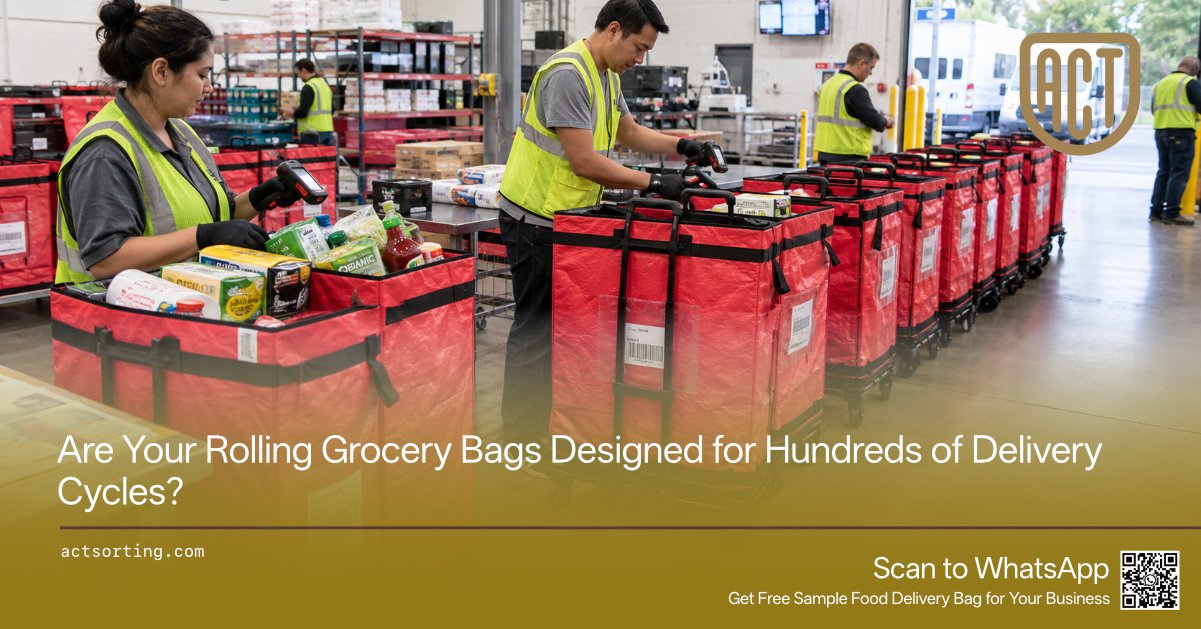
A Rolling Grocery Bag used in a supermarket or grocery delivery network may move through hundreds of handling processes. Employees load products, move orders to staging areas, roll bags through store spaces, place them into vehicles, unload them at delivery points, clean them, fold them, store them, and prepare them for the next customer.
The bag is not used once. It becomes a reusable operational tool.
A low-cost bag that needs frequent replacement can create unexpected expenses. Procurement teams must reorder stock, warehouse managers must handle inconsistent equipment, employees must adapt to different bag conditions, and operations may lose efficiency when suitable replacements are unavailable.
For supermarket chains, online grocery platforms, dark stores, grocery delivery companies, and retail fulfillment operators, the better question is not simply “How much does one bag cost?”
The better question is “How many successful delivery cycles can this bag support?”
ACTSORTING has specialized in commercial logistics bags since 2013. The company operates a manufacturing facility covering more than 12,000 square meters in Yangchun, Guangdong, China, with more than 400 experienced workers.
Supported by BSCI and ISO9001 certification, ACTSORTING develops Rolling Grocery Bags, reusable grocery totes, commercial delivery bags, and customized retail logistics solutions for businesses requiring stable quality and long-term supply.
Through OEM & ODM manufacturing, ACTSORTING can customize woven materials, dimensions, wheel structures, telescopic handles, reinforced bottoms, colors, logo printing, identification pockets, internal dividers, closures, and packaging.
A professional Rolling Grocery Bag should not only survive the first shipment from the factory.
It should continue working after hundreds of real grocery orders.
1. The Real Cost of a Rolling Grocery Bag Starts After the First Delivery
A new Rolling Grocery Bag always looks impressive.
The fabric is clean. The printing is sharp. The wheels move smoothly. The handle extends perfectly. The product photograph looks exactly like the supplier promised.
Then normal operations begin.
The bag enters a real grocery environment where it encounters beverage bottles, packaged food, household products, warehouse floors, delivery vehicles, loading areas, moisture, dust, and repeated employee handling.
This is where product differences become visible.
A bag with weak stitching may begin showing loose threads around the handles. A poor-quality wheel base may become unstable after repeated loading. A thin bottom panel may develop wear from daily movement. A surface that cannot be cleaned easily may gradually become unsuitable for customer-facing delivery.
The initial purchase price does not show these costs.
A grocery company purchasing 5,000 units may discover after several months that a percentage of the bags need repair or replacement. The company may need emergency purchasing, additional inventory storage, or temporary alternatives.
ACTSORTING approaches Rolling Grocery Bag development from a lifecycle perspective. The product is designed around repeated commercial use rather than occasional personal shopping.
Material selection, reinforcement areas, wheel attachment, handle structure, and folding performance are considered together.
For example, a supermarket delivery program with heavy beverage orders may require stronger lower reinforcement. A curbside pickup system may prioritize easy identification and fast cleaning. A dark store operation may require compact storage between delivery cycles.
The correct design depends on how the bag works every day.
Choosing ACTSORTING means developing a reusable grocery bag based on operational reality rather than judging quality only when the product is still sitting inside the shipping carton.
The benefit is a more predictable service life and fewer unexpected replacement problems after deployment.
2. Frequent Replacement Creates Hidden Costs for Grocery Operations
Replacing a damaged Rolling Grocery Bag involves more than buying another physical product.
There is procurement time. There is shipping cost. There is warehouse receiving. There is inventory management. There is employee adjustment. There is the possibility that the replacement does not match the original design.
For a small operation, this may be manageable.
For a supermarket chain operating dozens or hundreds of locations, repeated replacement becomes a system problem.
Imagine a grocery company using different versions of bags across different stores because replacement orders were made separately over time. One location uses a different size. Another has different label pockets. Another has a different handle structure.
The equipment may still function, but standardization becomes harder.
Employees need to learn different handling methods. Storage systems become less efficient. Drivers and warehouse teams spend additional time understanding which bag belongs where.
ACTSORTING supports businesses that need consistent commercial grocery equipment.
Through OEM & ODM development, customers can establish a standardized Rolling Grocery Bag specification including dimensions, materials, colors, logos, identification systems, wheel structures, and packaging.
Once approved, the same design can support future production runs.
This is especially valuable for growing grocery delivery networks. A company opening new stores or expanding online fulfillment capacity needs equipment that can be reproduced reliably.
The goal is not simply producing more bags.
The goal is creating a repeatable operational tool.
ACTSORTING’s manufacturing facility in Guangdong provides the production capacity required for customized bulk orders, while BSCI and ISO9001 certification support structured manufacturing processes.
For grocery operators, this creates a more stable supply relationship.
The benefit is lower disruption from frequent replacement and easier management across multiple locations.
A cheap bag that constantly needs replacing is not cheap. It is simply sending the invoice in smaller pieces, because apparently even equipment has learned subscription pricing.
3. Durable Materials Help Rolling Grocery Bags Survive Daily Commercial Use
Commercial grocery bags face much more demanding conditions than household shopping bags.
A consumer may use a shopping trolley once or twice per week. A grocery delivery company may move the same Rolling Grocery Bag several times every day.
The difference is enormous.
Repeated use requires materials that can handle friction, folding, loading pressure, cleaning, and transportation.
ACTSORTING can customize woven materials, laminated surfaces, reinforcement layers, and structural components according to the application.
For grocery delivery operations, laminated woven materials may provide advantages by creating a surface that is easier to clean and maintain. Reinforced woven structures can improve resistance against repeated handling.
However, durability does not mean simply making everything thicker.
An excessively rigid bag may become difficult to fold and store. An overly heavy structure may increase handling effort. The best solution balances strength, weight, flexibility, and operational convenience.
ACTSORTING evaluates the complete usage scenario.
What products are usually loaded? How heavy are typical orders? How often does the bag move? Does it travel inside delivery vehicles? How is it cleaned? How is it stored?
These questions influence the final construction.
A Rolling Grocery Bag designed for supermarket pickup may require different materials compared with one used for grocery delivery routes involving outdoor movement.
This customized approach helps customers avoid two common mistakes.
The first is choosing a bag that is too weak and requires constant replacement.
The second is choosing an unnecessarily heavy bag that creates additional handling costs.
ACTSORTING’s experience in commercial bag manufacturing allows customers to find a more practical balance.
The benefit is a reusable grocery bag that remains functional through repeated business cycles while maintaining manageable weight and handling performance.
4. Reinforced Structures Protect High-Wear Areas During Repeated Handling
Not every part of a Rolling Grocery Bag experiences the same stress.
The bottom contacts surfaces. The handle receives pulling force. The wheel connection supports movement. Corners experience impact. Seams carry tension when the bag is heavily loaded.
These areas usually determine service life.
A common mistake is strengthening the entire bag equally. This increases material usage but does not necessarily improve the areas that fail first.
ACTSORTING focuses on targeted reinforcement.
The bottom can be strengthened for heavier grocery products such as beverages and bulk household goods. Handle attachment areas can receive additional support. Wheel connection zones can be reinforced to improve stability during movement.
The body of the bag can remain flexible enough for storage and daily handling.
This approach is especially useful for Rolling Grocery Bags because the product combines soft textile construction with mechanical movement components.
The bag body needs flexibility. The rolling structure needs stability. The connection between these two systems requires thoughtful design.
ACTSORTING can customize reinforcement based on customer feedback, damaged samples, photographs, and operating conditions.
A supermarket chain may discover that the lower corners wear first. A delivery company may find that the handle attachment needs improvement. A fulfillment center may need stronger side panels because of heavier product combinations.
These real-world details become design information.
The advantage is using material where it creates the most value.
The benefit is longer service life without unnecessary weight or complexity.
For commercial buyers, the strongest bag is not the one with the most reinforcement everywhere.
It is the one reinforced in the places where the work actually happens.
5. Easy-Clean Surfaces Support More Hygienic Grocery Delivery Workflows
Grocery operations have a unique requirement compared with many other logistics environments.
The equipment is connected directly with food and household products.
Rolling Grocery Bags move through stores, loading areas, vehicles, and customer-facing environments. Over time, they may encounter dust, spills, moisture, and normal grocery handling residue.
A surface that is difficult to clean can reduce the practical lifespan of the product.
Employees may avoid using visibly dirty equipment. Managers may remove bags from circulation earlier than necessary. Customer-facing operations may experience inconsistent appearance.
ACTSORTING can customize materials and surfaces according to cleaning requirements.
Laminated woven fabrics can provide a smoother exterior surface for wiping. The bag structure can also be designed to reduce areas where dirt accumulates.
Identification pockets, seams, bottom panels, and corners should all be considered because these areas often collect the most residue.
Cleaning is part of the reusable lifecycle.
A Rolling Grocery Bag that can be quickly cleaned and returned to service creates more value than a product that technically lasts longer but becomes difficult to manage.
ACTSORTING works with customers to understand their cleaning routines and operating environment.
Some businesses may need frequent quick cleaning between orders. Others may require stronger resistance against outdoor conditions.
The design can follow the workflow.
The benefit is better equipment appearance, easier maintenance, and improved confidence that reusable bags remain suitable for continuous commercial operation.
A reusable product only creates savings when employees are willing and able to keep reusing it.
6. Foldable Designs Improve Storage Between Delivery Cycles
A grocery company does not only manage full bags.
It also manages empty bags.
After delivery, thousands of Rolling Grocery Bags eventually return to storage locations. If they cannot be organized efficiently, they consume valuable warehouse space.
Foldability therefore becomes an important part of commercial design.
ACTSORTING can develop the soft bag structure, folding method, support components, and storage approach according to customer requirements.
A bag used across multiple stores may need to collapse into a standardized size for transportation. A dark store may require compact storage because every square meter is valuable. A delivery fleet may need to return empty bags efficiently after completing routes.
The challenge is balancing structure and flexibility.
The bag needs enough support when loaded but should not become unnecessarily bulky when empty.
ACTSORTING can customize materials, removable supports, folding direction, and storage straps to create a practical reusable cycle.
This is especially valuable for businesses operating seasonal demand changes.
During promotions or holidays, additional Rolling Grocery Bags may be deployed quickly. After peak periods, unused bags need to return to storage without occupying excessive space.
The benefit is improved warehouse organization and easier equipment circulation.
The bag works during delivery and remains practical after delivery.
7. Standardized Rolling Grocery Bags Help Multi-Store Operations
Large grocery companies often operate many locations with similar but not identical workflows.
One store may have a larger online order volume. Another may have limited staging space. Another may focus more heavily on delivery than curbside pickup.
A standardized Rolling Grocery Bag system helps maintain consistency while allowing necessary customization.
ACTSORTING can create product families where different sizes share common features.
For example, multiple capacities can use the same color system, logo placement, identification pocket position, handle style, and wheel structure.
Employees transferring between locations immediately understand the equipment.
Procurement teams can manage fewer specifications.
Replacement orders become easier because the product standard is clearly defined.
This is particularly valuable for grocery companies expanding online fulfillment.
A new store should not need to redesign its equipment system from the beginning.
ACTSORTING supports this process through OEM & ODM development and bulk manufacturing.
Customers can build a product specification that grows with their business.
The benefit is operational consistency across locations.
A good equipment system allows a company to expand without creating a collection of unrelated bags that each have their own small operational personality.
8. OEM & ODM Customization Builds Bags Around Real Grocery Workflows
Every grocery operation has different requirements.
Some need maximum capacity. Some need compact storage. Some need stronger wheels. Some need additional order identification. Some need specific colors for internal sorting.
ACTSORTING provides OEM & ODM services to adapt Rolling Grocery Bags according to these requirements.
Customers can customize:
- Bag dimensions
- Material structure
- Colors
- Logo printing
- Transparent label holders
- Wheel systems
- Telescopic handles
- Bottom reinforcement
- Internal dividers
- Closures
- Packaging
The development process can begin from existing samples, drawings, photographs, or operational problems.
A grocery company does not need to accept a standard consumer trolley design and adjust its workflow around it.
The equipment can be designed around the workflow.
This is one of the main differences between consumer products and commercial solutions.
A commercial Rolling Grocery Bag needs to consider employees, vehicles, storage areas, customer handoff, and repeated cycles.
ACTSORTING combines manufacturing experience with customization capability to support these requirements.
The benefit is a product that fits the business instead of forcing the business to adapt around the product.
9. Why Grocery Companies Choose ACTSORTING for Long-Term Supply
ACTSORTING has focused on commercial bag manufacturing since 2013.
The company operates a production facility exceeding 12,000 square meters in Yangchun, Guangdong, China, with more than 400 workers supporting product development and manufacturing.
For grocery operators, this means access to a supplier capable of supporting both customized development and large-volume production.
ACTSORTING’s experience covers reusable logistics bags, delivery bags, sorting solutions, and commercial transport products.
Rolling Grocery Bag projects can include prototype development, material selection, structural optimization, testing adjustments, and final bulk production.
Supported by BSCI and ISO9001 certification, ACTSORTING maintains structured manufacturing processes for customers requiring consistent commercial supply.
The reason grocery companies choose ACTSORTING is not only factory capacity.
It is the ability to understand how a bag participates in a real operation.
A grocery bag is connected to picking, staging, delivery, storage, and customer experience.
The product needs to support all of those stages.
10. Bulk Manufacturing Supports Growing Grocery Delivery Networks
As online grocery continues expanding, equipment demand grows with it.
A successful pilot program may become hundreds of stores. A regional grocery service may expand into new cities. A delivery operation may need thousands of additional bags during seasonal demand.
The supplier must support growth.
ACTSORTING provides bulk manufacturing capability for customized Rolling Grocery Bags.
Once the product specification is approved, future production can follow the same requirements for materials, dimensions, colors, wheels, handles, reinforcement, identification systems, and packaging.
This consistency helps businesses maintain the same operational standards as they expand.
For supermarket chains, grocery delivery companies, dark stores, and fulfillment operators, reliable equipment supply is part of reliable customer service.
A missing grocery order creates frustration. A delayed pickup creates frustration. A broken delivery bag creates frustration.
Small equipment problems eventually reach the customer.
ACTSORTING helps businesses reduce these problems through customized product development and stable production.
For companies planning a Rolling Grocery Bag program, provide the expected order volume, bag size, product types, store environment, wheel requirements, branding requirements, and delivery workflow information to receive a customized manufacturing proposal.
The best reusable grocery equipment is not simply the bag that carries products.
It is the bag that continues supporting the business after thousands of products have already passed through it.
FAQ
Q: How long can a commercial Rolling Grocery Bag be used?
A: The service life depends on materials, construction, load conditions, cleaning routines, frequency of use, and operating environment. ACTSORTING designs products according to expected commercial cycles rather than one-time consumer use.
Q: Can ACTSORTING customize Rolling Grocery Bags for supermarket chains?
A: Yes. ACTSORTING supports OEM & ODM customization including size, material, wheel structure, handles, colors, logos, order pockets, reinforcement, and packaging for supermarket and grocery delivery programs.
Q: Are Rolling Grocery Bags suitable for online grocery fulfillment?
A: Yes. They can support order staging, curbside pickup, grocery delivery, and dark store workflows by helping consolidate and move customer orders more efficiently.
Q: Can the bag structure be reinforced without making it too heavy?
A: Yes. ACTSORTING can reinforce high-stress areas such as bottoms, corners, handles, and wheel connections while keeping the main body practical for daily handling and storage.
Q: Why choose ACTSORTING for commercial Rolling Grocery Bags?
A: ACTSORTING has specialized in logistics bag manufacturing since 2013, operates a 12,000+ square meter factory with over 400 employees, holds BSCI and ISO9001 certification, and supports customized bulk production for grocery and logistics companies.