

Table of Contents
- Mixed Parcel Sizes Create More Problems Than Most Buyers Expect
- Oversized Bags Waste Space When Routes Carry Mostly Small Packages
- Undersized Parcel Sorting Sacks Force Workers to Overload or Repack
- A Better Bag Size System Begins With Real Parcel Data
- Structured Openings Make Mixed Cartons Faster to Load
- Internal Dividers Keep Small Parcels From Disappearing Under Large Boxes
- Van Loading Totes Must Match Both Vehicle Space and Route Volume
- Foldable Designs Provide Capacity Without Permanent Storage Pressure
- OEM & ODM Manufacturing Turns Parcel Profiles Into Practical Bag Sizes
- ACTSORTING Supports Scalable Bag Systems for Complex Delivery Networks
Introduction
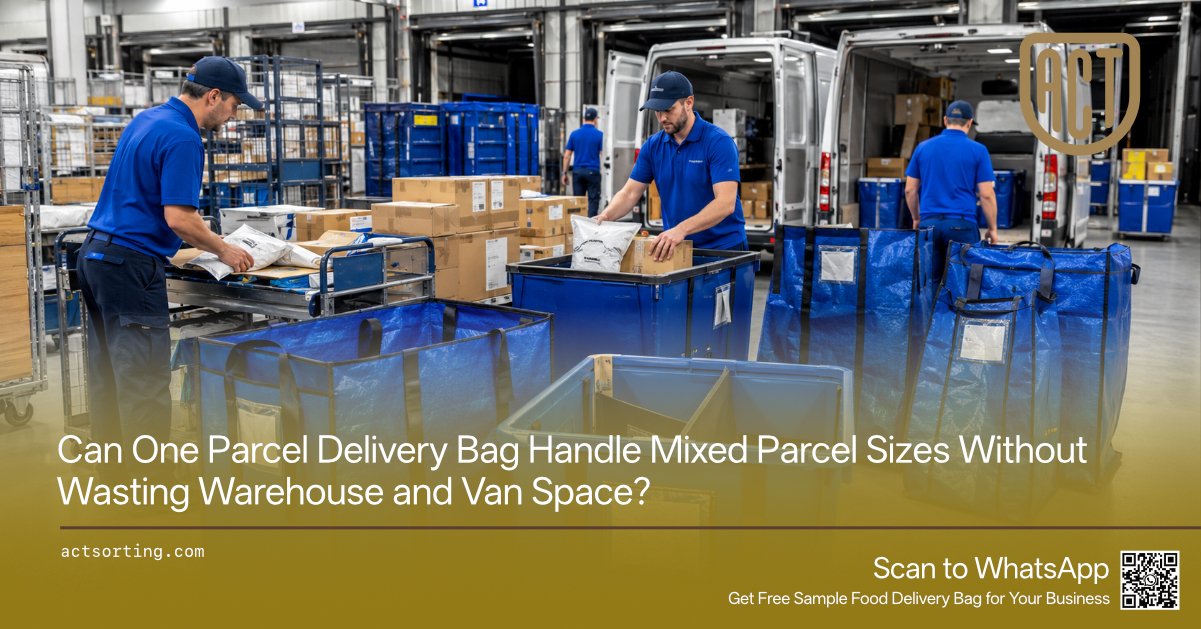
Most parcel delivery operations do not handle one convenient box size. A single route may contain flat poly mailers, shoe boxes, electronics cartons, document envelopes, irregular retail packages, and several larger boxes that seem determined to ruin every loading plan around them. Warehouse workers are expected to sort this mixture quickly, place it into bags, move it through staging lanes, and load it into a delivery van without wasting space or damaging the parcels.
This is where a poorly selected Parcel Delivery Bag creates problems long before anyone notices a material defect. A bag may be durable, well stitched, and reasonably priced, yet still perform badly because its dimensions do not match the actual parcel mix. Oversized bags remain half empty, collapse inside van shelves, and take up more space than the route requires. Undersized bags become overloaded, difficult to close, and unsafe to lift. Workers then divide one route across extra bags, move parcels again, or improvise with whatever empty container happens to be nearby.
These adjustments consume time and gradually destroy the intended sorting system. One route that should use three Last-Mile Delivery Totes suddenly needs five. A Van Loading Tote that looked efficient on a drawing cannot fit beneath the shelf when filled with tall cartons. Small mailers slide beneath larger packages and become difficult for drivers to find. The problem is not simply capacity. It is the relationship between bag dimensions, parcel profile, loading behavior, warehouse equipment, and vehicle space.
ACTSORTING has specialized in industrial logistics bags since 2013. The company operates a manufacturing facility covering more than 12,000 square meters in Yangchun, Guangdong, China, with over 400 experienced workers. ACTSORTING produces Parcel Delivery Bags, Parcel Sorting Sacks, Courier Sorting Totes, Last-Mile Delivery Totes, Van Loading Totes, and DSP Delivery Supplies for parcel delivery companies, e-commerce fulfillment centers, courier networks, postal operators, warehouse groups, and Amazon DSP-style delivery stations across Europe and North America.
Supported by BSCI and ISO9001 certification, ACTSORTING provides OEM & ODM manufacturing services covering fabric materials, dimensions, colors, logo printing, transparent label holders, closures, handle positions, reinforced structures, internal dividers, folded designs, and large-volume repeat production. The objective is not to create the biggest possible bag. It is to create a bag system that fits the parcels, the workers, the warehouse, and the vehicles without wasting capacity at every stage.
1. Mixed Parcel Sizes Create More Problems Than Most Buyers Expect
A parcel route rarely contains a neat collection of identical cartons. E-commerce delivery mixes products from different sellers, warehouses, and categories into the same route. One bag may need to hold clothing mailers, cosmetics boxes, books, household goods, electronic accessories, and irregular packages with weak outer cartons. The route volume may appear manageable by parcel count, but the physical combination can behave unpredictably.
Large cartons create empty gaps around them. Flat mailers slide into those gaps and become difficult to see. Small boxes settle at the bottom while heavier packages press down from above. Workers may continue adding parcels because the bag still appears to have space, even though the load has become unstable and difficult to handle.
This creates sorting and delivery problems. A worker may need to unload several packages to locate one small mailer. A driver may believe a parcel is missing because it has slipped beneath a larger carton. A bag may bulge beyond its intended width and no longer fit the van shelf. The closure may not reach across the opening, leaving the contents exposed during transportation.
A suitable Parcel Delivery Bag should therefore be selected according to more than total volume. Buyers need to consider the dimensions and proportions of the parcels entering the bag. A route containing 50 thin mailers behaves differently from a route containing 20 medium boxes, even if both groups occupy a similar theoretical volume.
ACTSORTING can develop Courier Sorting Totes according to actual parcel profiles, including common carton dimensions, average route count, maximum item size, total load, and handling method. A wider opening may help mixed cartons enter without catching. A more rectangular structure may reduce unusable gaps. Internal dividers may separate small packages from larger boxes.
The advantage is a more stable parcel group. Workers load faster, drivers search within a clearer arrangement, and bags fit vehicles more predictably. The evidence appears when one route consistently uses the planned number of totes instead of expanding into extra bags halfway through the morning shift.
Mixed parcel sizes are unavoidable. Allowing them to dictate the entire warehouse layout through daily improvisation is not.
2. Oversized Bags Waste Space When Routes Carry Mostly Small Packages
Large bags often look efficient because they appear to offer more capacity for a similar unit cost. Procurement teams may assume that a bigger Parcel Delivery Bag provides greater flexibility. In practice, oversized bags can create just as many problems as bags that are too small.
When a route contains mostly small packages, a large tote may remain only partially filled. Its soft walls collapse inward, parcels spread across the bottom, and the bag still occupies nearly its full footprint inside the van. Several half-empty bags can consume more shelf or floor space than a smaller, better-sized tote system.
The oversized body also makes handling less predictable. Workers may continue adding parcels simply because the bag appears empty, eventually creating a load that is too heavy or difficult to close. If the bag is lifted by long handles while only partially filled, cartons may shift toward one side and make the tote unstable.
Van loading becomes less efficient as well. A tall bag may block shelves even when it contains only a small parcel group. A wide tote may prevent another bag from fitting beside it. The delivery vehicle loses usable capacity without actually carrying more packages.
ACTSORTING can help customers create several standardized Parcel Delivery Bag sizes instead of relying on one oversized model for every route. A compact Courier Sorting Tote may handle dense urban routes with small parcels. A medium Last-Mile Delivery Tote can serve normal mixed delivery. A larger Parcel Sorting Sack may be reserved for high-volume routes or bulky packages.
This tiered approach gives warehouse teams more control. Workers select the tote according to expected route volume rather than forcing every parcel group into the same container. Fleet managers also gain a more predictable loading plan because each bag size has a defined role.
The benefit is better use of warehouse and vehicle space. Folded storage also becomes easier because smaller bags occupy less space when not required. Procurement teams may manage several approved models, but they avoid the much larger daily cost of using an inefficient oversized bag everywhere.
A bigger bag is not automatically a more productive bag. Sometimes it is simply a larger piece of fabric carrying an impressive amount of air.
3. Undersized Parcel Sorting Sacks Force Workers to Overload or Repack
An undersized Parcel Sorting Sack creates the opposite problem. The route contains more parcels than the bag can handle, but the dispatch schedule does not pause while someone finds a better container. Workers respond in predictable ways: they overload the bag, divide the route across unplanned totes, leave the closure open, or transfer parcels after the original bag is already full.
Overloading places extra stress on the material, seams, handles, and bottom panel. The bag expands beyond its intended shape, making it harder to lift and less likely to fit the staging rack or van shelf. Zippers become difficult to close. Hook-and-loop flaps cannot overlap correctly. Small parcels may fall from the opening during movement.
The route identification system also becomes less clear. If one planned route bag turns into two or three additional sacks, workers need extra labels and staging positions. One replacement bag may not match the original color or size. Drivers may not know that the same stop range has been divided across several containers.
Repacking creates further labor cost. Workers unload parcels, search for another tote, insert new labels, and move the bags to the correct staging lane. During busy dispatch periods, this is exactly the type of interruption that causes route departure delays.
ACTSORTING can customize Parcel Sorting Sacks according to expected route volume and maximum parcel dimensions. The bag opening, body width, depth, and height can be adjusted together rather than increasing only one measurement. Reinforced handles and bottoms can support higher loads when larger capacity is genuinely required.
Customers can also develop a controlled overflow model. For example, a standard blue Last-Mile Delivery Tote may serve normal route volume, while a smaller blue tote with an “Overflow” marking handles additional parcels. The route remains visually consistent, and drivers understand that both bags belong together.
The advantage is a planned response to volume variation. Workers do not need to search for random spare bags or overload the standard tote. The benefit is fewer handling interruptions, more reliable closures, and clearer vehicle loading.
A bag should have enough capacity for its assigned task. It should not need optimism, creative stretching, and three warehouse workers sitting on the flap to make it close.
4. A Better Bag Size System Begins With Real Parcel Data
Selecting bag dimensions through guesswork usually produces a product that is technically usable and operationally mediocre. A more reliable system begins with real parcel data.
Logistics teams should review common parcel dimensions, average parcel count per route, maximum carton size, typical route volume, average load weight, vehicle dimensions, shelf measurements, and seasonal variation. These figures reveal whether one bag size can support most operations or whether several models are needed.
For example, a fashion e-commerce network may handle a high percentage of flexible poly mailers and small shoe boxes. It may benefit from tall, lightweight Courier Sorting Totes with wide openings. A consumer electronics courier may handle denser rectangular cartons that require stronger bottoms and lower tote heights. A mixed retail route may need internal separation so small packages remain visible beside larger boxes.
Parcel count alone can be misleading. Forty mailers may fit easily inside one Parcel Delivery Bag, while forty medium cartons may require several totes. Weight also matters. A bag may have enough physical volume but become too heavy for safe one-person handling before it is full.
ACTSORTING can work from customer parcel samples, dimension lists, warehouse photographs, route records, van measurements, existing bags, or technical drawings. The OEM & ODM team can develop a size range based on how the operation actually behaves.
A customer may choose three coordinated models with common label holders, colors, handles, and closures. The small model handles compact parcel groups, the medium model serves standard routes, and the large model supports bulky or high-volume loads. Workers recognize the shared system even though the capacities differ.
The benefit is controlled variation instead of uncontrolled improvisation. Procurement manages a limited approved range, warehouse teams use the right bag for each parcel profile, and fleet managers can plan loading around known dimensions.
Evidence comes from fewer overflow bags, less unused tote volume, more consistent van loading, and reduced repacking. A good size system does not require every parcel to fit perfectly. It simply handles the normal mix without making each shift invent a new solution.
5. Structured Openings Make Mixed Cartons Faster to Load
The opening is where every parcel enters the bag, yet it often receives less attention than the body dimensions. A bag may offer sufficient internal volume but still load poorly because the mouth is narrow, unstable, or badly shaped.
Mixed cartons need a clear opening. Large boxes may catch against soft side panels, while flat mailers fold around the edge. If the bag collapses after every parcel is inserted, the worker must reopen it repeatedly. This becomes tiring and slow during high-volume sorting.
A structured opening does not necessarily mean a rigid frame. ACTSORTING can adjust fabric weight, upper-edge binding, side-panel construction, corner reinforcement, or removable support elements so the Parcel Delivery Bag remains accessible during loading while still folding for storage.
The correct structure depends on how the bag is filled. A tote placed on the warehouse floor may need a wider self-supporting mouth. A Parcel Sorting Sack hung from a frame can use a more flexible body. A bag loaded beside a conveyor may require the opening to face workers at a specific height and angle.
Closure design must work with the opening. A zipper should open wide enough for the largest expected carton. A hook-and-loop flap should not fall into the loading area. An open-top structure may be suitable for rapid staging but require an optional cover during transportation.
ACTSORTING can customize the opening width, shape, reinforcement, closure, and label position as one coordinated system. The label pocket should remain visible without obstructing access. Handles should not collapse into the bag while workers are loading it.
The advantage is smoother parcel insertion. The benefit is less repeated hand movement, fewer caught cartons, and faster route preparation. Workers can maintain a more consistent rhythm because the bag behaves predictably.
Evidence is visible on the warehouse floor. One worker can load the bag without holding it open with the other hand. Larger packages enter without forcing the seams apart. The tote remains stable until it is ready to move.
A warehouse bag does not need to stand proudly like retail packaging. It only needs to stop folding itself shut every time someone tries to use it.
6. Internal Dividers Keep Small Parcels From Disappearing Under Large Boxes
Mixed parcel routes often create a visibility problem inside the bag. Small mailers and compact boxes settle beneath larger cartons, making them difficult to locate later. Drivers may search through several packages or remove heavy items just to find one envelope.
This wastes time and increases handling. The more parcels are moved during the route, the more likely cartons are crushed, labels are damaged, or the original loading order is lost.
Internal dividers can create separate zones within one Last-Mile Delivery Tote. Small mailers may remain in a side section, while medium and larger boxes occupy the main compartment. Priority parcels, fragile items, documents, returns, or customer pickups can also have defined spaces.
ACTSORTING can customize removable or fixed divider systems according to parcel type and workflow. Hook-and-loop attachment allows dividers to be repositioned when the parcel mix changes. Lightweight panels add organization without making the entire tote rigid or difficult to fold.
The divider position should reflect real use. A narrow side compartment may keep document envelopes visible. A horizontal divider may separate lighter parcels from heavier cartons. Multiple smaller sections may support routes with many compact packages.
The bag still needs to remain practical when empty. Removable dividers can be detached or folded with the tote. The attachment points should withstand repeated adjustment, while the divider material must be strong enough to maintain separation during vehicle movement.
The advantage is better internal organization. The benefit is faster parcel retrieval, fewer unnecessary movements, and reduced risk of small packages becoming hidden or crushed. Drivers can search within a defined section instead of unloading the entire bag.
Not every operation needs internal dividers. A simple high-speed sorting sack may work better without them. The value comes from using the feature where it solves a real problem rather than adding it because a product specification needed another line.
When the parcel mix includes both large boxes and tiny mailers, however, one empty fabric compartment can become a surprisingly effective hiding place. Dividers make that game less entertaining for the parcels.
7. Van Loading Totes Must Match Both Vehicle Space and Route Volume
A tote can match the parcel volume but still waste vehicle space. It can also fit a van shelf perfectly while holding too few parcels for the assigned route. Effective Van Loading Totes must balance both requirements.
Vehicle measurements provide the physical limit. Shelf width, shelf height, aisle clearance, door opening, wheel arch position, and usable floor area determine the maximum tote dimensions. Route volume determines how many bags are needed and how frequently drivers access them.
ACTSORTING can develop rectangular Van Loading Totes based on actual vehicle interiors. A low-profile model may fit beneath shelving. A narrow tote may work beside the aisle. A taller Parcel Delivery Bag may serve a route section without fixed shelves.
Handle placement should follow the loading position. Side handles help drivers pull totes from shelves. Top webbing supports lifting from the floor. Lower loops can provide additional control for heavier loads. Handles must remain accessible after surrounding bags are loaded.
The tote should also maintain useful shape during the route. When partially filled, it should not collapse so completely that parcels spread across the shelf. When full, it should not bulge beyond the planned dimensions and block another bag.
Transparent label holders can show route number, stop range, loading sequence, or driver assignment. Printed numbers may identify which tote enters the van first and which should be opened later. Color coding can separate route zones or delivery waves.
The advantage is a repeatable loading arrangement. The benefit is better vehicle capacity, faster parcel access, and fewer daily loading adjustments. Fleet managers know how many totes fit, warehouse workers know where each model belongs, and drivers understand the route sequence.
Evidence appears when the same loading plan works across many vehicles and shifts rather than only when one experienced employee personally arranges every parcel. Standardization turns individual knowledge into an operating system.
A van is expensive equipment. Using its shelves to transport half-empty oversized bags is a peculiar way to demonstrate that investment.
8. Foldable Designs Provide Capacity Without Permanent Storage Pressure
Logistics operations need enough bags for peak volume, but peak volume does not continue throughout the year. A warehouse may require hundreds or thousands of additional Parcel Sorting Sacks during Black Friday, Christmas, Prime Day, or a major promotional campaign, then use far fewer bags in quieter periods.
Rigid containers create a storage problem when demand falls. They continue occupying the same floor or pallet space while empty. Foldable Parcel Delivery Bags provide temporary capacity without creating the same permanent footprint.
When empty, the bags can collapse, stack, bundle, and move into storage. A multi-site network can transfer unused Courier Sorting Totes between warehouses as regional demand changes. Folded bags consume less vehicle space during redistribution or return movement.
ACTSORTING can customize folded dimensions, integrated straps, bundle quantities, pallet arrangements, carton packing, and warehouse identification. Different bag sizes may fold into coordinated formats, making stock counting and storage easier.
The folding structure must still support daily use. A bag that folds compactly but collapses constantly during loading creates another problem. Fabric weight, panel construction, reinforced edges, and removable supports should balance storage efficiency with operational stability.
Internal dividers or bottom panels may also be removable so the tote can fold more effectively. Components can be designed to remain attached or stored within the bag, reducing the risk of missing parts.
The advantage is flexible capacity. The benefit is lower storage pressure, easier seasonal deployment, and more efficient equipment transfers between sites. Procurement teams can order sufficient peak-season stock without forcing warehouses to surrender permanent space to empty containers.
Evidence comes after the parcel surge ends. Extra bags fold onto pallets or shelves instead of occupying active staging lanes for the next ten months.
Good equipment should expand when the workload requires it and become compact when the work is finished. This is a standard many warehouse assets seem personally offended by.
9. OEM & ODM Manufacturing Turns Parcel Profiles Into Practical Bag Sizes
A useful OEM & ODM project begins with an operational profile rather than a request for “one large delivery bag.” The supplier needs to understand the parcels, routes, warehouse equipment, vehicles, workers, and expected handling cycle.
ACTSORTING can develop products from existing bag samples, technical drawings, parcel dimension lists, route volume data, warehouse photographs, van measurements, shelf sizes, material requirements, or current defect reports.
The design process may identify that the customer does not need one bag at all. A coordinated range of small, medium, and large Last-Mile Delivery Totes may provide better capacity control. All models can share the same colors, label holders, handle language, closures, logo placement, and reinforcement standards.
Fabric can be selected according to load, abrasion, folding frequency, weather exposure, stiffness, and target service life. Dimensions can match parcel profiles and vehicle interiors. Openings can support the largest common cartons. Dividers can protect small packages. Handles can follow actual lifting and pulling movements.
Customers can also customize transparent pockets, barcode windows, route markings, warehouse codes, reflective elements, logo printing, closures, internal panels, bottom reinforcement, and packaging.
The sample should be tested inside the real operation. Workers should load the usual parcel mix, fit the tote into vehicles, retrieve small packages, use the closure, drag the bag, lift it, and fold it. A sample filled with perfectly arranged empty cartons for a product photograph proves almost nothing about a live delivery route.
Once approved, the dimensions, tolerances, material, color, handles, pockets, closures, reinforcement, dividers, and folded structure should become the mass-production reference.
The advantage is a bag system developed around real parcel behavior. The benefit is less wasted volume, fewer overloaded sacks, faster loading, and better vehicle compatibility. The evidence is repeatable performance across bulk orders and future replenishment.
Customization should solve the difference between theoretical capacity and actual daily use. Otherwise, it is merely a logo printed on the same old problem.
10. ACTSORTING Supports Scalable Bag Systems for Complex Delivery Networks
ACTSORTING has manufactured industrial logistics bags since 2013. Its products include Parcel Delivery Bags, Parcel Sorting Sacks, Courier Sorting Totes, Last-Mile Delivery Totes, Van Loading Totes, and DSP Delivery Supplies for parcel carriers, e-commerce fulfillment centers, courier fleets, postal operators, 3PL providers, warehouse networks, retail distribution centers, and Amazon DSP-style delivery stations.
The company’s manufacturing facility in Yangchun, Guangdong covers more than 12,000 square meters and employs over 400 experienced workers. BSCI and ISO9001 certification support responsible manufacturing, quality management, and stable large-volume production.
ACTSORTING provides OEM & ODM customization across fabric materials, fabric weight, dimensions, colors, label holders, barcode pockets, logo printing, route markings, warehouse codes, closures, handles, webbing structures, reinforced bottoms, internal dividers, folding designs, packaging, and carton labels.
For mixed parcel operations, customers can provide common parcel dimensions, average route volume, maximum carton size, expected load, van or shelf measurements, current bag samples, defect photographs, color requirements, route documents, logo artwork, target quantity, and required delivery schedule.
ACTSORTING can then develop a coordinated size system instead of forcing the operation into one generic tote. A compact Courier Sorting Tote may serve small-parcel routes, a medium Parcel Delivery Bag may cover standard mixed delivery, and a larger Parcel Sorting Sack may handle bulky or high-volume groups.
Bulk production consistency is essential. Finished dimensions, material, color, label holder position, opening structure, closure, handles, reinforcement, dividers, folded size, and packing should follow the approved specification. Repeat orders should remain compatible with the same shelves, vehicles, staging lanes, and route systems.
This is particularly important for multi-site logistics networks. One warehouse should not receive a tote that is slightly wider, softer, or differently colored than the model already used elsewhere. Small variation becomes a large operational problem when thousands of bags circulate across many facilities.
ACTSORTING supports new product development, customized bulk orders, recurring production, peak-season preparation, new warehouse launches, and long-term standardized logistics bag programs.
For companies currently dealing with half-empty oversized bags, overloaded small sacks, hidden mailers, poor van fit, unstable openings, or too many incompatible tote sizes, the problem deserves more than another quotation based only on length, width, and height.
Provide the real parcel mix, vehicle measurements, route volume, handling method, closure preference, color system, required labels, logo, target quantity, and current pain points to receive a customized manufacturing proposal.
The right Parcel Delivery Bag should make mixed parcel sizes easier to manage. It should not become one more oddly shaped item fighting for space inside the warehouse and van.
FAQ
Q: Can ACTSORTING develop several Parcel Delivery Bag sizes for one logistics network?
A: Yes. ACTSORTING can develop coordinated small, medium, and large Parcel Delivery Bags with consistent colors, labels, handles, closures, branding, and reinforcement for different parcel profiles and route volumes.
Q: What information is needed to customize the correct bag size?
A: Useful information includes common parcel dimensions, maximum carton size, average route volume, expected load, van and shelf measurements, loading method, label format, closure preference, existing samples, and current operational problems.
Q: Can internal dividers be added to Courier Sorting Totes?
A: Yes. Fixed or removable dividers can separate small mailers, larger cartons, priority packages, returns, or fragile items. The divider system can be customized according to the parcel mix and folding requirements.
Q: Are foldable Van Loading Totes suitable for mixed parcel routes?
A: Yes. Foldable Van Loading Totes can provide structured route organization during use and collapse for compact storage afterward. Fabric stiffness, opening support, dimensions, and reinforcement can be adjusted for commercial use.
Q: Can ACTSORTING maintain the same dimensions for repeat bulk orders?
A: Yes. Approved dimensions, tolerances, material, color, pockets, closures, handles, dividers, reinforcement, folding structure, and packaging can be used as production references for repeat orders and multi-site programs.