

Table of Contents
- The Small Sorting Errors Behind Expensive Delivery Claims
- A Parcel Delivery Bag Should Protect Route Integrity
- Clear Label Holders Keep Physical Parcels Connected to Digital Records
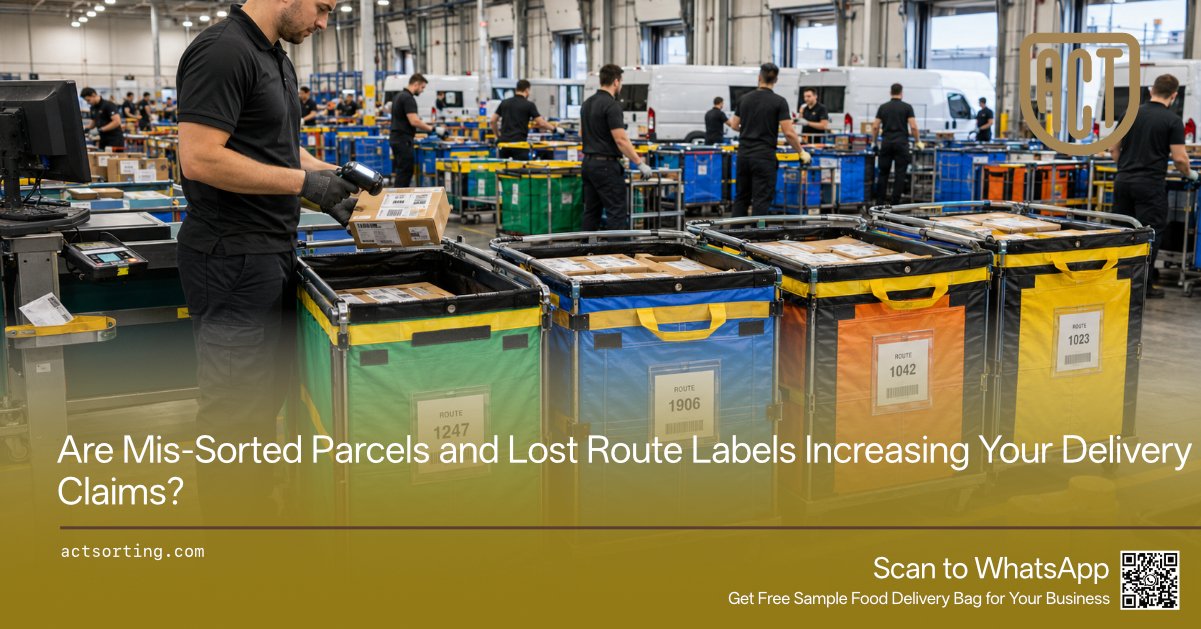
- Color-Coded Parcel Sorting Sacks Reduce Wrong-Lane Movement
- Secure Closures Prevent Parcels From Mixing During Transfer
- Courier Sorting Totes Make Exception Handling Easier
- Van Loading Totes Help Drivers Confirm the Correct Route Group
- Durable Construction Reduces Spills, Damage, and Emergency Repacking
- OEM & ODM Customization Builds Control Into the Bag System
- ACTSORTING Supports Reliable Bulk Supply for Large Delivery Networks
Introduction
A parcel does not need to disappear completely to become expensive. It may only need to enter the wrong sorting lane, lose its route label, fall from an overloaded bag, or arrive inside the wrong delivery van. The package is still somewhere inside the logistics network, but warehouse teams, drivers, customer service agents, and tracking systems no longer agree on where that somewhere is.
This is how a small physical sorting mistake becomes a delivery claim. A worker scans a parcel correctly but places it into the wrong sack. A paper route label slips from a bag during floor dragging. Two similar black totes are loaded into neighboring vans. A weak closure opens during hub transfer and parcels from different routes become mixed. The digital record may show the correct destination while the physical package quietly travels in another direction.
For parcel delivery companies, e-commerce fulfillment centers, courier networks, postal operators, regional distribution hubs, and Amazon DSP-style delivery stations, these errors create more than delayed shipments. They produce extra scans, manual investigations, redelivery costs, customer service tickets, refund pressure, damaged brand trust, and sometimes direct compensation claims.
A suitable Parcel Delivery Bag should therefore do more than carry packages. It should preserve route integrity from sorting lane to staging area, from staging area to van, and from van to final delivery. Transparent label holders, color systems, secure closures, reinforced structures, predictable dimensions, and practical handles all help workers understand where the bag belongs and what it contains.
ACTSORTING has specialized in industrial logistics bags since 2013. The company operates a manufacturing facility covering more than 12,000 square meters in Yangchun, Guangdong, China, supported by more than 400 experienced workers. Its product range includes Parcel Delivery Bags, Parcel Sorting Sacks, Courier Sorting Totes, Last-Mile Delivery Totes, Van Loading Totes, and DSP Delivery Supplies for commercial delivery and warehouse operations across Europe and North America.
Supported by BSCI and ISO9001 certification, ACTSORTING provides OEM & ODM manufacturing services covering fabric selection, custom dimensions, colors, logo printing, transparent label pockets, barcode windows, closure systems, webbing positions, handle structures, reinforced wear zones, folding designs, and large-volume repeat production.
The objective is simple: keep the physical parcel group aligned with the route information attached to it. When the bag supports that control, fewer packages need to be found, corrected, rescanned, or explained to an unhappy customer later.
1. The Small Sorting Errors Behind Expensive Delivery Claims
Most parcel claims do not begin with a dramatic warehouse accident. They begin with an ordinary mistake made during a busy shift. A package is placed into the neighboring route bag. A tote is moved from one staging lane to another without its label being updated. A worker sees two bags with similar markings and assumes they belong to the same vehicle. None of these moments appears serious at the time, which is exactly why they repeat so easily.
The cost becomes clearer at scale. Consider a delivery center processing 50,000 parcels per day. Even if only one parcel in every 1,000 enters the wrong physical route group, that creates 50 exceptions requiring investigation, correction, redelivery, return movement, or customer support. The sorting error may take three seconds to make and several hours to fully resolve.
A poorly designed Parcel Delivery Bag increases this risk. If route information is difficult to see, workers check less carefully under time pressure. If bags collapse or overlap in crowded lanes, labels become hidden. If every tote uses the same color and shape, visual confirmation becomes slower. If closures are unreliable, parcels can move between route groups during transportation.
The direct costs include additional labor, repeat scanning, vehicle mileage, repacking, and compensation. The indirect costs are harder to calculate. Customer service teams spend time explaining delays. Drivers face additional stops. Warehouse supervisors lose time tracing movement records. Delivery performance reports become less reliable because operational errors are mixed with transportation problems.
ACTSORTING develops Parcel Sorting Sacks and Courier Sorting Totes around visible identification and controlled handling. Transparent card holders keep route information attached to the bag. Custom colors separate services or delivery zones. Secure closures help prevent parcels from escaping or mixing. Reinforced handles allow workers to move a full route group without grabbing loose packages individually.
The practical value is fewer opportunities for physical and digital records to separate. A parcel that is scanned into Route 28 should remain inside the Route 28 bag until the correct worker or driver removes it. That sounds obvious, but logistics systems have a remarkable talent for making obvious things surprisingly difficult at scale.
2. A Parcel Delivery Bag Should Protect Route Integrity
Route integrity means that parcels sorted into one delivery group remain together through every handling stage. The group should move from sorting to staging, from staging to loading, and from loading to delivery without becoming mixed with another route.
Loose parcels make this difficult because each package remains an independent item. Workers must repeatedly identify, move, and confirm every carton or mailer. A Parcel Delivery Bag changes this by turning several parcels into one controlled route unit. Once the correct packages enter the bag, the entire group can move through the operation together.
For example, a warehouse may use one Last-Mile Delivery Tote for stops 1 to 20, another for stops 21 to 40, and a third for a particular apartment complex. A regional hub may assign one Parcel Sorting Sack to each destination depot. A courier company may group parcels by postcode, driver, departure wave, or vehicle.
The bag must be designed to preserve this grouping. Its capacity should match route volume without encouraging dangerous overloading. The opening should support fast loading without allowing parcels to fall out. Handles should remain reliable during repeated movement. The closure should suit the level of security and access required.
ACTSORTING can customize open-top, hook-and-loop, zipper, flap, buckle, drawstring, and strap closure systems. An open-top Parcel Delivery Bag may suit a controlled sorting lane where speed is the priority. A zippered Parcel Sorting Sack may be more appropriate for hub-to-hub transfer. A hook-and-loop Last-Mile Delivery Tote can support drivers who open and close the bag many times during one route.
Transparent route pockets and permanent printing strengthen route integrity further. The bag can display a route number, barcode, warehouse code, driver ID, van number, hub destination, or stop range. Workers do not need to reopen the bag to understand where it belongs.
The benefit is not merely cleaner organization. It is fewer rehandling decisions, fewer mixed routes, and a clearer chain of custody. A well-designed bag keeps the group stable while the network around it moves quickly.
3. Clear Label Holders Keep Physical Parcels Connected to Digital Records
Modern logistics depends on scanning, but scanning alone cannot control where a physical parcel is placed. A barcode may be recorded correctly while the package enters the wrong bag. This creates a gap between the digital system and the warehouse floor.
A visible label holder helps close that gap. It keeps route or destination information attached to the physical parcel group, allowing workers to confirm the bag before moving or loading it. The digital route exists in the system, while the transparent pocket makes the same route visible in the real warehouse.
The design of the label holder matters. A pocket that is too small may bend the barcode sheet. A pocket that is too deep can hide the route number. A cloudy or scratched material can reduce scanner performance. A badly positioned card slot may be covered when bags are stacked or become dirty when the tote is dragged.
ACTSORTING can customize transparent pockets in different dimensions, materials, orientations, and positions. Small windows may carry basic route cards. Larger holders can fit barcode sheets, A4 transfer documents, delivery manifests, or driver assignment forms. The opening direction can be selected to reduce the risk of documents falling out during handling.
Some operations require label holders on more than one side. A front pocket may be visible in staging lanes, while a side pocket can be scanned after the Van Loading Tote enters a vehicle shelf. Permanent printed numbers or warehouse codes can provide backup identification if the removable card becomes damaged.
Color coding can support the same system. The bag color gives workers the broad category, while the label provides the specific destination. Blue may indicate standard outbound delivery, green may represent returns, red may identify priority shipments, and gray may separate failed deliveries.
This combination reduces the time needed to confirm each bag and makes visual errors easier to notice. A green return bag sitting in a blue outbound lane immediately looks wrong, even before anyone reads the label.
The evidence appears in cleaner staging areas, faster scanning, and fewer route investigations. A transparent label pocket is not advanced technology, but it often prevents the very human habit of putting the right parcel in the wrong place.
4. Color-Coded Parcel Sorting Sacks Reduce Wrong-Lane Movement
Warehouse workers make decisions under time pressure. During busy dispatch periods, visual signals are often processed faster than written instructions. Color-coded Parcel Sorting Sacks use this advantage to make route or service categories easier to recognize.
A distribution center may assign colors according to delivery region, departure wave, parcel status, vehicle type, or service level. Blue bags may serve standard routes, yellow bags may identify same-day delivery, red bags may carry urgent parcels, green bags may handle customer returns, and gray bags may contain failed deliveries.
The specific colors matter less than the consistency of the system. If red represents priority shipments in one warehouse, it should not represent returns in another facility using the same operating standard. A multi-site logistics network benefits when employees can move between locations without relearning the physical language of the bags.
ACTSORTING supports custom body colors, webbing colors, edge binding, printed panels, logos, and permanent category markings. Color references can follow approved samples or specified standards, helping repeat orders remain visually consistent.
Material choice affects color appearance. The same shade may look different on PP woven fabric, laminated fabric, webbing, zipper tape, and printed areas. These elements should be reviewed together rather than approved separately and then expected to perform a small miracle during final assembly.
Color coding is particularly valuable during peak seasons. Temporary workers may have limited knowledge of route structures, but they can understand clear visual categories quickly. Supervisors can also inspect staging lanes more efficiently because misplaced bags stand out.
The system should still include readable labels and scans. Color is a support layer, not a replacement for detailed route information. When combined with transparent card holders, it provides fast general recognition followed by precise confirmation.
The operational benefit is fewer wrong-lane movements and shorter training time. Workers make fewer decisions based on memory, while managers gain a more visible warehouse floor. A good color system turns the bag into a communication tool without requiring another screen, login, software subscription, or cheerful onboarding webinar.
5. Secure Closures Prevent Parcels From Mixing During Transfer
Parcels can be sorted correctly and still become mixed later if the bag does not contain them reliably. This risk increases during floor dragging, conveyor movement, van loading, hub transfer, and transportation over uneven roads.
An overloaded open-top bag may allow small parcels to fall out. A weak hook-and-loop closure can open during movement. A narrow zipper may be left unfastened because workers find it too slow. A poorly shaped flap may expose the opening when the bag tilts.
The closure system must match the workflow. High-speed warehouse sorting may require quick access, while hub-to-hub transportation may need stronger containment. Last-mile drivers may open the same tote dozens of times, so the closure must be practical enough to use repeatedly rather than ignored after the third stop.
ACTSORTING can customize closure type, opening width, flap length, zipper size, hook-and-loop position, buckle placement, and strap structure. A wide hook-and-loop flap may suit Last-Mile Delivery Totes. A reinforced zipper can support Parcel Sorting Sacks moving between hubs. Open-top Courier Sorting Totes can remain suitable inside controlled staging areas.
The closure should not interfere with route identification or handling. A flap that covers the label pocket slows scanning. A zipper pull hidden beneath a handle makes access awkward. A strap positioned across the opening can catch larger cartons during loading.
Secure containment helps maintain route integrity and protects parcels from falling onto warehouse floors or vehicle interiors. It also reduces emergency repacking. When a bag opens unexpectedly, workers must stop, determine which parcels belong together, scan them again, and find replacement equipment.
The direct feature is a practical closure. The advantage is controlled parcel movement. The benefit is fewer mixed routes and fewer handling interruptions. The evidence comes when bags arrive at the next hub or delivery stop with the same contents that left the previous one.
6. Courier Sorting Totes Make Exception Handling Easier
Not every parcel follows the normal route. Some have damaged labels, incorrect addresses, failed scans, customer changes, oversized packaging, delivery restrictions, or other exceptions. These shipments need to be separated without disappearing into an unstructured corner of the warehouse.
Courier Sorting Totes can create dedicated exception groups. Instead of placing problem parcels on random carts or beside workstations, teams can assign clearly marked totes for address review, damaged packaging, missed scan, priority investigation, failed delivery, or return-to-sender processing.
This helps both physical control and digital follow-up. A supervisor can see how many exception bags are waiting. Workers know where to place parcels requiring review. Customer service teams receive more reliable status updates because the physical items remain grouped according to their next action.
ACTSORTING can customize exception totes using distinctive colors, large transparent document holders, printed instructions, secure closures, and reinforced structures. A red Courier Sorting Tote may identify urgent investigation. A gray tote may hold failed delivery parcels. A yellow bag may contain shipments waiting for address confirmation.
Label pockets can carry exception codes, batch sheets, timestamps, driver notes, or barcode documents. Different sizes can be used according to expected volume. Smaller bags may prevent sensitive exception categories from becoming overloaded, while larger Parcel Delivery Bags can handle high-volume return or reprocessing areas.
The benefit is faster exception visibility. Problem parcels remain separate from normal outbound flow, reducing the risk that they are loaded again without correction. Workers spend less time searching for individual items, and supervisors can prioritize categories based on operational urgency.
Exception handling is where weak warehouse systems become obvious. Normal parcels keep moving despite minor inefficiencies. Problem parcels stop, accumulate, and expose every unclear rule. A dedicated tote does not solve the underlying address or scan issue, but it prevents the parcel from joining the warehouse’s informal collection of “someone will deal with this later.”
7. Van Loading Totes Help Drivers Confirm the Correct Route Group
The final warehouse check often happens at the vehicle. By this point, parcels may have passed through several sorting stages, and the loading team must confirm that each route group enters the correct van.
Van Loading Totes make this process easier by presenting parcels as identifiable units. Instead of checking every loose package, workers confirm the bag’s route number, color, label, driver assignment, or loading sequence.
The dimensions of the tote should match the vehicle. A rectangular bag may fit more efficiently against shelves or van walls. A lower-profile tote can sit beneath fixed shelving. Taller bags may support bulky route groups. Consistent finished dimensions help fleet managers calculate how many totes fit inside each vehicle.
ACTSORTING can customize transparent pockets on the front or side so labels remain visible during loading. Large printed numbers can indicate loading sequence. Permanent vehicle or depot codes can support multi-site operations. Reflective details may improve visibility in darker loading bays or early-morning dispatch conditions.
Handles must remain accessible after the bag is placed inside the van. Side webbing can help drivers pull totes from shelves, while top handles support lifting. Lower loops may assist with heavily loaded bags.
The route group can also be divided into smaller stop ranges. One Last-Mile Delivery Tote may cover stops 1 to 20, another stops 21 to 40, and so on. Drivers then search within a smaller parcel group instead of the entire vehicle.
The benefit extends beyond departure accuracy. Drivers can maintain better organization throughout the route, separate returns, and identify which tote should be opened next. Fewer parcels are moved unnecessarily, reducing handling time and package damage.
A delivery van is already a small moving warehouse. It does not need to become a mystery box with wheels.
8. Durable Construction Reduces Spills, Damage, and Emergency Repacking
A bag failure can destroy route integrity in seconds. A torn bottom releases parcels onto the floor. A detached handle causes the tote to tilt. A split seam allows small packages to escape. Workers then need to identify, inspect, scan, and repack the contents.
This is why durability must be considered as an operational control rather than a simple product claim. The material, stitching, webbing, edge binding, and reinforcement work together to keep the route group physically contained.
ACTSORTING can manufacture Parcel Delivery Bags using PP woven fabric, laminated woven materials, coated fabrics, polyester blends, and reinforced wear zones. The selection depends on expected load, floor friction, weather exposure, folding frequency, and target service life.
Bottom panels and lower corners often need additional protection because bags are dragged across concrete, metal ramps, warehouse floors, and van interiors. Options include denser woven materials, double-layer bottoms, coated drag zones, reinforced corners, and extended webbing structures.
Handle attachment points also require attention. Cross-stitching, additional reinforcement panels, wider webbing, and longer strap extensions can distribute weight across a larger section of the bag body.
The advantage is fewer sudden failures. The benefit is less emergency repacking, fewer parcel spills, and lower replacement frequency. Warehouse workers can move bags at normal speed without stopping to inspect loose seams or weak handles.
Durability should be measured through the number of useful handling cycles rather than the thickness of the fabric alone. An excessively heavy bag may create more strain without protecting the correct wear zones. Targeted reinforcement is often more practical.
A reliable Parcel Sorting Sack should quietly remain intact while everyone focuses on the parcels. When workers begin discussing the bag during a shift, it is usually because something has already gone wrong.
9. OEM & ODM Customization Builds Control Into the Bag System
A generic bag carries parcels. A customized Parcel Delivery Bag can support a specific sorting and delivery system.
ACTSORTING’s OEM & ODM process can begin with technical drawings, existing samples, vehicle dimensions, warehouse layouts, parcel data, route cards, defect photographs, or a description of the current operational problem.
A customer may report frequent wrong-route loading. The solution could involve stronger color coding, larger transparent label holders, printed van numbers, and consistent pocket placement. Another customer may experience parcel spills during hub transfer, requiring a different closure, reinforced seams, and a more stable opening.
Fabric material, dimensions, colors, closure systems, handles, webbing, transparent pockets, barcode windows, reinforcement, folding structure, logo printing, warehouse codes, route markings, and packaging can all be customized.
The sample should then be tested under real working conditions. Workers should load it, drag it, scan the label, pull it from van shelves, open the closure, fold it, and use it through several handling cycles. A sample approved only through photographs may hide problems that become obvious within five minutes on the warehouse floor.
Once the design is confirmed, the technical specification should control mass production. Material, finished dimensions, tolerances, printing, colors, pocket size, closure, handle position, webbing, reinforcement, and packing must follow the approved reference.
The advantage of this process is a bag designed around the workflow rather than the other way around. The benefit is fewer workarounds, clearer route control, and better compatibility across warehouses and vehicles.
OEM & ODM should not mean placing a logo on a stock sack and declaring the engineering complete. The useful part is solving the operational problem that caused the customer to search for a new supplier in the first place.
10. ACTSORTING Supports Reliable Bulk Supply for Large Delivery Networks
ACTSORTING has specialized in industrial logistics bags since 2013. The company manufactures Parcel Delivery Bags, Parcel Sorting Sacks, Courier Sorting Totes, Last-Mile Delivery Totes, Van Loading Totes, and DSP Delivery Supplies for parcel carriers, e-commerce fulfillment centers, courier fleets, postal operators, 3PL providers, warehouse networks, retail distribution centers, and Amazon DSP-style delivery stations.
The manufacturing facility in Yangchun, Guangdong covers more than 12,000 square meters and employs more than 400 experienced workers. BSCI and ISO9001 certification support responsible production management and stable quality systems.
For customized orders, customers can provide existing bag samples, technical drawings, material requirements, route card dimensions, van or shelf measurements, expected load, closure preferences, current defect photographs, color references, logo artwork, target quantity, and required delivery schedule.
ACTSORTING can support custom material, size, color, printing, transparent label pockets, barcode windows, closures, handles, webbing, reinforced bottoms, warehouse codes, route markings, folded structures, packaging, and carton labels.
Bulk production consistency is essential. The approved sample and technical specification should remain the reference for fabric, finished size, color, label holder position, closure, handle layout, reinforcement, printing, and packing. Repeat orders should fit the same warehouse equipment, vehicles, and route systems as the original batch.
This production stability is particularly important for multi-site logistics networks. A company may need the same Courier Sorting Totes across several warehouses, followed by new orders for seasonal peaks, route expansion, or replacement stock. Inconsistent dimensions or colors would gradually weaken the standardized system.
ACTSORTING can support sample development, customized bulk orders, recurring production, new warehouse launches, and long-term logistics bag programs. The company’s manufacturing scale helps customers move from one approved design to stable repeat supply.
For operations facing frequent mis-sorting, unreadable labels, mixed routes, parcel spills, delivery claims, or inconsistent equipment, the next step should be a product specification based on the actual workflow.
Provide the expected size, parcel type, average load, route identification method, label dimensions, closure preference, material requirements, color system, logo, order quantity, and current pain points to receive a customized manufacturing proposal.
Delivery claims are expensive because the problem appears after the original sorting decision has already traveled through the network. A better Parcel Delivery Bag helps prevent that mistake while the parcel is still inside the warehouse, where correcting it costs far less.
FAQ
Q: Can Parcel Delivery Bags reduce parcel sorting mistakes?
A: Yes. Clear label holders, color coding, secure closures, standardized sizes, visible route numbers, and practical handling structures help workers keep parcels in the correct route group from sorting to delivery.
Q: Can ACTSORTING customize transparent label holders for barcode scanning?
A: Yes. Transparent pockets can be customized according to route card, barcode sheet, driver document, hub label, or A4 transfer sheet dimensions. Position and opening direction can also be adjusted.
Q: Which closure is best for preventing parcel mixing?
A: The suitable closure depends on the workflow. Zippers provide stronger containment, hook-and-loop closures support repeated access, and open-top bags suit controlled high-speed sorting areas. ACTSORTING can customize each option.
Q: Are color-coded Parcel Sorting Sacks available for bulk orders?
A: Yes. ACTSORTING supports customized fabric colors, webbing colors, printed category panels, route markings, warehouse codes, and logos for large-volume and repeat production programs.
Q: Which companies commonly use these logistics bags?
A: Typical customers include parcel delivery companies, courier fleets, e-commerce fulfillment centers, postal operators, 3PL providers, retail distribution hubs, warehouse groups, and Amazon DSP-style delivery stations.